


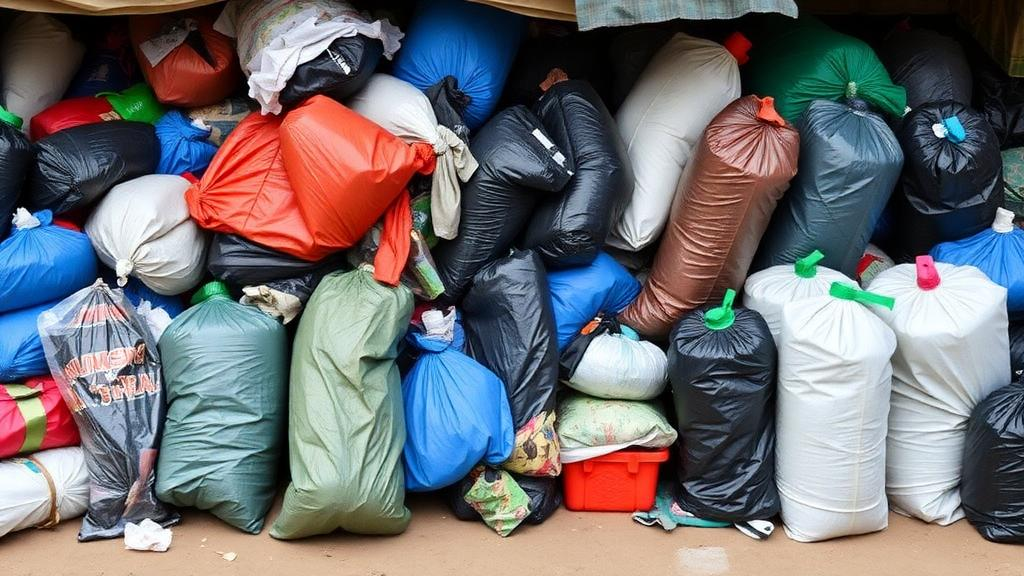
Bangladesh generates far less waste per person than most of the world, yet its cities are struggling to turn that advantage into a functioning circular economy. A new benchmarking study published in SN Social Sciences by Imran Hossain of Varendra University and colleagues paints a detailed, data-driven portrait of a waste system that collects nearly everything its urban residents throw away but recycles almost none of it, and where the willingness of households to sort their own trash dramatically outpaces what they actually do. The research, which triangulates global datasets, governance indicators and a door-to-door survey in the city of Rajshahi, offers one of the clearest quantitative diagnoses yet of why so many developing-country waste transitions stall between collection and recovery.
The study’s starting point is scale. Drawing on the World Bank’s What a Waste 3.0 country and city datasets, the authors project that Bangladesh’s municipal solid waste generation will rise from 0.515 kilograms per capita per day in 2022 to 0.648 kilograms per capita per day by 2050. That figure remains below the global median, which reflects the country’s lower consumption levels, but the trajectory matters more than the level. A roughly 26 percent increase in per-person waste output over less than three decades means that every truck, landfill, composting plant and collection crew in the country will face intensifying pressure even if population growth alone were not already straining municipal budgets. The authors frame this as a rising service burden that the current system is structurally unprepared to absorb.
The most striking number in the country-level analysis is the gap between collection and recycling. Bangladesh reports urban collection coverage of 96.96 percent, a figure that would place it alongside many high-income nations and suggests that the visible, labor-intensive front end of waste management, the daily removal of garbage from streets and households, is largely working. Yet reported recycling stands at just 3.14 percent. The researchers describe this as a clear collection-recycling difference, and it is the central paradox of the paper. A system can appear successful on paper while sending nearly all of its collected material to open dumps or poorly controlled sites, capturing none of the economic and environmental value embedded in organic matter, plastics, paper and metals.
Dhaka, the capital, illustrates the composition problem behind that paradox. The city profile in the What a Waste 3.0 dataset shows that 81.05 percent of Dhaka’s municipal waste is food and organic material, a share far higher than in most wealthy cities. In principle, that is an opportunity: organic waste is ideal feedstock for composting and biogas production, technologies that are well understood and relatively inexpensive. In practice, the dataset records that 74.50 percent of the city’s waste ends up in open dumping. Wet, high-organic waste mixed with plastics and other residuals contaminates everything it touches, making source segregation, separating organics, recyclables and residuals at the household, the technical precondition for any recovery process. Without segregation at origin, composting becomes unviable and recycling streams are hopelessly mixed.
The governance half of the analysis explains why the technical fixes have not taken hold. Using the World Bank’s Worldwide Governance Indicators, the authors examined Bangladesh’s performance across all six dimensions of governance, and found that the country’s 2024 estimates remained negative across the board. There is, however, a modest signal of improvement: government effectiveness rose from −0.811 in 1996 to −0.619 in 2024, a gain of nearly 0.2 points on the indicator’s standard scale over 28 years. At that pace, the authors imply, the institutional capacity needed to design, finance and enforce a modern waste system will lag far behind the waste volumes the country will generate. Governance indicators are not abstract statistics here; they proxy the state’s ability to run regulatory agencies, coordinate city corporations, and hold contractors accountable.
Implementation failures compound the capacity problem. The study notes that Dhaka’s master plan for waste management was reported as not implemented, a finding that echoes a broader pattern in South Asian urban governance where planning documents exist on paper but stall in execution. Recent scholarship cited by the authors, including work on ward-based governance frameworks in Dhaka and on the progressive formalization of household source segregation in Khulna, suggests that the missing ingredient is not knowledge of what to do but the institutional machinery to do it consistently, ward by ward, year after year. A master plan that is never operationalized leaves city corporations improvising, and improvisation favors collection, the most visible and politically rewarded service, over the harder work of recovery.
To test the demand side of the transition, the researchers turned to Rajshahi City Corporation, where they surveyed 358 households in a cross-sectional study reviewed by the Ethical Review Committee of Varendra University before data collection began in February 2025. The behavioral results are the paper’s most sobering finding. Only 12.6 percent of surveyed households met the segregation-related behavior standard, meaning that fewer than one in eight families actually separated their waste in a way that would support downstream recovery. For a country whose recycling rate is 3.14 percent, this is the bottleneck in its most concrete form: even if Rajshahi built composting plants and materials recovery facilities tomorrow, the feedstock arriving at those facilities would be contaminated by the other 87.4 percent of households.
What makes the Rajshahi data genuinely surprising, and the reason the findings have circulated widely among waste-policy researchers, is the gap between attitude and action. Willingness to participate in segregation ranged from 82.1 percent to 89.7 percent across the survey items. In other words, roughly nine out of ten households say they want to sort their waste, but only about one in eight does. The authors interpret this through the lens of behavioral theory, drawing on the tradition of the theory of planned behavior and its extensions, which hold that intention only converts into behavior when supported by enabling conditions: convenient infrastructure, clear information, social norms and perceived policy effectiveness. The Rajshahi gap suggests that Bangladesh’s problem is not apathy but the absence of the systems that let good intentions become daily practice.
The study’s benchmarking approach is itself a methodological contribution. Rather than measuring waste performance on a single metric, the authors combine three independent lenses: physical performance from the What a Waste datasets, institutional capacity from the Worldwide Governance Indicators, and behavioral readiness from primary household data. This triangulation reveals that a country can score well on one dimension while failing on others, and that the binding constraint shifts depending on which layer you examine. Bangladesh looks strong on collection, weak on recovery, weak on governance implementation, and paradoxically strong on willingness but weak on practice. Any national strategy that targets only one of these layers, the authors argue, will be defeated by the others.
The implications reach well beyond Bangladesh. The Global Waste Management Outlook 2024, produced by the United Nations Environment Programme and the International Solid Waste Association, warns that the world is in an age of waste, and that much of the growth in waste generation will occur precisely in countries whose governance and infrastructure are least prepared for it. The Bangladesh benchmark offers a template for diagnosing that mismatch elsewhere: measure the collection-recycling difference, check whether master plans are actually implemented, read the governance indicators, and above all survey households to find out whether the intention-behavior gap is the real bottleneck. In Rajshahi, at least, the answer is clear. The public is ready. The system is not, and until governance capacity and household-level infrastructure catch up with public willingness, nearly all of the country’s waste will continue its one-way journey from bin to dump.
Subject of Research: Benchmarking Bangladesh's municipal solid waste transition through governance indicators, waste recovery performance, and household segregation behavior
Article Title: Benchmarking municipal solid waste transition through governance, recovery performance, and household segregation readiness
Article References: Hossain, I., Haseeb, M., & Khudoykulov, K. (2026). Benchmarking municipal solid waste transition through governance, recovery performance, and household segregation readiness. SN Social Sciences, 6(9), Article 431. https://doi.org/10.1007/s43545-026-01724-x
Image Credits: AI Generated
DOI: 10.1007/s43545-026-01724-x
Keywords: municipal solid waste, Bangladesh, waste segregation, recycling, governance, circular economy, household behavior, Rajshahi, Dhaka, What a Waste 3.0, Worldwide Governance Indicators, urban policy
Cite Scienmag News
Courtney Benton. (October 10, 2026). Bangladesh’s Waste Crisis: High Collection, Low Recycling and a Household Gap. Scienmag. https://scienmag.com/bangladeshs-waste-crisis-high-collection-low-recycling-and-a-household-gap/
Courtney Benton. "Bangladesh’s Waste Crisis: High Collection, Low Recycling and a Household Gap." Scienmag, 10 October 2026, https://scienmag.com/bangladeshs-waste-crisis-high-collection-low-recycling-and-a-household-gap/. Accessed 10 October 2026.
Courtney Benton. "Bangladesh’s Waste Crisis: High Collection, Low Recycling and a Household Gap." Scienmag. October 10, 2026. https://scienmag.com/bangladeshs-waste-crisis-high-collection-low-recycling-and-a-household-gap/


