


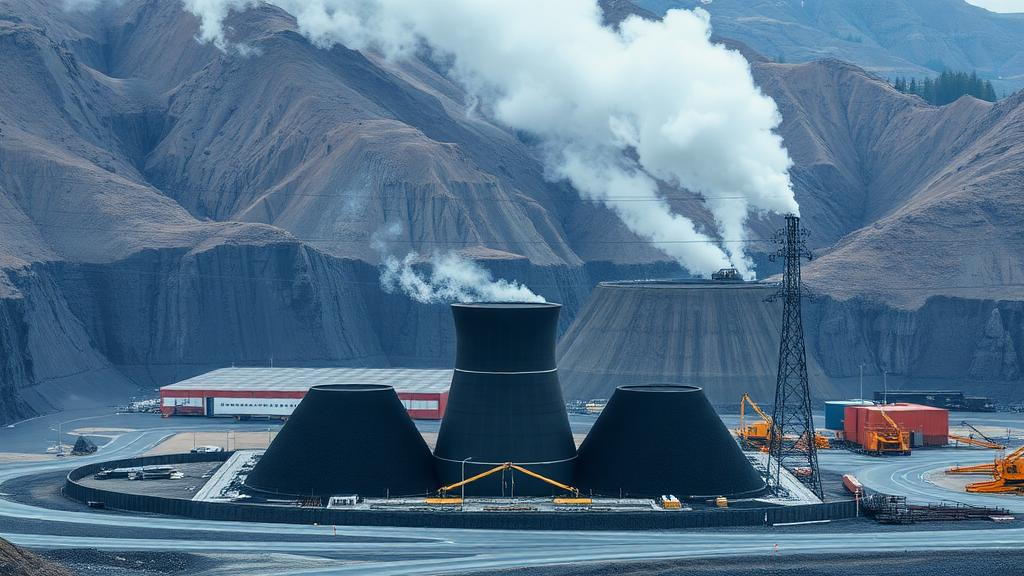
Open-pit coal mines are among the most unforgiving industrial environments on Earth: colossal machines grind away at unstable terrain while weather, geology, and operational stress interact in ways that defy simple prediction. A new study published in Energy Reports introduces SCALE-SMART, a computational framework that fuses multiscale modeling, machine learning, and energy-aware control to detect hazards earlier, more accurately, and with dramatically less power than existing monitoring systems. In benchmark tests on a dataset of roughly 75,000 mining blocks, the framework reached 94.1 percent hazard-prediction accuracy while cutting energy consumption by 43.3 percent compared with baseline approaches.
The problem the researchers set out to solve is structural. Conventional safety systems in open-pit mines typically rely on individual sensor readings checked against fixed thresholds. That approach struggles because mining is inherently multiscale: a vibrating bearing on a single haul truck (a micro-level event) can cascade into an equipment-cluster failure (meso-level), which in turn can interact with slope instability or adverse weather (macro-level) to produce a catastrophic outcome. Threshold-based monitoring cannot capture these cross-scale dependencies, so hazards are often identified late, incorrectly, or not at all. Meanwhile, the relentless data collection such systems demand makes them energy-hungry and increasingly unsustainable as sensor networks expand.
SCALE-SMART attacks both weaknesses at once. Its architecture gathers data at three levels simultaneously: micro-level signals from vibration, temperature, pressure, and gas sensors mounted on equipment; meso-level information about how machine clusters coordinate, share workloads, and develop bottlenecks; and macro-level inputs covering terrain, slope stability, geology, and environmental conditions. The data streams are filtered, normalized, and spatially and temporally aligned before being fed into a hybrid modeling layer that combines physics-based equations with machine-learned representations, so the system respects known physical behavior while still capturing nonlinear patterns that pure physics cannot easily describe.
The heart of the framework is a cross-scale attention mechanism borrowed from modern deep learning. Multi-head attention layers compute query, key, and value representations for features from each scale, then use scaled softmax weighting to decide which signals matter most for a given prediction. This lets the model amplify, say, a subtle gas-concentration anomaly when terrain data suggests elevated landslide risk, while suppressing irrelevant noise. In effect, the system learns dynamically which scale of information deserves attention in each situation, something fixed-threshold alarms can never do. The authors report that this fusion of multiscale features is what drives much of the framework’s accuracy advantage.
A second pillar is federated learning, a distributed training strategy that addresses both privacy and practicality. In the study, 50 simulated monitoring clients each trained models locally for five epochs per communication round, with 10 randomly selected clients participating at a time across 100 total rounds. A central server merged the local updates using Federated Averaging, weighted by sample counts, into a global model that was then redistributed. Crucially, raw data never left any client; only model parameters traveled. Data was deliberately partitioned with a Dirichlet distribution (alpha equal to 0.5) to simulate the non-uniform, non-IID conditions typical of real mines, where different monitoring units see very different mixes of operational states.
The energy-aware control module is perhaps the most novel ingredient. Rather than monitoring everything at full intensity all the time, the system computes a normalized risk score from hazard probability, severity, and prediction uncertainty. Risk bands below 0.33 trigger reduced sensing frequency, computation, communication, and power; scores of 0.67 and above ramp all of these up proportionally for intensive hazard hunting. An optimization objective explicitly balances expected detection reward against energy cost, controlled by a tunable trade-off parameter. In low-risk conditions, the mine effectively idles its monitoring apparatus; the moment danger signals accumulate, resources surge to where they are needed.
The benchmark results are striking. Against three adapted baselines, FC-CRF, PF-Unet3+, and YOLO+ML, all trained and tested on identical block-level hazard labels, SCALE-SMART achieved 94.1 percent accuracy, 93.5 percent precision, 92.8 percent recall, and a 93.1 percent F1-score, with false positives falling to just 3.9 percent. Detection latency averaged 43 to 50 milliseconds across test intervals, far ahead of competitors. Energy consumption dropped to 68 kilowatt-hours against 120 for the FC-CRF baseline, a 43.3 percent saving, while computation load fell to 55 percent and monitoring efficiency climbed to 91 percent. Adaptive monitoring efficiency rose from 75 percent to above 85 percent over the observed periods.
Robustness and scalability held up too. Under 20 percent artificial noise, SCALE-SMART retained 90.3 percent accuracy with a stability index of 0.89, well above the baselines, which the authors attribute to the attention mechanism’s ability to filter irrelevant signals. When tested across node counts from 50 to 200, distributed performance ranged from 88 to 98 percent and improved as more nodes joined, suggesting the federated architecture scales gracefully for sprawling mine sites. Failure rates declined steadily during simulated operation, indicating the system learns and adapts rather than degrading over time.
The authors are candid about limitations. The evaluation relied on a synthetic Kaggle-based mining block model dataset rather than real sensor feeds, and hazard labels had to be derived from geological, operational, and environmental attributes because no predefined safety-event labels existed. Domain shift when transferring to different geologies, sensor drift, communication failures, and cybersecurity threats such as data poisoning in the federated network all remain open concerns, and the framework has not yet been validated in an operating mine. Future work outlined in the paper includes field trials, lightweight edge-computing accelerations, integration with autonomous haulage and robotic systems, and richer reinforcement-learning-based prediction. If those steps succeed, the vision is a mine that watches itself at every scale, spends energy only where danger demands it, and warns of disaster before it begins.
Subject of Research: Multiscale computational modeling and machine learning for energy-aware safety monitoring in open-pit coal mines
Article Title: Multiscale computational modeling and machine learning for energy aware safety monitoring in open pit coal mines
Article References: Wei, P., Zhang, F., Suo, Z., Chai, L., & Li, F. (2026). Multiscale computational modeling and machine learning for energy aware safety monitoring in open pit coal mines. Energy Reports, 16, Article 109771. https://doi.org/10.1016/j.egyr.2026.109771
Image Credits: AI Generated
DOI: 10.1016/j.egyr.2026.109771
Keywords: open-pit coal mining, SCALE-SMART, multiscale modeling, machine learning, federated learning, cross-scale attention, energy-aware monitoring, hazard prediction, safety monitoring, slope stability, predictive simulation, industrial AI
Cite Scienmag News
Sloane Callahan. (October 10, 2026). Smart AI Framework Watches Coal Mines at Every Scale While Slashing Energy Use. Scienmag. https://scienmag.com/smart-ai-framework-watches-coal-mines-at-every-scale-while-slashing-energy-use/
Sloane Callahan. "Smart AI Framework Watches Coal Mines at Every Scale While Slashing Energy Use." Scienmag, 10 October 2026, https://scienmag.com/smart-ai-framework-watches-coal-mines-at-every-scale-while-slashing-energy-use/. Accessed 10 October 2026.
Sloane Callahan. "Smart AI Framework Watches Coal Mines at Every Scale While Slashing Energy Use." Scienmag. October 10, 2026. https://scienmag.com/smart-ai-framework-watches-coal-mines-at-every-scale-while-slashing-energy-use/


