


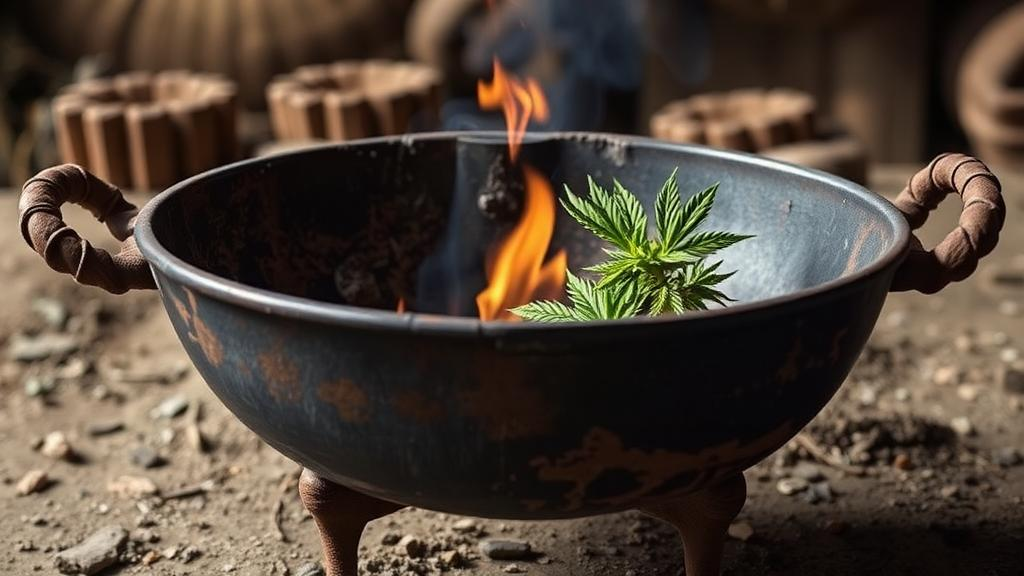
Archaeologists have long suspected that the peoples of early Iron Age Xinjiang, in northwestern China, used plants in ways that went far beyond food, fuel, and medicine. Now a team of researchers has produced direct chemical evidence that a carved wooden vessel recovered from a cemetery in the region was used to burn cannabis and aromatic plants in ritual settings. The study, published in npj Heritage Science, combines organic residue analysis with wood anatomical examination to reconstruct, molecule by molecule, what was once burned inside an object that has survived roughly 2,300 to 2,500 years underground.
The artefact at the centre of the investigation is a wooden brazier excavated from the Hongshan Cemetery, which dates to the fifth to third century BC. Braziers, vessels designed to hold burning material, are among the most evocative categories of archaeological finds because they imply deliberate, controlled fire used in proximity to people. Whether such vessels served everyday purposes, such as heating, lighting, cooking, or insect repulsion, or specialised ceremonial ones, is often difficult to establish from form alone. The Hongshan brazier, however, offered an unusually promising case, because charred residues adhering to its surfaces could potentially preserve the chemical fingerprints of the plants that had burned within it.
To interrogate those residues, the researchers turned to gas chromatography-mass spectrometry, or GC-MS, a technique that separates complex mixtures of organic compounds and identifies them by their mass-to-charge signatures. Organic residues are fragile things: heat, oxidation, and microbial decay destroy most of the biomolecules that plants and animals leave behind. Yet certain compounds are notably durable, and it is precisely these that survive long enough to be detected millennia later. The GC-MS analysis of samples taken from the brazier revealed a suite of such compounds, and among them was one with unmistakable significance: cannabinol, commonly abbreviated as CBN.
Cannabinol is a chemical signature of cannabis. It forms primarily through the oxidation and degradation of tetrahydrocannabinol, the psychoactive constituent of the plant, when cannabis material is exposed to heat and then ages over long periods. Finding CBN in multiple samples from the brazier therefore constitutes direct chemical evidence that cannabis was burned inside or on the vessel. This matters because visual identification of burned plant remains is often ambiguous; charred seeds and woody fragments can be difficult to assign to species, and residues can be contaminated or misattributed. A biomarker such as CBN, detected repeatedly across samples, provides a far more secure identification and links the plant explicitly to the act of burning rather than to incidental contact or later deposition.
The cannabis finding alone would be noteworthy, but the residue analysis told a richer story. The team also identified artemisia ketone, a characteristic volatile compound of Artemisia annua, along with benzaldehyde and benzoic acid esters, compounds associated with aromatic plants more broadly. Together, these biomarkers indicate that Artemisia annua and other fragrant plant materials were burned in the brazier alongside cannabis. Additional plant-derived biomarkers pointed to a diversity of botanical inputs, suggesting that the burning was not a single, isolated event involving one species but a recurring practice involving a deliberate assemblage of plants chosen for particular qualities, whether their aroma, their smoke, or their symbolic associations.
The choice of plants is itself culturally informative. Artemisia species, the wormwoods and sagebrushes, are among the most widespread plants of the arid Eurasian steppe, and they have a long documented history of ritual and medicinal use across the continent. Their pungent, aromatic smoke has been valued for fumigation, purification, and healing in traditions from East Asia to Europe. Combining Artemisia with cannabis in a single burning event suggests a curated practice rather than opportunistic fuel use. The researchers interpret this assemblage as evidence for ritual plant burning, a practice in which the smoke itself, and the sensory and spiritual experience it produced, was the point.
The brazier itself yielded a second layer of evidence through wood anatomical analysis. By examining the microscopic structure of the wood, including the cellular features that distinguish different tree genera, the team identified the raw material as trunks of Picea, the spruces. Spruce wood is characteristic of the coniferous forests available in parts of Xinjiang and neighbouring mountain regions, and its identification grounds the object in the local environmental and economic world of its makers. Knowing what the vessel was made from, and not just what it contained, helps archaeologists understand the full chain of choices involved: which trees were selected, how the timber was worked into a brazier, and how the object fit into the material culture of the community that used it.
The condition of the brazier added a further clue to its function. The wood bears repeated scorch marks, evidence that the vessel was exposed to fire not once but many times. This pattern of repeated burning is central to the team’s interpretation of the object as a specialised ritual implement rather than a domestic vessel. A cooking pot or heating pan might show wear from heat, but the combination of a purpose-built form, repeated charring, and residues of psychoactive and aromatic plants points to a vessel whose principal role was to hold burning plant material during ceremonial activities. In other words, the brazier was not an ordinary household object that occasionally served ritual purposes; it was, on this evidence, an instrument made and used for ritual itself.
The Hongshan Cemetery dates to the early Iron Age, a period of profound transformation across Inner Asia. Between the fifth and third centuries BC, mobile pastoral communities moved across the steppes and mountain corridors of Central Asia, exchanging goods, technologies, and ideas along routes that would later crystallise into the Silk Roads. Plants occupied a central place in these exchanges and in the belief systems of the people who carried them. Cannabis, in particular, has emerged in recent archaeological research as a plant of remarkable ritual significance in this region, with earlier studies at other sites in the broader Xinjiang and Pamir region having reported evidence of cannabis burning in burial contexts. The new chemical evidence from Hongshan adds an important data point to this emerging picture, confirming that ritual plant burning was practised at yet another early Iron Age cemetery and that it involved a sophisticated combination of species.
What makes this study methodologically significant is the way it integrates two independent lines of analysis. The GC-MS work identifies what was burned; the wood anatomical work identifies what the burning implement was made of and how it was used. Neither alone would suffice. Residue chemistry without a secure understanding of the artefact risks misinterpreting contamination or secondary deposition, while morphological analysis without chemistry leaves the function of an object open to speculation. By combining the two, the researchers built a case in which the object, its use-wear, and its chemical contents all converge on the same interpretation: a specialised wooden brazier, carved from spruce, repeatedly used to burn cannabis, Artemisia annua, and other aromatic plants in rituals performed by early Iron Age communities in Xinjiang.
The broader implications reach into some of the deepest questions in archaeology: how ancient people experienced the sacred, and how plants mediated that experience. Smoke is ephemeral, leaving almost nothing behind for the excavator’s trowel. Yet the biomarkers trapped in charred residues offer a rare window into this invisible dimension of past life. The Hongshan brazier demonstrates that the spiritual world of early Iron Age Xinjiang was one in which plants were active participants, their smoke rising from carved wooden vessels in ceremonies whose precise meaning may be lost but whose material traces now speak clearly. As residue analysis techniques continue to advance, archaeologists expect more such discoveries, each one adding chemical detail to the sensory and ritual landscapes of societies that left no written records of their beliefs.
Subject of Research: A wooden brazier and ritual plant burning in early Iron Age Xinjiang, China
Article Title: A wooden brazier and ritual plant burning in early Iron Age Xinjiang, China
Article References: Song, Y., Wang, Y., Tang, Y., Wang, D., Chen, R., & Wen, R. (2026). A wooden brazier and ritual plant burning in early Iron Age Xinjiang, China. npj Heritage Science. https://doi.org/10.1038/s40494-026-02984-9
Image Credits: AI Generated
DOI: 10.1038/s40494-026-02984-9
Keywords: wooden, brazier, ritual, plant, burning, early, Iron, Xinjiang, China, scientific research
Cite Scienmag News
Courtney Benton. (October 10, 2026). Ancient Brazier Reveals Cannabis and Artemisia Burned in Iron Age Rituals. Scienmag. https://scienmag.com/ancient-brazier-reveals-cannabis-and-artemisia-burned-in-iron-age-rituals/
Courtney Benton. "Ancient Brazier Reveals Cannabis and Artemisia Burned in Iron Age Rituals." Scienmag, 10 October 2026, https://scienmag.com/ancient-brazier-reveals-cannabis-and-artemisia-burned-in-iron-age-rituals/. Accessed 10 October 2026.
Courtney Benton. "Ancient Brazier Reveals Cannabis and Artemisia Burned in Iron Age Rituals." Scienmag. October 10, 2026. https://scienmag.com/ancient-brazier-reveals-cannabis-and-artemisia-burned-in-iron-age-rituals/


