


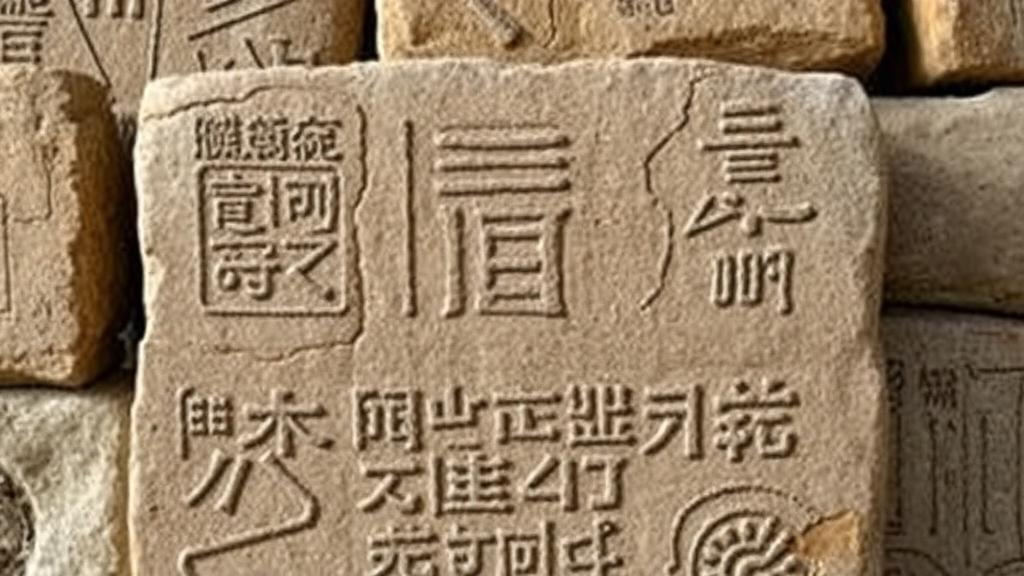
For thousands of years, stone stele inscriptions have carried the written memory of civilizations—imperial edicts, funerary epitaphs, religious dedications, and canonical texts carved into rock with a permanence their makers believed would outlast everything. Yet stone is not eternal. Wind, rain, frost, lichen, and human contact have worn away strokes and fractured characters, and with each eroded glyph, a fragment of history becomes irretrievable. A new study published in npj Heritage Science introduces an artificial intelligence framework designed to slow, and in digital form reverse, that loss. The work, led by Jipeng Qiang of Yangzhou University with colleagues from City University of Hong Kong and Zhengzhou University, presents both the first systematic benchmark for the task of stele inscription text image super-resolution and a universal restoration framework called SteleSR that can be grafted onto a wide range of existing AI models.
The problem the researchers set out to solve is deceptively narrow but technically profound. Super-resolution—the task of reconstructing a high-resolution image from a degraded, low-resolution one—has been a staple of computer vision research for years. General-purpose models can sharpen photographs of faces, landscapes, and printed text with impressive results. Ancient inscriptions, however, break these models in a specific and revealing way. When a neural network trained on natural images confronts a weathered Chinese character, it does not know which broken fragments belong together. The result is what the authors call a semantic-visual imbalance: the restored image may look superficially plausible, but the network invents spurious topological connections between stroke fragments, fusing separate strokes or bridging unrelated components until the character becomes illegible to any reader who knows the script.
This failure mode matters because inscriptions are not merely pictures. They are text, and their value lies in legibility. A restoration that produces a beautiful but unreadable character has failed at the only task that counts. Conversely, a restoration that simply guesses what the character should be risks fabricating history—substituting the model’s expectation for the stone’s actual evidence. The tension between visual authenticity and semantic legibility is the central technical challenge of the field, and it is the tension that SteleSR is explicitly engineered to resolve.
The team’s approach unfolds in two layers. The first is a data problem: there are no paired examples of pristine inscriptions and their weathered counterparts, because the pristine originals no longer exist. To train a super-resolution model, researchers need input-output pairs, so the team built one synthetically. But synthetic noise—random blur, pixelation, or abrasion applied by an algorithm—bears little resemblance to the slow, structured damage of real weathering, and models trained on unrealistic degradation generalize poorly to actual stele photographs. To bridge this gap between synthetic noise and real-world damage, the researchers propose a progressive paradigm built on what they describe as LLM-driven structural decoupling and LVM-guided style injection. In essence, a large language model contributes knowledge of how characters are structurally composed—which strokes and components belong to which glyph—while a large vision model contributes knowledge of what weathered stone actually looks like, injecting realistic degradation styles into the training pipeline.
The second layer is the SteleSR framework itself, which is designed not as a single monolithic model but as a set of plug-in objectives that can be integrated into diverse super-resolution backbones. Two losses carry most of the weight. The first is an Edge-aware loss, which constrains the model to preserve and sharpen the true structural contours of carved strokes rather than blurring them into mush or hallucinating connections. The second is a Text Prior loss, which injects semantic knowledge of the script itself, encouraging the network to produce characters that are not just sharp but structurally coherent as writing. Because these objectives are backbone-agnostic, they can be attached to whichever super-resolution architecture a lab already uses, improving it without requiring a rebuild from scratch.
The evaluation strategy reflects the same dual concern with appearance and meaning. Rather than relying solely on standard image-similarity metrics, which are notorious for rewarding blurry but statistically safe outputs, the team assessed their results across both semantic and structural metrics—measuring whether restored characters remain recognizable as valid glyphs and whether their stroke topology survives reconstruction. Across these evaluations, SteleSR consistently enhanced the performance of the various underlying models it was attached to, suggesting that the framework’s gains come from the injected priors rather than from any single architectural trick. The authors position this as a pioneering standard for high-fidelity digital preservation of historical artifacts, and the code and data have been released openly on GitHub, lowering the barrier for museums, conservators, and other research groups to adopt and extend the method.
The broader significance of the work lies in what it says about how AI should handle cultural heritage. The dominant paradigm in generative vision is to produce plausible images, but plausibility is a dangerous objective when the subject is historical evidence. A generative model asked to restore a damaged inscription will happily invent a complete character, because complete characters are what its training data suggest a damaged character should become. SteleSR’s design philosophy pushes in the opposite direction: the semantic priors it injects are meant to guide reconstruction toward structural coherence without overriding what the stone actually preserves. The distinction is subtle but crucial—a restoration should recover what time has obscured, not what the model wishes were there.
There is also a methodological lesson in the two-layer design. The field of real-world super-resolution has long struggled with the domain gap between laboratory degradation models and the messy damage of actual photographs. By using large language models to reason about character structure and large vision models to model realistic degradation, the researchers demonstrate a template that could transfer to other heritage domains: weathered manuscripts, eroded rock art, faded frescoes, and corroded metal inscriptions all share the same fundamental problem of paired-data scarcity and domain-specific damage patterns. Related work in the same journal—including diffusion-based restoration of Huashan rock art and VLM-based degradation prior learning—suggests a rapidly converging research frontier in which foundation models supply the domain knowledge that small, task-specific networks lack.
The practical stakes are considerable. China alone holds an enormous corpus of stele inscriptions spanning more than two millennia, many of them deteriorating in open air or in underfunded storage. Digital photography campaigns have captured these artifacts, but low-resolution or degraded scans limit both scholarly reading and public engagement. A universal restoration framework that runs on existing super-resolution backbones means institutions do not need cutting-edge infrastructure to participate; they need only the released code, their own photographs, and the computational means to fine-tune. High-fidelity digital surrogates also serve conservation directly, providing a record of current condition against which future degradation can be measured, and enabling virtual access that reduces physical handling of fragile originals.
None of this replaces the epigrapher’s trained eye or the philologist’s knowledge of the script. What SteleSR offers is an instrument—a way of making weathered text legible enough for experts to read, while keeping the machine’s imagination on a leash. The study was partially supported by the National Language Commission of China, the National Natural Science Foundation of China, the Blue Project of Jiangsu Province, and the Top-level Talents Support Program of Yangzhou University, and it appears in an open-access journal, consistent with the team’s decision to release code and data publicly. As environmental pressure on stone heritage accelerates, tools that bridge the gap between what pixels show and what characters mean may determine how much of the carved record survives—not in stone, but in the digital commons where the next generation of readers will encounter it.
Subject of Research: AI-based super-resolution restoration of weathered ancient stele inscriptions
Article Title: Bridging the semantic-visual gap: a universal super-resolution framework for ancient stele inscriptions
Article References: Qiang, J., Hou, W., Zhu, Y., Yuan, Y., Zhao, X., & Wang, X. (2026). Bridging the semantic-visual gap: a universal super-resolution framework for ancient stele inscriptions. npj Heritage Science. https://doi.org/10.1038/s40494-026-03024-2
Image Credits: AI Generated
DOI: 10.1038/s40494-026-03024-2
Keywords: super-resolution, stele inscriptions, cultural heritage, deep learning, digital preservation, computer vision, large language models, epigraphy, image restoration, npj Heritage Science, semantic legibility, SteleSR
Cite Scienmag News
Courtney Benton. (October 10, 2026). AI Restores Weathered Ancient Stele Inscriptions by Teaching Machines to Read Stone. Scienmag. https://scienmag.com/ai-restores-weathered-ancient-stele-inscriptions-by-teaching-machines-to-read-stone/
Courtney Benton. "AI Restores Weathered Ancient Stele Inscriptions by Teaching Machines to Read Stone." Scienmag, 10 October 2026, https://scienmag.com/ai-restores-weathered-ancient-stele-inscriptions-by-teaching-machines-to-read-stone/. Accessed 10 October 2026.
Courtney Benton. "AI Restores Weathered Ancient Stele Inscriptions by Teaching Machines to Read Stone." Scienmag. October 10, 2026. https://scienmag.com/ai-restores-weathered-ancient-stele-inscriptions-by-teaching-machines-to-read-stone/


