


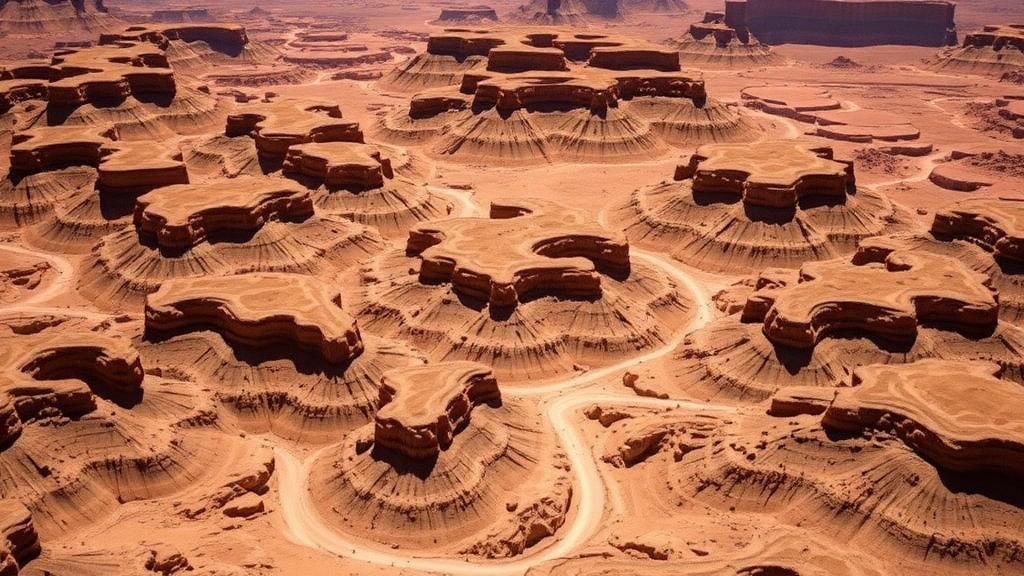
Deep in the heart of the Iranian Plateau, on the eastern edge of the Great Kavir salt desert, lies a landscape that has quietly recorded tens of thousands of years of climate change. The Khur Basin, a 120-square-kilometer depression southeast of the town of Khur, is today one of the most hostile environments on Earth, with mean annual temperatures around 20 degrees Celsius, a mere 86 millimeters of erratic rainfall, and potential evaporation exceeding 3000 millimeters per year. Yet a new study published in the E&G Quaternary Science Journal shows that this hyper-arid desert was once shaped by dramatically different conditions, including phases of higher rainfall, expanding lakes, and stabilizing soils. By reading the layers of gravel, sand, salt, and ancient soil preserved across the basin, researchers have assembled the first comprehensive model of how this desert landscape evolved through the late Quaternary period.
The research, led by Zakieh Rashidi Koochi of the University of Würzburg together with colleagues from Germany and Iran, tackles a long-standing gap in the environmental history of western Asia. The Central Iranian Plateau occupies a pivotal position on any map of early human dispersal, linking Europe and Central Asia along routes that prehistoric humans and later trade caravans may have followed during more humid periods. But while continuous lake sediments in western Iran and loess-paleosol sequences in the north have yielded rich paleoclimate records, the vast central deserts remain nearly blank on the scientific map. Harsh climate, difficult access, and the poor preservation of organic material in hyper-arid settings have meant that the interplay between past human migration and environmental change in this region has remained largely speculative.
To fill that gap, the team adopted an integrative approach that combined geomorphological mapping with detailed stratigraphical fieldwork. Using satellite imagery, digital elevation models, geological maps, and extensive field observations, they mapped the basin’s landforms at a scale of 1:10,000, applying the German GMK25 geomorphological mapping symbology. They then examined twelve sedimentary sections distributed across eight geomorphic units, from the mountain front to the lowest point of the playa. The sections were described using standard sedimentological and soil classification methods, capturing textures, structures, paleosols, and the distinctive gypsum-rich horizons that characterize desert soils in central Iran.
The resulting picture is one of a landscape organized around a large-scale source-to-sink sediment cascade. Sediment eroded from the Cretaceous limestones, sandstones, and shales of the Hoz-e-Mirza Mountains is transported across pediments carved into Miocene marls and mudstones, then spread across alluvial fans before reaching the endorheic playa some 14 kilometers away. Sand dunes, extensions of the vast Sargardan and Shotoran sand seas, cap the most distal parts of the pediments and block the fan deposits at the playa margins. The playa itself sits at two distinct elevations, with a dune-dammed surface standing up to 4 meters above the main playa floor, a striking testament to the power of wind-blown sand to reorganize an entire drainage system.
The stratigraphy of the alluvial fan sections revealed four recurring sedimentary units: fluvial gravels, reddish paleosols, gypsic soils, and reworked Miocene marls. The gravels show the lateral discontinuities and interbedding with finer lenses typical of braided river channels, indicating episodes of intense precipitation and high discharge in the catchment. The paleosols, with their clay-enriched reddish horizons, blocky structure, and visible clay coatings, qualify as argillic horizons that form only under wetter conditions than today and require thousands to tens of thousands of years to develop. Such horizons, the authors argue, are in situ relicts of landscape stability during periods of increased rainfall, most plausibly during Marine Isotope Stage 3 or earlier.
Because no numerical ages could be obtained directly from the Khur Basin archives, the team built a tentative chronology by systematically reviewing every available dated geoarchive from the Iranian Plateau, drawing on luminescence dating, cosmogenic exposure ages, and radiocarbon records from alluvial fans, playas, lakes, and dunes across the region. This comparative framework allowed them to identify six main stages of landscape evolution. The earliest stage, prior to and during MIS 3, saw the erosion of the ancient pediment surface, the formation of local alluvial covers, the development of paleodunes, and the first soil formation on old alluvial deposits.
The second stage coincides with the Last Glacial Maximum and MIS 2, when cold and arid conditions gripped the plateau. Intense frost weathering in the mountains increased debris production, while slightly higher precipitation than today allowed alluvial fans to prograde far into the basin interior. The same cold, dry, and windy conditions likely drove the formation of the basin’s sand dunes, consistent with dated sand ramps in central Iran that accumulated between 28,000 and 18,000 years ago and with dune origins at the margins of the Persepolis Basin attributed to the LGM. During this period, sediment supply rather than transport capacity controlled fan development across much of Iran.
The transition from the last glacial period to the Holocene brought a sharp increase in precipitation. The researchers propose that a perennial lake may have formed in the playa, or that existing lake levels rose significantly, accompanied by initial soil development and the formation of younger soils within older fan surfaces. Although no fossil lake terraces were found in the field, widespread backward-erosional features on the distal and medial fans can be interpreted as the legacy of a subsequent lake-level retreat. That retreat, the fourth stage, is linked to the severe drought of the Younger Dryas around 12,900 to 11,700 years ago, when falling lake levels across the wider region, vanishing vegetation cover, and intensified surface fragmentation triggered alluvial fan dissection and renewed dune formation.
The final two stages bring the story to the present. During the early to mid-Holocene, arid conditions, stronger and possibly shifted winds, and the collapse of vegetation and water bodies reactivated the dune fields at the basin’s edge. Migrating southeastward, the dunes dammed part of the main playa of the Great Kavir, and up to 4 meters of new playa sediments accumulated behind the sand barrier. In the late Holocene, an overall trend of increasing aridity allowed aeolian processes to dominate completely: deflation deepened the main playa, gypsum-rich soils developed on abandoned and eroded fan surfaces, and mobile wind ripples, with wavelengths of 150 to 200 millimeters aligned to the prevailing northwesterly winds, spread across the dune field, marking the active saltation that continues today.
The significance of this work extends well beyond a single desert basin. By systematically integrating stratigraphical, pedological, and geomorphological evidence that had previously been studied in isolation, the study demonstrates how discontinuous desert archives can be stitched into a coherent narrative of landscape-climate interaction. The six-stage model provides a relative chronological framework that future high-resolution dating studies can refine and quantify. It also offers a crucial environmental backdrop for archaeologists investigating when the migration routes and trade corridors of the Iranian Plateau were active, and how their use was tied to shifting climates. As the authors note, understanding how this extreme environment responded to past climate changes opens a new perspective on geomorphic responses to environmental change in the world’s drylands, a question of growing urgency as modern arid regions face an increasingly uncertain water future.
Subject of Research: Late Quaternary landscape evolution and climate-driven geomorphological processes in the Khur Basin, central Iran
Article Title: Late Quaternary geomorphological processes and landscape evolution in the Khur Basin, central Iran
Article References: Rashidi Koochi, Z., Büdel, C., Walk, J., Fuchs, M., Torabi, M., Karimi, A., Baumhauer, R., & Stauch, G. (2025). Late Quaternary geomorphological processes and landscape evolution in the Khur Basin, central Iran. E&G Quaternary Science Journal, 74(2), 193-212. https://doi.org/10.5194/egqsj-74-193-2025
Image Credits: AI Generated
DOI: 10.5194/egqsj-74-193-2025
Keywords: Khur Basin, central Iran, geomorphology, Quaternary, alluvial fans, sand dunes, playa, paleoclimate, Last Glacial Maximum, Holocene, paleosols, Great Kavir
Cite Scienmag News
Violet Maxwell. (October 10, 2026). Desert Archive: Six Climate-Driven Stages Shaped Iran’s Khur Basin Over 50,000 Years. Scienmag. https://scienmag.com/desert-archive-six-climate-driven-stages-shaped-irans-khur-basin-over-50000-years/
Violet Maxwell. "Desert Archive: Six Climate-Driven Stages Shaped Iran’s Khur Basin Over 50,000 Years." Scienmag, 10 October 2026, https://scienmag.com/desert-archive-six-climate-driven-stages-shaped-irans-khur-basin-over-50000-years/. Accessed 10 October 2026.
Violet Maxwell. "Desert Archive: Six Climate-Driven Stages Shaped Iran’s Khur Basin Over 50,000 Years." Scienmag. October 10, 2026. https://scienmag.com/desert-archive-six-climate-driven-stages-shaped-irans-khur-basin-over-50000-years/


