


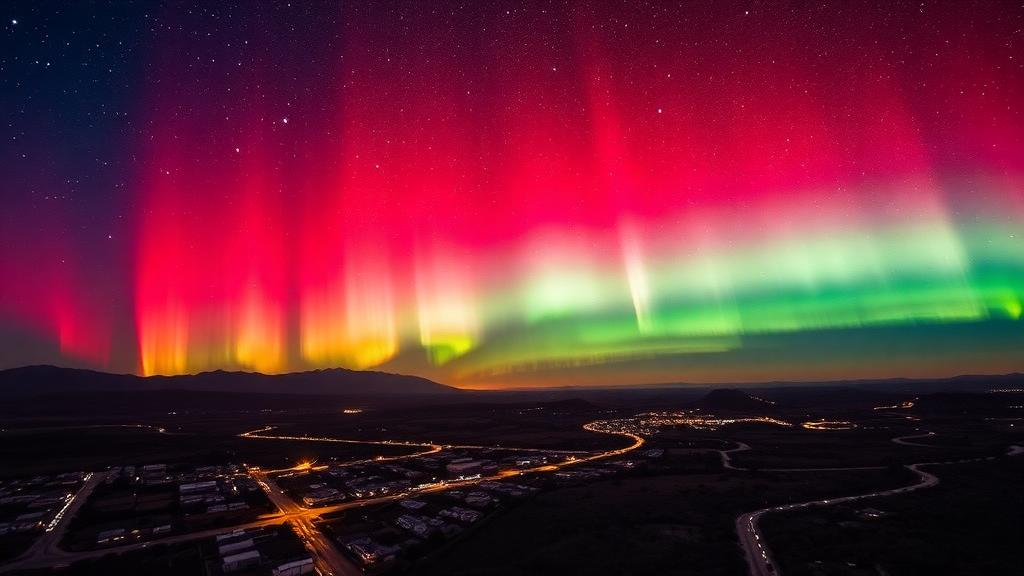
Deep in the archives of a regional Spanish newspaper, scientists have found a treasure trove of celestial fire. A team of researchers at the University of Extremadura has combed through every issue of the newspaper Extremadura published between 1923 and 2017, uncovering 31 news items about the aurora borealis. The study, published in the journal History of Geo- and Space Sciences, transforms ordinary journalism into scientific data, showing how colorful lights usually confined to polar skies occasionally blazed over southwestern Europe, startling farmers, misleading firefighters, and, during the Spanish Civil War, convincing terrified onlookers that the sky itself was an omen of catastrophe.
Auroras occur when charged particles from the Sun, funneled along Earth’s magnetic field lines, collide with atoms and molecules in the upper atmosphere. Oxygen atoms glow green and red at altitudes between roughly 100 and 500 kilometers, while nitrogen contributes blues and purples. These displays are most common inside the auroral ovals that encircle the magnetic poles, but during powerful geomagnetic storms, when coronal mass ejections slam into Earth’s magnetosphere, the ovals expand equatorward and the lights become visible at middle and even low latitudes. Because the frequency and intensity of such storms follow the roughly 11-year solar cycle, historical aurora sightings serve as a proxy record of solar behavior, complementing the sunspot number, the longest-running direct dataset of solar observations.
The Extremadura newspaper, founded in 1923, is one of the oldest and most recognized media outlets in its region, and it was never intended as a scientific instrument. Yet its complete run, digitized in PDF form with help from the newspaper’s staff, allowed the team to run optical character recognition searches using more than a dozen geophysically relevant keywords, including the Spanish term for the phenomenon, aurora, along with related words such as phenomeno and the less common phrase for northern lights. The same systematic approach had previously yielded records of a super-bolide, a meteorite fall, and an exceptional month of thunderstorms, demonstrating that regional newspapers can be mined as surprisingly rich documentary archives.
The recovered articles fall into two categories: 12 items describing direct observations and 19 offering general reports and scientific explanations. The direct sightings cluster around the great geomagnetic storms of the 20th century, with notable events in 1926, 1938, 1950, 1956, 1957, 1958, and 1991. Crucially, when the researchers plotted these dates against the smoothed sunspot number, the auroras lined up with the maxima of solar cycles 16 through 19 and cycle 22. That correlation matters, because no systematic catalog of auroras observed in the Iberian Peninsula during the 20th century previously existed; the newspaper collection now fills that gap.
The earliest event, the geomagnetic storm of January 1926, generated two news items. One briefly reported a brilliant aurora seen for several hours over the United States, while a longer piece published that July described a formidable magnetic storm that disrupted telegraph, telephone, and submarine cable communications for hours. The article recounted how the Norwegian physicist Carl Störmer measured auroral rays reaching 72 degrees of elevation in the Oslo sky, implying altitudes of about 503 kilometers. It described the spectacle unfolding from a yellow-greenish arc in the north into an immense corona of dazzling red rays, visible from Sweden and Denmark to France, and noted that observatories in Meudon and Ebro recorded the accompanying magnetic disturbance. The sunspot group responsible was estimated to span roughly 100,000 kilometers.
Perhaps the most dramatic event in the collection is the great aurora of 25 to 26 January 1938, remembered as the Fatima Storm because some Roman Catholics linked it to the Fatima prophesies. The newspaper reported that the Astronomical Observatory of San Fernando confirmed an aurora of varying intensity recorded from 23:00 until 02:00, with maxima at 21:00 and around 23:30, and that magnetic instruments in the city had shown alterations for days beforehand. Dispatches from Berlin, Rome, and Warsaw described the display stretching from Scandinavia to the Mediterranean, with multicolored lines on a dark red background. Modern estimates place the storm’s intensity at roughly minus 336 nanotesla on the Dcx index, with a maximum Kp index of 9. The storm cut transatlantic radio communications and even delayed trains in England whose signaling apparatus malfunctioned. In war-torn Spain, citizens and soldiers unfamiliar with the phenomenon interpreted the blood-red sky as a presage of greater tragedy.
The 1950s, near the peak of the strongest solar cycle ever recorded, produced a flurry of sightings. In February 1950, the sky turned red over the Extremaduran town of Hervás, and the newspaper noted that some timorous residents considered it a harbinger of war. In January 1957, red glows were reported from Seville, Huelva, Ávila, Lugo, Monforte de Lemos, and Salamanca, lasting about 20 minutes in Seville, while in Lugo firefighters mobilized for hours believing the aurora was a large fire. That storm reached a minimum Dst index of minus 250 nanotesla. In February 1958, the crew of the German ship Beate Bolten sighted an aurora near the Panama Canal, the closest to the Equator recorded during the International Geophysical Year, and the newspaper noted that German captains had spotted about a dozen auroras around Spain during that period. A September 1958 storm, with a Dst minimum near minus 302 nanotesla, produced spectacular rayed bands and pulsating red surfaces across Germany and France.
The most recent major event in the archive is the great red aurora of November 1991, one of the largest geomagnetic storms on record with a Dst peak of minus 354 nanotesla. The newspaper described luminous phenomena in the Huesca Pyrenees, Lleida, and Zaragoza that residents repeatedly reported to the fire brigade as fires, a telltale signature of red auroral light at low latitudes. An astronomer at a local agrometeorological center explained that even trained observers initially mistook the glow for flames. The analysis shows that such misunderstandings are not anecdotal quirks but recurring social responses: in 1957, 1991, and likely 1950, emergency services or frightened citizens mistook auroras for conflagrations or omens. For social scientists, the archive offers a century-long record of how geomagnetic storms rippled through public opinion.
Not every sighting survived scrutiny. A 1952 item described concentric rainbow-colored arcs over Hervás, but the researchers judged it highly improbable to be an aurora, since concentric arcs are uncharacteristic of the dynamic, changing forms auroras display, rainbow hues are physically implausible at Extremadura’s latitude of 38 to 40 degrees where red is the expected color, and no geomagnetic storm is documented around that date. The general reports in the collection also trace the evolution of auroral science itself, covering explanations by Spanish meteorologists in the 1950s and 1970s, Soviet and French attempts to create artificial auroras in 1974, NASA’s THEMIS mission of 2007, and aurora-hunting expeditions to Greenland, Iceland, and Norway in the 2010s.
The broader significance of the work lies in what it says about reconstructing the Sun’s past. Space weather is not merely a curiosity; severe geomagnetic storms can damage power grids, satellites, and communication systems, and understanding their historical frequency is essential for assessing future risk. Because instrumental magnetic records extend back barely a century and a half, historians of the Sun rely on proxies such as aurora sightings, sunspot drawings, and even radiocarbon spikes in tree rings. The Extremadura study demonstrates that local newspapers from low-latitude regions, where auroras are rare precisely because only exceptional storms produce them, are especially valuable: every sighting they record is, by definition, evidence of an extraordinary solar event. A comparison with previous surveys of newspaper space-weather reporting suggests the coverage in Extremadura is entirely typical, meaning similar archives almost certainly await discovery in other regional papers worldwide, each yellowed page a potential data point in the long history of our stormy star.
Subject of Research: Historical aurora records from a Spanish newspaper as proxies for 20th-century solar activity
Article Title: Aurora records in the Spanish newspaper Extremadura for the period 1923–2017
Article References: Sánchez Romero, C., Díaz-Condiño, L., Tovar Hernández, I., Pérez Aparicio, A. J., Sánchez Carrasco, V. M., Gallego Herrezuelo, M. C., & Vaquero, J. M. (2025). Aurora records in the Spanish newspaper Extremadura for the period 1923–2017. History of Geo- and Space Sciences, 16(2), 13-22. https://doi.org/10.5194/hgss-16-13-2025
Image Credits: AI Generated
Keywords: aurora borealis, geomagnetic storms, solar activity, sunspots, space weather, newspaper archives, Extremadura, Iberian Peninsula, solar cycle, history of science, International Geophysical Year, Aurora
Cite Scienmag News
Grant Pearson. (October 10, 2026). Old Newspaper Pages Reveal Decades of Rare Auroras Over Southern Spain. Scienmag. https://scienmag.com/old-newspaper-pages-reveal-decades-of-rare-auroras-over-southern-spain/
Grant Pearson. "Old Newspaper Pages Reveal Decades of Rare Auroras Over Southern Spain." Scienmag, 10 October 2026, https://scienmag.com/old-newspaper-pages-reveal-decades-of-rare-auroras-over-southern-spain/. Accessed 10 October 2026.
Grant Pearson. "Old Newspaper Pages Reveal Decades of Rare Auroras Over Southern Spain." Scienmag. October 10, 2026. https://scienmag.com/old-newspaper-pages-reveal-decades-of-rare-auroras-over-southern-spain/


