


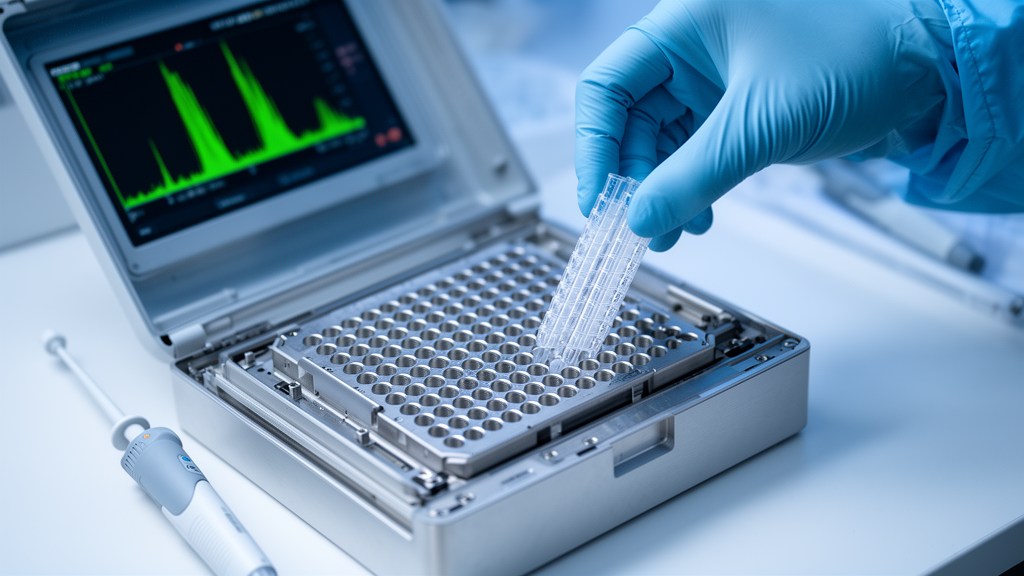
Quantitative real-time PCR, or qPCR, remains one of the most widely used techniques in molecular biology, underpinning everything from clinical diagnostics and pathogen detection to gene expression profiling and genetic genotyping. Because the technique converts tiny amounts of nucleic acid into measurable fluorescent signals across repeated heating and cooling cycles, laboratory scientists have long assumed that nearly every technical parameter of the thermal cycler matters. Among those parameters, the ramp rate, which describes how quickly the instrument’s heating block moves between the denaturation, annealing and extension temperatures, has attracted particular attention. A new exploratory study from researchers at the Vinča Institute of Nuclear Sciences, part of the University of Belgrade in Serbia, now suggests that this particular variable may matter far less than many practitioners fear, at least for the probe-based assays commonly used in genotyping and gene expression work.
The research, published in Molecular Biology Reports by Ivan Zivotic, Ivana Kolic, Mariana Seke, Milan Stefanovic, Ljiljana Stojkovic, Aleksandra Stankovic, Maja Zivkovic and colleagues, set out to systematically evaluate whether slow, intermediate and fast ramp rates produce measurable shifts in cycle threshold values, the Ct values that serve as the primary readout of qPCR experiments. The team used a commercial TaqMan SNP genotyping assay alongside two well-characterized housekeeping genes, GAPDH and PPIA, providing both a genotyping application and a gene expression application within the same experimental framework. Eleven heterozygous DNA samples and three RNA samples were analyzed, with each ramp rate condition tested across two independent runs to distinguish genuine systematic effects from ordinary run-to-run noise.
The technical logic behind the question is straightforward. During each PCR cycle, DNA strands must separate at high temperature, primers and probes must bind at lower temperatures, and the polymerase must extend the new strand. If the instrument transitions too quickly between these temperature plateaus, reagents may not fully equilibrate, annealing may be incomplete, and enzyme activity may be briefly suboptimal. Conversely, slower ramps extend the total run time, which is a practical concern for high-throughput laboratories and for point-of-care settings where speed is critical. Earlier work has shown that ramp rate can matter in specific contexts. Studies of rapid microfluidic thermocyclers and ultrafast PCR platforms have demonstrated that carefully engineered fast cycling can work, but also that faster quantitative protocols may lose sensitivity or show increased variability under some conditions.
The clinical stakes of this question are not trivial. Research on tuberculosis diagnostics, for example, has documented that widespread use of incorrect ramp rate settings can negatively impact the performance of commercial line-probe assays used to detect drug-resistant Mycobacterium tuberculosis, leading to calls for better thermocycler configuration in diagnostic laboratories. Those findings created a plausible expectation that ramp rate could similarly distort Ct values in qPCR, potentially affecting quantification of viral loads, expression of disease-related genes, and genotyping calls across countless laboratories. The Serbian team’s results, however, point in a different direction for standard probe-based qPCR chemistry.
Across both the genotyping assay and the gene expression assays targeting GAPDH and PPIA, the researchers observed no consistent effect of ramp rate on Ct values. When they compared slow, intermediate and fast ramp settings within individual runs, they did identify isolated statistically significant or borderline significant differences, including for the FAM-labeled probe used in the genotyping assay and for both housekeeping gene expression measurements. Yet these differences failed a crucial test of reliability: they were not reproduced consistently across independent runs or across pairwise comparisons between ramp rate conditions. In other words, a difference that appeared in one run might vanish in the next, a pattern more consistent with ordinary experimental variability than with a genuine systematic influence of heating speed.
The authors conclude that the observed effects appeared to be assay- and run-dependent rather than attributable to a consistent influence of ramp rate itself. This distinction carries real methodological weight. Ct values are inherently sensitive to many sources of noise, including pipetting variation, reagent preparation, optical fluctuations, sample quality and the stochastic behavior of amplification at low template concentrations. When a sporadic difference between two ramp rate conditions falls within the range of ordinary run-to-run variation, attributing it to the ramp rate would be a statistical overreach. By requiring reproduction across runs before claiming an effect, the study models the kind of cautious interpretation that the updated MIQE 2.0 guidelines encourage for quantitative PCR reporting more broadly.
The findings align with a body of work suggesting that modern qPCR chemistry is more forgiving of thermal cycling parameters than early protocols assumed. Probe-based detection chemistries such as TaqMan rely on the 5′ nuclease activity of the polymerase releasing a fluorescent reporter, and the accumulation of fluorescence over cycles integrates the kinetics of many individual extension events. Small perturbations in the seconds spent transitioning between temperatures may be buffered by the exponential nature of amplification, where each cycle’s yield feeds into the next. Nearest-neighbor thermodynamic analyses of nucleic acid hybridization also indicate that primer and probe binding equilibria are governed primarily by sequence and temperature rather than by the speed at which those temperatures are reached, provided the hold times at each step are adequate.
Nevertheless, the researchers are careful to frame their work as exploratory rather than definitive. The sample size was modest, with eleven heterozygous DNA samples and three RNA samples, and the assay panel was limited to a single commercial SNP genotyping assay and two housekeeping genes. The authors explicitly note that larger studies involving more assays and samples are needed to determine whether PCR ramp rate has a meaningful impact on qPCR performance and reproducibility under different experimental conditions. Different amplicon lengths, different polymerase formulations, different detection chemistries such as SYBR Green intercalating dyes, and different instrument architectures could all behave differently. Studies of amplicon length effects on real-time PCR results, for instance, show that the physical dimensions of the amplified product can influence outcomes, and it remains possible that longer amplicons interact with ramp rate in ways the short targets tested here do not.
For working laboratories, the practical message is one of measured reassurance rather than license for indiscriminate protocol changes. The results suggest that laboratories running standard probe-based qPCR assays need not worry excessively about modest differences in ramp rate settings between instruments, provided that validation is performed on the actual platform in use. This matters for multi-site studies, for laboratories that must transfer validated assays between different thermal cycler models, and for clinical settings where instrument availability varies. At the same time, the tuberculosis diagnostic literature demonstrates that some assays are genuinely sensitive to thermal cycling parameters, so blanket assumptions in either direction would be unwise. The sensible approach, consistent with the study’s conclusions, is empirical verification: run the assay under the intended conditions, confirm that Ct values and amplification efficiency remain within established acceptance criteria, and document the settings used.
The study also arrives at a moment when the qPCR field is actively revisiting its reporting standards. The MIQE 2.0 revision of the minimum information guidelines reflects growing recognition that technical parameters, instrument characteristics and data analysis choices all shape the reproducibility of quantitative PCR results. By systematically probing one such parameter and reporting both the significant and non-significant findings, the Belgrade team contributes to a more honest empirical picture of what actually drives Ct variability. Their work was supported by the Ministry of Science, Technological Development and Innovation of the Republic of Serbia, and the underlying data are available within the paper and its supplementary materials. While the question of ramp rate effects is not fully closed, this exploratory study provides a useful data point: for the genotyping and gene expression assays tested, the speed at which the thermal cycler moved between temperatures left the fundamental quantitative output of qPCR essentially unchanged, an encouraging result for anyone who has ever worried that a slightly slower machine might quietly be skewing their numbers.
Subject of Research: Effect of thermal cycler ramp rate on cycle threshold values in quantitative real-time PCR genotyping and gene expression assays
Article Title: Limited effect of PCR ramp rate on qPCR Ct values: an exploratory study
Article References: Zivotic, I., Kolic, I., Seke, M., Stefanovic, M., Stojkovic, L., Stankovic, A., & Zivkovic, M. (2026). Limited effect of PCR ramp rate on qPCR Ct values: an exploratory study. Molecular Biology Reports, 53(1), Article 1690. https://doi.org/10.1007/s11033-026-12881-w
Image Credits: AI Generated
DOI: 10.1007/s11033-026-12881-w
Keywords: qPCR, ramp rate, Ct values, thermal cycler, TaqMan assay, GAPDH, PPIA, genotyping, gene expression, amplification efficiency, MIQE guidelines, reproducibility
Cite Scienmag News
Juliet Wilcox. (October 10, 2026). Thermal Cycler Speed Barely Moves qPCR Ct Values, Exploratory Study Finds. Scienmag. https://scienmag.com/thermal-cycler-speed-barely-moves-qpcr-ct-values-exploratory-study-finds/
Juliet Wilcox. "Thermal Cycler Speed Barely Moves qPCR Ct Values, Exploratory Study Finds." Scienmag, 10 October 2026, https://scienmag.com/thermal-cycler-speed-barely-moves-qpcr-ct-values-exploratory-study-finds/. Accessed 10 October 2026.
Juliet Wilcox. "Thermal Cycler Speed Barely Moves qPCR Ct Values, Exploratory Study Finds." Scienmag. October 10, 2026. https://scienmag.com/thermal-cycler-speed-barely-moves-qpcr-ct-values-exploratory-study-finds/


