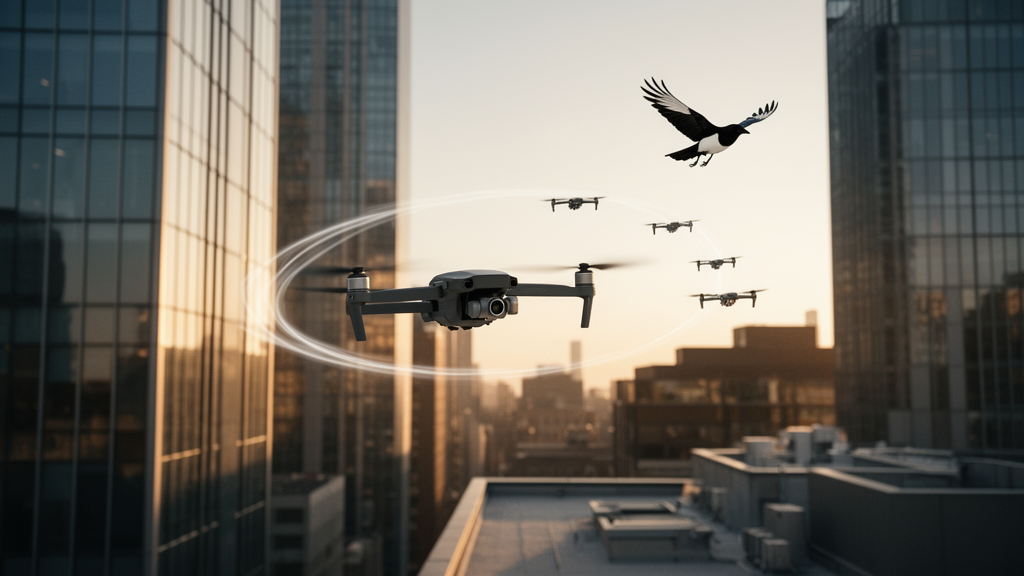
Getting a drone safely from point A to point B through a mountainous landscape crowded with no-fly zones, buildings, and weather hazards is one of the hardest problems in modern robotics. A team at Changsha University of Science and Technology in China now reports a fresh answer, borrowing its logic from an unlikely teacher: the red-billed blue magpie, a clever cooperative hunter native to East Asian forests. In a study published in Cluster Computing, researchers led by Yong He and Boji Huang describe a new optimizer, called the Differential Red-billed Blue Magpie Optimizer, or DRBMO, that plans three-dimensional unmanned aerial vehicle paths faster, shorter, and more reliably than a lineup of competing algorithms.
The core challenge is what mathematicians call a multimodal optimization problem. A drone’s route can be described as a chain of waypoints in three-dimensional space, and the quality of any candidate route is scored by a cost function that blends four ingredients: total path length, flight altitude, proximity to threats, and smoothness of turns. The altitude term penalizes flying too low or too high, since cameras and sensors work best within a defined band. The threat term models hazards such as buildings, no-fly zones, and bad weather as cylindrical regions, with a safety buffer whose size depends on positioning accuracy and environmental conditions. The smoothness term constrains the yaw and pitch angles between consecutive path segments so that the resulting route is actually flyable within a drone’s mechanical limits.
Traditional swarm intelligence algorithms, from Particle Swarm Optimization to the Grey Wolf Optimizer, have long been applied to this kind of problem because they can search vast solution spaces without needing a precise mathematical model of the terrain. But they share two chronic weaknesses: slow convergence and a tendency to get stuck in local optima, meaning the algorithm settles on a merely decent route while a far better one hides elsewhere in the landscape. The original Red-billed Blue Magpie Optimizer, introduced in 2024, mimics how real magpies hunt in small groups of two to five birds for small prey and in flocks of more than ten for larger quarry, and even cache surplus food for later. It performed well, but the Changsha team found it still converged slowly and could be trapped by deceptive terrain.
The new DRBMO algorithm attacks those weaknesses with four coordinated upgrades. The first targets the very beginning of the search. Standard algorithms scatter their initial candidate solutions randomly, which can leave some regions of the search space crowded and others empty. The researchers instead used a piecewise linear chaotic map, a deterministic nonlinear system whose output, though bounded, wanders ergodically across its entire range. By seeding the population through this chaotic sequence, the initial candidates spread far more evenly across the search space, giving the algorithm a head start in covering terrain and improving its odds of escaping local optima later on.
The second upgrade is a progressive dynamic step size. In the original algorithm, the size of each search agent’s jump depends heavily on random numbers, producing erratic movement and poor final precision. DRBMO replaces this with a step that starts large, at 1.0, and shrinks linearly to 0.1 as iterations proceed. Early on, big steps let the magpie-inspired agents sweep broadly across the solution space; later, small steps allow fine-grained refinement around promising regions. This gradual tightening balances the two fundamental forces of any metaheuristic: exploration, the wide search for where good solutions might live, and exploitation, the focused polishing of the best candidates found so far.
The third innovation imports a weapon from a different algorithmic family. Differential Evolution, a classic technique from the 1990s, creates new candidate solutions by taking one random individual and adding a scaled difference between two others. That difference vector gives the perturbation a direction, unlike the Gaussian noise used in the original magpie algorithm, which jiggles candidates blindly around the population mean. By grafting this differential mutation operator into the predation phase of DRBMO, the researchers gave their search agents the ability to make asymmetric leaps across the solution space, which proved especially valuable on rugged, multi-peaked landscapes where mean-guided updates tend to funnel everyone toward the same mediocre peak.
The fourth change reworks the dynamic weight factor that governs how strongly the current best solution pulls the rest of the population. The team replaced the original formula with a nonlinear expression based on exponential functions, which starts large to encourage wide exploration and then falls rapidly as iterations advance, accelerating convergence in the final stages without letting the swarm collapse prematurely onto a local optimum. Importantly, the researchers also showed that all these additions come at essentially no computational cost: a formal time complexity analysis found that DRBMO retains the same overall complexity, O(T times N times D), as the original algorithm, where T is the number of iterations, N the population size, and D the problem dimension.
The evidence for these claims comes in layers. Qualitative experiments tracking individual search trajectories, exploration-exploitation ratios, and population diversity confirmed that the chaotic initialization produced uniformly spread agents and that the differential operator helped the algorithm escape multi-peak traps. On the CEC 2022 benchmark suite of ten standard test functions, run thirty independent times in both ten and twenty dimensions against six rival algorithms including an improved magpie variant, an improved Particle Swarm Optimization, a Q-learning-guided Grey Wolf Optimizer, the Dung Beetle Optimizer, and a multi-strategy Harris Hawks Optimization, DRBMO found the global optimum on nearly every function and posted lower standard deviations, a sign of robustness rather than lucky runs. A Wilcoxon rank-sum test at the five percent significance level backed the statistical significance of the gaps. An ablation study then dismantled the algorithm piece by piece, showing that each of the four strategies contributed measurable gains on its own.
The decisive test, however, was three-dimensional drone path planning in simulated mountainous terrain spanning 100 by 150 by 5 kilometers, with cylindrical threat zones added to create four scenarios of escalating difficulty. Across all four, DRBMO produced the shortest paths and the lowest total planning costs. In the most complex scenario, it beat the improved magpie optimizer, the original magpie optimizer, the improved Grey Wolf Optimizer, the Dung Beetle Optimizer, and improved Particle Swarm Optimization by 9.21, 16.97, 17.52, 18.69, and 19.18 percent respectively on path cost, with path length advantages of up to 16.73 percent. The algorithm converged within roughly one hundred iterations in every scenario, and its planned routes were smooth, kept a sensible altitude, and avoided sharp maneuvers. Planning time was equal to or slightly better than the original algorithm, confirming that the improvements bought performance without computational overhead.
The authors are candid about the method’s limits. DRBMO carries a relatively large number of tunable parameters, and poor settings can degrade performance, making it somewhat sensitive to configuration. Its multi-stage framework also adds computational burden on extremely high-dimensional problems, and it was built for static environments; when the landscape changes mid-flight, the population typically needs reinitialization. Future work, the team says, will pursue adaptive parameter control, lightweight strategies such as dimension-grouped perturbation updates and random subspace reduction, and dynamic response mechanisms with environmental change detection, potentially drawing on adaptive restarts and memory-based transfer learning. For now, the study offers a striking example of a broader trend in artificial intelligence research: taking the cooperative hunting tricks of a bird, sharpening them with chaos theory and evolutionary operators, and turning them into a practical tool that may help autonomous drones find their way through the world’s most cluttered skies.
Subject of Research: A bio-inspired metaheuristic optimization algorithm for UAV three-dimensional path planning in complex environments
Article Title: An investigation of a differential red-billed blue magpie optimization algorithm for UAV three-dimensional path planning
Article References: He, Y., Huang, B., Gao, Q., Huang, Q., & Li, S. (2026). An investigation of a differential red-billed blue magpie optimization algorithm for UAV three-dimensional path planning. Cluster Computing, 29(13), Article 747. https://doi.org/10.1007/s10586-026-06564-1
Image Credits: AI Generated
DOI: 10.1007/s10586-026-06564-1
Keywords: UAV path planning, swarm intelligence, metaheuristic algorithms, red-billed blue magpie optimizer, differential evolution, chaotic mapping, drone navigation, 3D optimization, Cluster Computing, local optima, convergence speed, computational intelligence
Cite Scienmag News
Denise Maddox. (October 10, 2026). Magpie-Inspired Algorithm Charts Smarter 3D Flight Paths for Drones. Scienmag. https://scienmag.com/magpie-inspired-algorithm-charts-smarter-3d-flight-paths-for-drones/
Denise Maddox. "Magpie-Inspired Algorithm Charts Smarter 3D Flight Paths for Drones." Scienmag, 10 October 2026, https://scienmag.com/magpie-inspired-algorithm-charts-smarter-3d-flight-paths-for-drones/. Accessed 10 October 2026.
Denise Maddox. "Magpie-Inspired Algorithm Charts Smarter 3D Flight Paths for Drones." Scienmag. October 10, 2026. https://scienmag.com/magpie-inspired-algorithm-charts-smarter-3d-flight-paths-for-drones/