


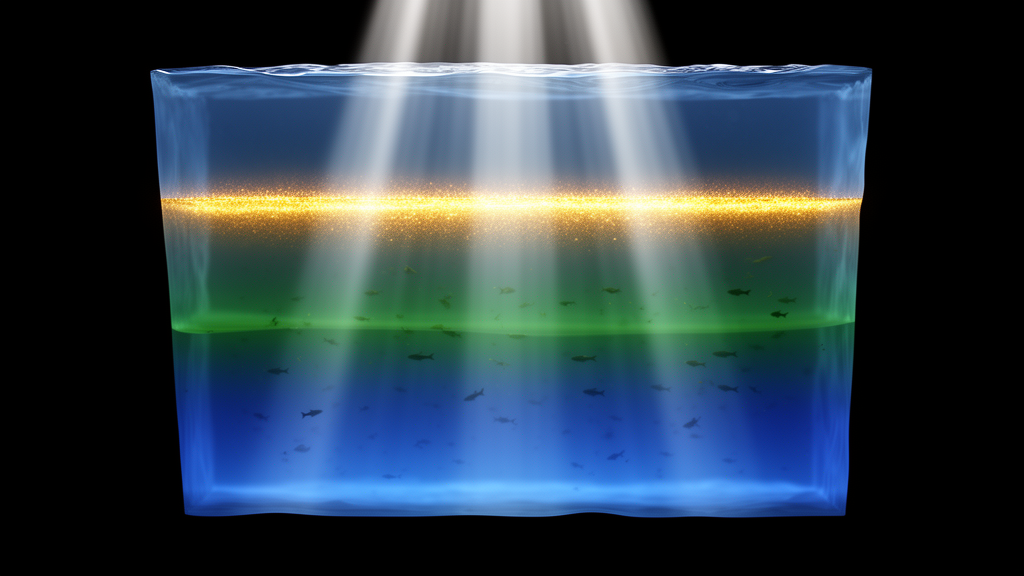
Light is the engine of the ocean. It warms the sea surface, drives photosynthesis, shapes the vertical structure of marine ecosystems, and even influences chemical reactions such as nitrification, which is inhibited under high irradiance. Yet in most marine ecosystem models, the way sunlight travels through seawater remains strikingly crude. A team of researchers from the University of Liège and Univ. Grenoble Alpes, led by Loïc Macé, has now built a far more sophisticated way of simulating underwater light, and they have tested it in one of the world’s most optically complex seas: the Black Sea. Their work, published in Geoscientific Model Development, delivers a three-stream radiative transfer module that plugs directly into NEMO, the Nucleus for European Modelling of the Ocean, one of the most widely used ocean simulation frameworks on the planet.
Most existing schemes inside NEMO treat sunlight as a single downward stream that simply fades with depth, resolved over only two to five broad wavebands. The new module, adapted from the model developed for the MITgcm-DARWIN configuration, does something fundamentally different. It separates the light field into three distinct streams: a direct downward stream that has not yet been scattered, a scattered downward stream produced by light deflected forward by particles and water molecules, and an upward stream of backscattered light heading back toward the surface. Each stream is solved independently for every wavelength, and the model runs across 33 wavebands spanning 250 to 4000 nanometres, with a fine 25-nanometre resolution in the visible range where biology matters most.
The technical heart of the module is a set of coupled equations describing how each stream is attenuated by absorption, forward scattering, and backscattering as it propagates through the water column. These processes are governed by the inherent optical properties of seawater, which are determined by what is actually in the water: pure seawater itself, phytoplankton, detritic non-algal particles, and coloured dissolved organic matter, known as CDOM. In the coupled configuration, a biogeochemical model supplies the concentrations of these optically active constituents, and the module converts them into spectral absorption and scattering coefficients. CDOM, which absorbs strongly at short wavelengths, is handled with an exponential decay law referenced at 412 nanometres, while phytoplankton optics are computed from three functional types relevant to the Black Sea: diatoms, small flagellates, and large flagellates.
What makes this development genuinely powerful is the feedback loop. The simulated irradiances are not just diagnostic outputs; they are fed back into the physics and the biology. The total scalar irradiance budget becomes the source term in the temperature equation of NEMO, replacing the crude attenuation schemes of the past, and the visible-range scalar irradiance available to phytoplankton drives primary production in the coupled ecosystem model. This two-way coupling maintains physical consistency: the same light that heats the water is the light that plankton use to grow. The researchers calibrated a tuning factor, set to 0.85 in the Black Sea configuration, that accounts for the small fraction of absorbed energy used by photosynthesis and particle degradation rather than heating.
The test case is the Black Sea, a basin whose biogeochemistry is simulated operationally by the Copernicus Marine Service using the NEMO-BAMHBI framework. BAMHBI, the BiogeochemicAl Model for Hypoxic and Benthic Influenced areas, explicitly represents the anoxic deep layer of the Black Sea and the full marine foodweb from bacteria to mesozooplankton. Previously it relied on a simple three-band optics scheme in which a single downward light stream was attenuated following Beer’s law. Substituting that scheme with the new three-stream model required careful calibration, which the team performed using more than a decade of data from Biogeochemical Argo floats drifting through the basin, measuring chlorophyll, particle backscattering, CDOM fluorescence, and downwelling irradiance at 380, 412 and 490 nanometres.
The surface boundary conditions come from an unexpected direction: the sky. The team used the MAR regional atmospheric model, running with the ECMWF ecRad radiation scheme and a high-resolution gas-optics configuration, to simulate spectral shortwave fluxes over the Black Sea in the same 33 wavebands used by the ocean module. MAR separates direct and diffuse irradiance, exactly the split the ocean model needs, and validation against ground observations showed correlations above 0.9 with low bias. Importantly, because sea surface reflectance is computed as a ratio of upwelling to downwelling irradiance, any residual bias in the atmospheric forcing largely cancels out, making the reflectance output robust.
The validation results are encouraging. Simulated downwelling irradiances at 412 and 490 nanometres agree very well with BGC-Argo profiles, with regression slopes close to one, although the model absorbs slightly too much light near the surface at shorter wavelengths where CDOM dominates. Sea surface temperature simulations remain consistent with observations, with correlations above 0.99, and the mixed layer depth, thermocline, and cold intermediate layer of the basin are preserved. Surface chlorophyll improves modestly, with the root mean square error dropping by 0.16 milligrams per cubic metre, though the model still tends to overestimate winter and spring blooms. The most striking gap appears during the May-to-July coccolithophore bloom, when the model underestimates reflectance at 490 nanometres because it does not capture the intense scattering from these calcifying plankton.
Perhaps the most transformative capability is the direct simulation of sea surface reflectance, the quantity that satellites actually measure. Rather than comparing modelled chlorophyll with satellite-derived chlorophyll through uncertain inversion algorithms, the model now produces reflectance fields that can be compared directly with remote-sensing data. The team went further and applied the same band-ratio inversion algorithm used operationally for Black Sea satellite products to their own simulated reflectance, producing a reflectance-derived chlorophyll estimate. This estimate agreed better with the satellite product than the dynamically simulated chlorophyll for most of the year, with a substantially lower error, particularly during the early spring bloom. The exercise also revealed a subtlety: the coccolithophore bloom visible in satellite reflectance does not appear in the satellite chlorophyll signal, because increases in both blue and green reflectance cancel out in the band ratio, suggesting the satellite product itself may be biased during such blooms.
The module also ships with a stochastic mode designed to confront one of the field’s thorniest problems: uncertainty in optical properties. Using first-order autoregressive processes with roughly 75-kilometre spatial correlation and one-month temporal correlation, the model perturbs absorption and scattering coefficients with standard deviations of up to 50 percent, following log-normal distributions consistent with the statistics of optical variables. A 50-member ensemble compared against in situ reflectance measurements from the AERONET-OC Galata tower off the Romanian coast showed that observations generally fell within the ensemble spread, with uncertainty widening during bloom periods. This quantification of model uncertainty is precisely what is needed for future data assimilation of reflectance, a step that could revolutionise how satellite ocean colour constrains ecosystem forecasts.
There are trade-offs. Running the radiative transfer model at every time step across 33 wavebands roughly doubles the computation time compared with the simple optics scheme, a cost that matters for long-term or global simulations, though it can be reduced by lowering spectral resolution or simplifying the scattering treatment. The authors also note limitations: the assumption of no bottom reflection restricts some coastal applications, phytoplankton optical properties were derived partly from Mediterranean observations, and suspended minerals near river mouths are not yet explicitly represented. Still, the implications reach well beyond the Black Sea. With hyperspectral satellite missions such as NASA’s PACE and the Italian Space Agency’s PRISMA now delivering reflectance data at unprecedented spectral resolution, models capable of resolving light propagation in fine wavebands are becoming essential. By making sophisticated radiative transfer a pluggable component of NEMO, this work opens a path toward ocean models that speak the same optical language as the satellites watching them, bringing simulation and observation into direct, quantitative conversation.
Subject of Research: Three-stream spectral radiative transfer modelling coupled with biogeochemical simulation of the Black Sea in the NEMO ocean modelling framework
Article Title: Three-stream modelling of radiative transfer for the simulation of Black Sea biogeochemistry in a NEMO framework
Article References: Macé, L., Vandenbulcke, L., Brankart, J.-M., Grailet, J.-F., Brasseur, P., & Grégoire, M. (2026). Three-stream modelling of radiative transfer for the simulation of Black Sea biogeochemistry in a NEMO framework. Geoscientific Model Development, 19(18), 9077-9102. https://doi.org/10.5194/gmd-19-9077-2026
Image Credits: AI Generated
Keywords: radiative transfer, NEMO, Black Sea, biogeochemical modelling, ocean optics, sea surface reflectance, phytoplankton, CDOM, BGC-Argo, remote sensing, Copernicus Marine Service, stochastic modelling
Cite Scienmag News
Violet Maxwell. (October 9, 2026). New Ocean Model Tracks Light in Three Streams to Simulate Black Sea Ecosystems. Scienmag. https://scienmag.com/new-ocean-model-tracks-light-in-three-streams-to-simulate-black-sea-ecosystems/
Violet Maxwell. "New Ocean Model Tracks Light in Three Streams to Simulate Black Sea Ecosystems." Scienmag, 9 October 2026, https://scienmag.com/new-ocean-model-tracks-light-in-three-streams-to-simulate-black-sea-ecosystems/. Accessed 9 October 2026.
Violet Maxwell. "New Ocean Model Tracks Light in Three Streams to Simulate Black Sea Ecosystems." Scienmag. October 9, 2026. https://scienmag.com/new-ocean-model-tracks-light-in-three-streams-to-simulate-black-sea-ecosystems/


