


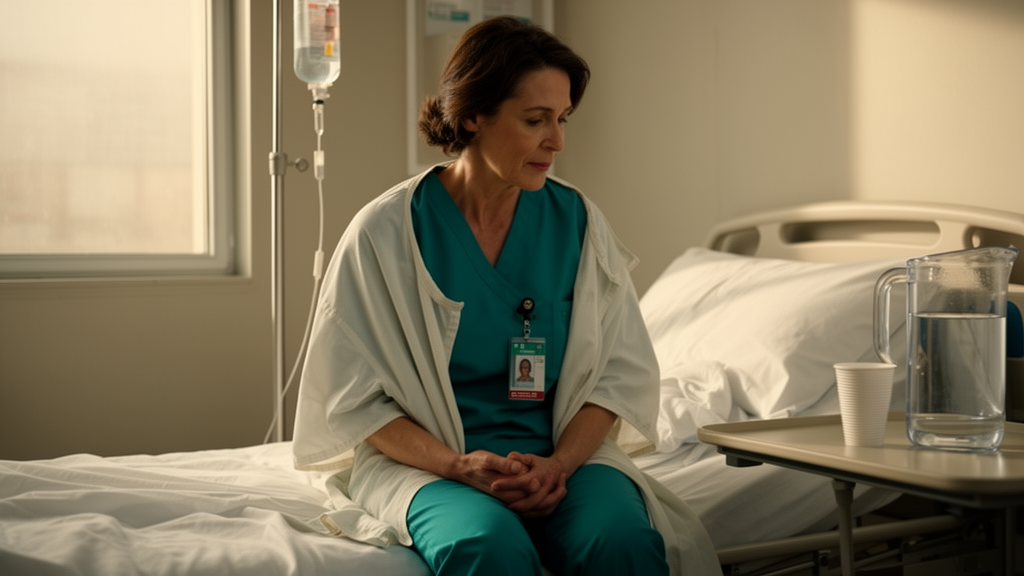
What happens when the people who deliver hospital care suddenly find themselves on the receiving end of it? A new qualitative study from a tertiary hospital in China set out to answer that question by interviewing clinical nurses about their experiences as patients, and the results expose service quality failures that conventional patient satisfaction surveys routinely miss. The research, published in BMC Nursing by a team at the Fourth Affiliated Hospital of Zhejiang University School of Medicine, used the well-established SERVQUAL model as an analytical lens to map precisely where the hospital’s promised service fell short of what patients actually experienced. Because the participants were insiders, they could compare the care they received with the care they themselves provide, offering a rare dual perspective on the machinery of modern hospital medicine.
The study recruited ten clinical nurses using purposive sampling combined with maximum variation sampling, a technique designed to capture a wide range of experiences across different departments, seniority levels, and clinical backgrounds. Data were collected through face-to-face, semi-structured interviews, a method that allows participants to speak freely while the interviewer probes specific themes. The researchers then applied framework analysis, a structured qualitative approach in which data are systematically charted against an organizing framework, in this case the five classic gaps described by the SERVQUAL model. To ensure the findings were trustworthy, the team followed Lincoln and Guba’s criteria for qualitative rigor and reported the work according to the COREQ checklist, a 32-item standard for transparent reporting of qualitative research.
The SERVQUAL model, originally developed for service industries, conceptualizes quality as the distance between what customers expect and what they perceive they received, and it breaks that distance into five diagnostic gaps: the knowledge gap between customer expectations and management’s understanding of them, the standards gap between management perception and service specifications, the delivery gap between specifications and actual service, the communication gap between what is delivered and what is promised externally, and ultimately the gap between expectation and perception. Mapping the nurses’ accounts onto this architecture, the researchers identified five core themes and thirteen sub-themes, each aligning with one or more of these gaps. The framework gave structure to complaints that might otherwise have remained anecdotal, turning individual frustrations into a diagnosable map of organizational failure points.
The first theme, a demand for optimization of medical service processes, corresponds to the knowledge gap. Nurses who became patients described convoluted admission procedures, unclear pathways between departments, and waiting sequences that seemed designed without any consideration of the patient’s perspective. As staff members, they understood the logic behind each step, yet experiencing the process firsthand revealed how disorienting and inefficient it felt from a hospital bed. This insider-outsider contrast is precisely what makes the dual perspective so valuable: managers who design processes rarely walk through them as patients, and ordinary patients lack the technical vocabulary to articulate exactly where the design breaks down.
The second and fourth themes both mapped onto the delivery gap, the distance between the service a hospital specifies and the service it actually provides. Participants pointed to shortcomings in the hospitalization environment and in service details, from physical discomforts on the ward to small failures of coordination that compounded during a stay. Separately, they described deviations in nursing professional competence and execution, moments when the care delivered did not match the professional standard that nurses themselves know should apply. That nurses criticized their own profession’s execution is notable; it suggests the delivery gap is not merely a resource problem but also one of consistency, supervision, and the everyday drift that occurs when standards are not actively enforced.
A third theme, insufficient nurse-patient communication and humanistic care, aligned with the standards gap, and the researchers interpreted its interpersonal communication component as an extension of the communication gap. Participants reported that during their own hospitalizations, explanations were thin, emotional support was scarce, and the human dimension of care, the listening, the reassurance, the acknowledgment of fear, was often absent. Technical competence was present, but the relational fabric that transforms procedures into care was frayed. This finding resonates with a large body of nursing literature showing that patients judge quality at least as much by how they are treated as by what is done to them, and it suggests that communication standards within the hospital were not sufficiently specified or operationalized.
The most striking discovery, however, emerged from a cross-cutting analysis that the authors termed being assumed to know. Because the participants were hospital employees, providers simply withheld the information, explanations, and follow-up that are routinely offered to lay patients. Staff assumed a nurse-patient already understood her diagnosis, her medications, and her discharge plan, so they skipped the briefings, the teach-back conversations, and the check-in calls that form the backbone of patient education. This silent omission manifested both as a knowledge gap, since the institution failed to recognize what this particular class of patients actually needed, and as a failure of interpersonal communication at the level of individual care encounters. The phenomenon reveals a subtle form of discrimination by expectation: being an insider paradoxically reduced the quality of care received.
The implications of being assumed to know extend well beyond the ten nurses interviewed. Any hospital employs hundreds of clinicians, administrators, and students who eventually become patients, but the underlying mechanism, tailoring communication based on assumptions about who the patient is, applies to anyone perceived as knowledgeable, including physicians treated at their own institutions, returning patients familiar with the system, and health professionals’ family members. The study suggests that patient-centered communication should be a default protocol rather than a judgment call, because assumptions about a patient’s knowledge are frequently wrong and almost never verified. A fifth theme, limited awareness of the hospital’s advantageous disciplines, was interpreted as a staff-facing extension of the knowledge gap, indicating that even employees lacked full information about the institution’s centers of excellence, a signal of internal communication weaknesses.
Methodologically, the study demonstrates the analytical power of pairing a dual-perspective population with a mature service quality framework. Framework analysis allowed the researchers to remain anchored to SERVQUAL’s five gaps while still letting new patterns, such as being assumed to know, surface from the data, and the two interpretive extensions they propose show how a decades-old model can be adapted to novel contexts. The single-center design and small sample of ten participants limit generalizability, and the authors themselves frame their findings as generating context-specific strategies that warrant further evaluation rather than as universally applicable prescriptions. Qualitative work of this kind is hypothesis-generating by design, and the natural next step is to test whether the identified gaps respond to targeted interventions, such as standardized communication checklists or process redesign informed by patient walkthroughs.
The broader significance of the research lies in its alignment with the World Health Organization’s vision of integrated, people-centered health services. Traditional quality evaluations rely heavily on patient satisfaction scores, which are known to be inflated by politeness, low expectations, and fear of consequences, and they systematically miss the latent gaps that only insiders can see. By asking nurses to evaluate their own hospital as patients, the study effectively recruited expert auditors who cannot be fooled by the facade of quality. If hospitals routinely incorporated the dual perspective of staff-turned-patients into their quality improvement cycles, they would gain a diagnostic instrument that is cheap, ethically straightforward, and uniquely sensitive to the seams where promised care and delivered care come apart. For a profession built on caring for others, the study is a reminder that the most revealing test of a hospital’s quality may be how it treats its own.
Subject of Research: Nursing service quality gaps examined through nurses' dual experiences as care providers and patients using the SERVQUAL model
Article Title: Nurse as patient: a qualitative study on nursing service quality gaps based on the SERVQUAL model
Article References: Nurse as patient: a qualitative study on nursing service quality gaps based on the SERVQUAL model. (n.d.). https://doi.org/10.1186/s12912-026-05495-x
Image Credits: AI Generated
DOI: 10.1186/s12912-026-05495-x
Keywords: nursing, SERVQUAL model, service quality, qualitative research, patient experience, nurse-patient communication, hospital care, framework analysis, patient-centered care, BMC Nursing, Zhejiang University, humanistic care
Cite Scienmag News
Ophelia Keating. (October 9, 2026). When Nurses Become Patients: Study Reveals Hidden Gaps in Hospital Care Quality. Scienmag. https://scienmag.com/when-nurses-become-patients-study-reveals-hidden-gaps-in-hospital-care-quality/
Ophelia Keating. "When Nurses Become Patients: Study Reveals Hidden Gaps in Hospital Care Quality." Scienmag, 9 October 2026, https://scienmag.com/when-nurses-become-patients-study-reveals-hidden-gaps-in-hospital-care-quality/. Accessed 9 October 2026.
Ophelia Keating. "When Nurses Become Patients: Study Reveals Hidden Gaps in Hospital Care Quality." Scienmag. October 9, 2026. https://scienmag.com/when-nurses-become-patients-study-reveals-hidden-gaps-in-hospital-care-quality/


