


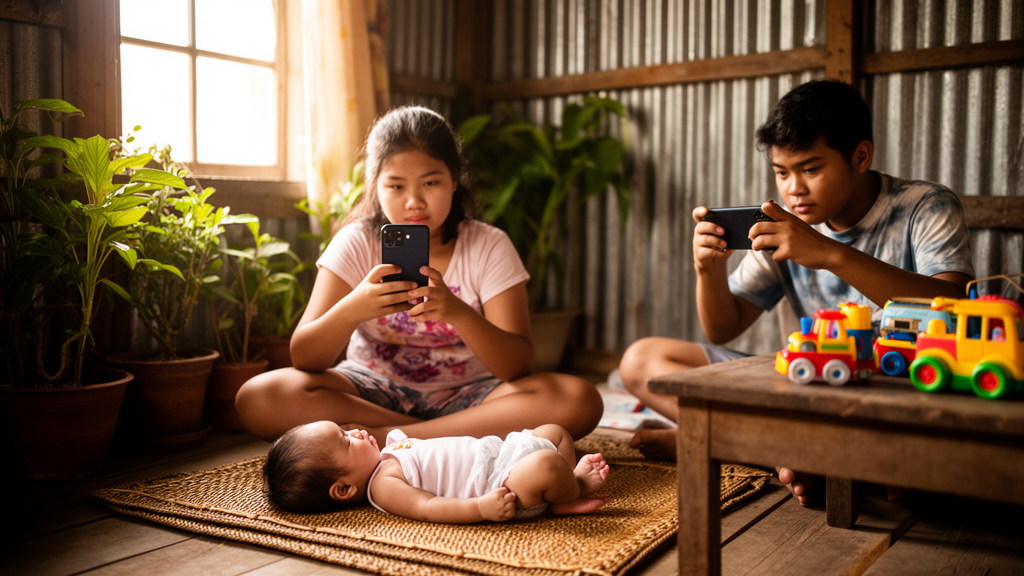
“I’m a student, a worker, and a mother. Sometimes, I feel like I have three bodies.” That single sentence, spoken by a senior high school student in the Philippines, captures the central tension running through a new study from Ateneo de Manila University: the daily negotiation of being an adolescent and a parent at the same time. The research, published in the August 2026 issue of the Journal of Research on Adolescence, used a participatory technique known as photovoice to place teenage mothers and fathers at the center of the research process, asking them not to be subjects of someone else’s analysis but to document and interpret their own lives through images they captured or chose themselves. The result is a portrait of young parenthood that resists the flat categories of statistics and policy briefs, revealing instead a set of lives still actively unfolding, shaped by relationships, responsibilities, and choices that arrive alongside the ordinary business of growing up.
The study was designed and implemented by Dr. Liane Alampay, Dr. Bernice Landoy Mamauag, and Jennel Reyes, in partnership with the Masayang Pamilya Organization, Inc., and was conceived as a needs assessment to inform the development of a parenting program for teenage parents. The researchers invited nine Filipino teenage parents, aged 15 to 20, from low-income communities in two provinces in Central Luzon. Those areas were identified as priorities by the partner organization because of their high rates of teenage pregnancy. The choice of method was deliberate. Photovoice asks participants to take or select photographs that represent meaningful aspects of their experience and then to share the stories behind those images, allowing their own perspectives to shape the programs and support systems being built around them. In this case, the researchers gave no photography lessons and offered no tips on lighting or framing. Participants were simply asked to make sure their photographs represented something meaningful to them, a distinction the team considered essential to keeping the process authentic.
That authenticity showed in the images themselves. Because taking photographs was already part of the participants’ everyday lives, the method offered a familiar, low-barrier way to express experiences that might otherwise be difficult to articulate. Some participants moved beyond literal representation entirely, using objects symbolically: crayons became a representation of family, while a permanent marker stood for the lasting effects of sexual interactions. One participant, a young mother identified as “Joyce,” photographed herself holding her child in an image titled “Hindi hadlang ang pagiging ina sa pag-aaral” — “Motherhood is not an obstacle to studying” — reflecting her experience of pursuing her education while raising a child. Her words about having three bodies, moving between school, work, and caregiving, describe a form of identity negotiation in which adulthood is being built even as adolescence is still underway.
The context that makes this work urgent is stark. Teenage parenthood remains a pressing concern in the Philippines, with an estimated 150,000 teenage pregnancies recorded in 2022 and a 35 percent rise in births among girls younger than 15. Behind those numbers, existing studies point to persistent gaps between the country’s laws and programs and the lived experiences of teenage parents, including stigma and services that are inaccessible or irrelevant to their actual circumstances. It is precisely this gap that the Ateneo team set out to document. Rather than beginning with a predefined set of needs, they began with the young parents themselves, using their photographs and discussions as the primary evidence base for understanding what support would actually matter.
What those images revealed was a life that could not be reduced to the label “teenage parent.” Through their photographs, the young parents offered glimpses into lives shaped by responsibilities that arrived alongside adolescence. They spoke about uncertainty and conflict in their relationships, changes in friendships and family dynamics, and the demands of caring for a child while pursuing education or employment. For one participant, motherhood existed alongside being a first-year college student and a food server. For another, friends became family, highlighting the role of peers as a source of support and a safe space to speak openly. Across the photographs and the group discussions, the researchers identified eight core themes: managing stresses and conflicts in partner relationships; peers as a source of emotional support; support and strain in family relationships; shifts in normative adolescent experiences and priorities; strain and agency in balancing roles; a desire to enhance parenting knowledge and skills; environmental drivers of early sexual exposure; and sexual knowledge drawn from social media.
To interpret these themes, the researchers turned to Life Course Theory, a framework that views individual development as a pathway shaped by the timing of life events, the relationships surrounding them, and the broader structural conditions in which they occur. Viewed through this lens, the challenges the young parents described are not isolated personal failings but outcomes shaped by relationship dynamics and structural norms in low-resource contexts, which together influence the transition to parenthood. The framework helps explain why two adolescents facing similar circumstances may follow very different trajectories: the timing of a birth relative to schooling, the availability of family support, the behavior of a partner, and the norms of a community all redirect the course. The photographs made these intersecting forces visible in ways that survey questions about “challenges” rarely can.
The study also found that teenage parents navigated their circumstances in strikingly different ways, and the researchers interpreted these differences as forms of agency exercised amid real constraints. Some participants continued their education or pursued employment, while others expressed a desire to improve how they cared for and related to their children. These were not passive adaptations but active choices about what mattered most and what could be changed. The researchers saw in them evidence that young parents are not simply recipients of intervention but actors with their own priorities, and that programs designed for them should build on that agency rather than assume its absence.
Fathers and partners emerged in the narratives in contradictory ways, functioning simultaneously as sources of stress and of support. Several mothers described conflict-laden relationships marked by imbalanced household responsibilities, financial control, and verbal and physical conflicts, tensions compounded by the adolescents’ still-developing emotional regulation capacities. Yet when fathers shared caregiving, this enabled mothers to continue their education, illustrating how paternal involvement operates as a critical resource for young families. On the strength of this finding, the paper calls for gender-responsive strategies to bring young fathers meaningfully into support programs, both to strengthen family functioning and to shift the traditional gender norms that leave adolescent mothers disproportionately bearing the burdens of early parenthood. The implication is that any parenting program aimed at teenage mothers alone will address only half of the relational system in which these young families live.
Beyond the findings on relationships and agency, the study underscored a set of concrete service needs: accessible counseling, healthier communication and conflict resolution skills, stronger support systems for young parents, and comprehensive sexual and reproductive health education. These recommendations flow directly from what participants photographed and said, which is precisely the point of the photovoice approach — it converts lived experience into actionable evidence without requiring participants to translate their lives into the language of researchers first. At the heart of the study is a recognition that teenage parenthood is shaped by more than its challenges. It is also shaped by the relationships, circumstances, and choices through which young people find their way.
The photographs did not offer a single story of teenage parenthood, one in which becoming a parent becomes the whole story of a young person’s life. Instead, they opened a window into lives shaped by relationships, responsibilities, uncertainty, support, and choices. They revealed young people who are still growing and still finding their way while learning to care for someone else. What emerged were stories still unfolding — of young people still becoming. For researchers, policymakers, and program designers, the message is equally clear: if interventions are to succeed where laws and services have fallen short, they must begin by seeing teenage parents as these young people see themselves, one meaningful image at a time.
Subject of Research: Lived experiences of Filipino teenage parents studied through the photovoice method
Article Title: Understanding Filipino teenage parents using the photovoice method
Article References: Understanding Filipino teenage parents using the photovoice method. (n.d.). Original publication
Image Credits: AI Generated
DOI: Not provided
Keywords: photovoice, teenage pregnancy, adolescent parenthood, Philippines, Life Course Theory, Ateneo de Manila University, parenting program, gender-responsive support, adolescent development, participatory research, Journal of Research on Adolescence, sexual and reproductive health
Cite Scienmag News
Courtney Benton. (October 9, 2026). Filipino Teenage Parents Tell Their Own Stories Through Photographs. Scienmag. https://scienmag.com/filipino-teenage-parents-tell-their-own-stories-through-photographs/
Courtney Benton. "Filipino Teenage Parents Tell Their Own Stories Through Photographs." Scienmag, 9 October 2026, https://scienmag.com/filipino-teenage-parents-tell-their-own-stories-through-photographs/. Accessed 9 October 2026.
Courtney Benton. "Filipino Teenage Parents Tell Their Own Stories Through Photographs." Scienmag. October 9, 2026. https://scienmag.com/filipino-teenage-parents-tell-their-own-stories-through-photographs/


