


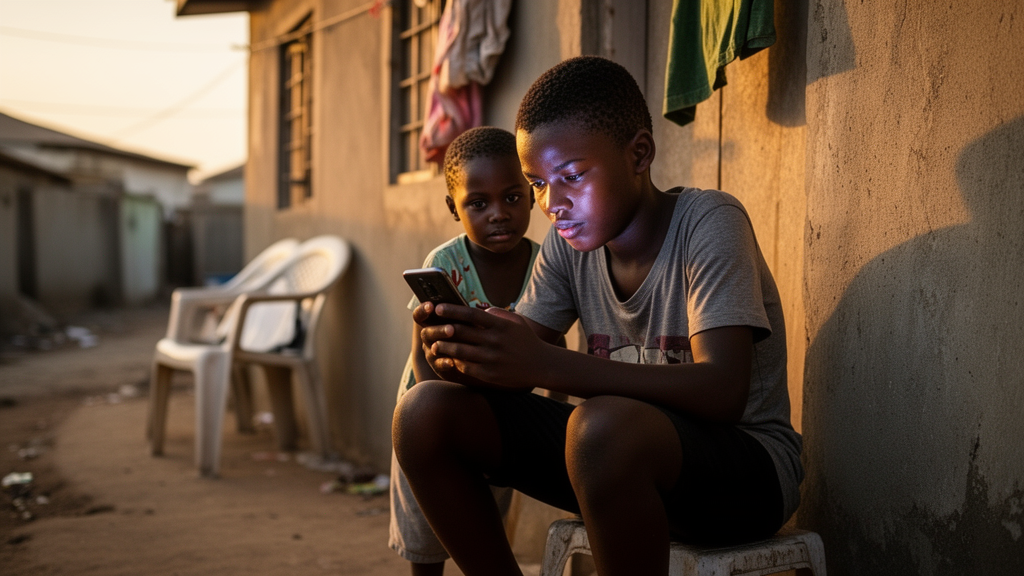
Social media has become woven into the daily routines of children across the world, and Ghana is no exception. In the port city of Tema, one of the country’s most urbanized and industrially significant metropolitan areas, children as young as eight are logging onto platforms designed for adults, navigating feeds, messages, and comment sections that were never built with their developmental needs in mind. A new study published in SN Social Sciences by Sylvester Kyei-Gyamfi of Ghana’s Ministry of Gender, Children and Social Protection and colleagues, including Frank Kyei-Arthur of the University of Environment and Sustainable Development, offers one of the most detailed quantitative portraits to date of what children in a West African urban setting actually experience when they go online. The headline finding is stark: 66.4 percent of the children surveyed reported encountering unsolicited online interactions, ranging from cruel remarks to explicit sexual harassment, and the burden falls unevenly on girls and older children.
The research team employed a convergent mixed-methods design, a strategy that gathers numerical and narrative evidence in parallel and then integrates the two streams to produce a richer picture than either could alone. Quantitative data came from an online survey administered to 400 children aged 8 to 17, collected through the KoboToolbox data platform, which is widely used in field research across low-resource settings. In parallel, the researchers conducted telephone interviews with 50 children who served as key informants, allowing them to probe the texture of children’s experiences in their own words. The statistical analysis relied on descriptive statistics to map the prevalence of different encounter types, Pearson’s chi-square tests to examine associations between demographic characteristics and risk, and Fisher’s exact test where cell counts were too small for the chi-square approximation to be reliable. The qualitative interviews were analyzed thematically, following the widely cited approach developed by Virginia Braun and Victoria Clarke.
The demographic gradients in the data are among the study’s most consequential findings. Girls reported unsolicited encounters at a rate of 78.7 percent, substantially higher than the overall sample average, a pattern consistent with a large international literature documenting that online harassment and unwanted sexual contact disproportionately target female users. Age mattered just as much: among older children in the sample, prevalence climbed to 85.9 percent. This developmental gradient makes intuitive sense. Adolescents spend more time online, maintain larger networks of contacts, use direct messaging more intensively, and are more likely to engage with strangers, all of which expand the attack surface for unwanted contact. Developmental psychology also suggests that adolescents are more susceptible to social influence and peer dynamics, which can normalize risky sharing and make it harder to disengage from hostile interactions once they begin.
What exactly are children encountering? The most common form of unsolicited contact, reported by 65.5 percent of those who experienced such encounters, was uncomplimentary remarks, essentially verbal abuse, insults, and demeaning comments directed at the child. This finding aligns with the extensive cyberbullying literature, including meta-analyses by Robert Kowalski and colleagues showing that digital harassment is associated with depression, anxiety, and psychosomatic complaints among adolescents. Nearly half of affected children, 49.9 percent, reported exposure to violent content they had not sought out, echoing decades of research on the effects of media violence on young people. Most alarmingly, 44.8 percent reported sexual harassment, a figure that places Tema’s children within the range documented in meta-analytic work by Sheri Madigan and colleagues on unwanted online sexual exposure and solicitation among youth globally. That nearly one in two children who face unwanted online contact experience sexualized harassment underscores how urgently child protection frameworks in the region need updating.
The qualitative interviews add crucial interpretive depth to these numbers. Children described how hostile interactions unfold in comment threads, private messages, and group chats, and how content that is violent, sexual, or otherwise inappropriate surfaces in their feeds without any deliberate search on their part. The interviews also illuminate the social context in which these encounters occur: children often know the perpetrators, at least by online identity, and the boundary between peer conflict and genuine victimization can be blurry. This matters for intervention design, because responses that treat all unwanted contact as predation by strangers may miss the more common reality of peer-to-peer cruelty, which requires different educational and disciplinary strategies than those aimed at adult offenders.
How do children respond when these encounters happen? The study found that the most common reaction, reported by 34.6 percent of affected children, was to tell a parent or guardian, a finding the researchers treat as encouraging because disclosure is the first step toward adult intervention. Close behind, 29.0 percent said they blocked the offender, using the platform-level technical controls that most major social media services provide. Blocking is an effective immediate defense, but it is a purely individual remedy: it removes one perpetrator while leaving the underlying dynamics of the platform untouched, and it does nothing for children who lack the confidence or knowledge to use these tools. The distribution of responses suggests that a meaningful share of children neither disclose nor block, silently absorbing the harm, a pattern that previous research on adolescents and parental communication has identified as a persistent challenge for safeguarding.
The theoretical framing of the study draws on ecological systems theory, the framework developed by Urie Bronfenbrenner, which holds that child development is shaped by nested layers of environment, from the immediate family to broader cultural and policy contexts. Applied to online risk, this perspective insists that a child’s vulnerability is not a fixed individual trait but a product of interactions between the child’s digital literacy, the supervision practices of parents, the design choices of platforms, and the legal and institutional environment of the country. Ghana has begun building that institutional layer: the country passed a Cybersecurity Act in 2020 and, in 2024, adopted a National Child Online Protection Framework. The Tema findings provide exactly the kind of empirical baseline that such frameworks need in order to prioritize resources and measure progress over time.
The authors argue that three lines of action follow from their results. First, digital literacy programs should be expanded and embedded in schools, teaching children not only how to use platforms but how to recognize manipulation, manage privacy settings, and respond constructively to harassment. Recent work on evidence-based digital literacy curricula for youth suggests these programs can be effective when they are assessed and iterated rather than delivered as one-off awareness campaigns. Second, parental involvement needs strengthening, which in the Ghanaian context may require parent education initiatives, since many caregivers did not grow up with social media and may underestimate both its benefits and its risks. Third, the researchers call for effective and enforceable policies, noting that platform safety features designed primarily for Western markets may not account for the linguistic, cultural, and infrastructural realities of African users.
The study also makes a methodological contribution to a field in which children’s voices are often mediated entirely through adult reports. By surveying children directly and interviewing a subset as key informants, the researchers treated young people as credible witnesses to their own digital lives, an approach grounded in the ethical guidance for research with children articulated by Priscilla Alderson and Virginia Morrow. The study received ethical approval from the National Child Protection Committee of Ghana’s Ministry of Gender, Children and Social Protection, and informed consent was obtained from all respondents. The authors note that the data cannot be shared openly due to ethical restrictions protecting child participants, though reasonable requests can be directed to the corresponding author.
For a global audience, the Tema findings carry a message that extends well beyond Ghana. As internet access expands across Africa faster than child protection infrastructure, hundreds of millions of children are coming online in societies where safeguarding institutions are still maturing. The patterns documented here, with girls and adolescents bearing disproportionate risk and sexual harassment approaching the prevalence of more widely discussed harms like cyberbullying, suggest that the global conversation about child online safety must center the experiences of children in the Global South rather than extrapolating from European and North American surveys. Two-thirds of children encountering unwanted contact is not a marginal problem to be managed; it is a structural feature of how current platforms intersect with childhood, and the Tema study offers both the evidence and the policy roadmap to begin changing that.
Subject of Research: Children's experiences of unsolicited online encounters on social media in Tema, Ghana
Article Title: Social media and child safety in Tema, Ghana: Examining unsolicited online encounters
Article References: Kyei-Gyamfi, S., Kyei-Arthur, F., Kyei-Gyamfi, Z., Kotey, V. K., & Appiah, M. (2026). Social media and child safety in Tema, Ghana: Examining unsolicited online encounters. SN Social Sciences, 6(10), Article 517. https://doi.org/10.1007/s43545-026-01805-x
Image Credits: AI Generated
DOI: 10.1007/s43545-026-01805-x
Keywords: social media, child safety, Ghana, cyberbullying, online sexual harassment, digital literacy, parental mediation, child online protection, mixed methods, Tema, online risk, adolescents
Cite Scienmag News
Courtney Benton. (October 9, 2026). Two-Thirds of Children in Ghana’s Tema Face Unsolicited Encounters on Social Media, Study Finds. Scienmag. https://scienmag.com/two-thirds-of-children-in-ghanas-tema-face-unsolicited-encounters-on-social-media-study-finds/
Courtney Benton. "Two-Thirds of Children in Ghana’s Tema Face Unsolicited Encounters on Social Media, Study Finds." Scienmag, 9 October 2026, https://scienmag.com/two-thirds-of-children-in-ghanas-tema-face-unsolicited-encounters-on-social-media-study-finds/. Accessed 9 October 2026.
Courtney Benton. "Two-Thirds of Children in Ghana’s Tema Face Unsolicited Encounters on Social Media, Study Finds." Scienmag. October 9, 2026. https://scienmag.com/two-thirds-of-children-in-ghanas-tema-face-unsolicited-encounters-on-social-media-study-finds/


