


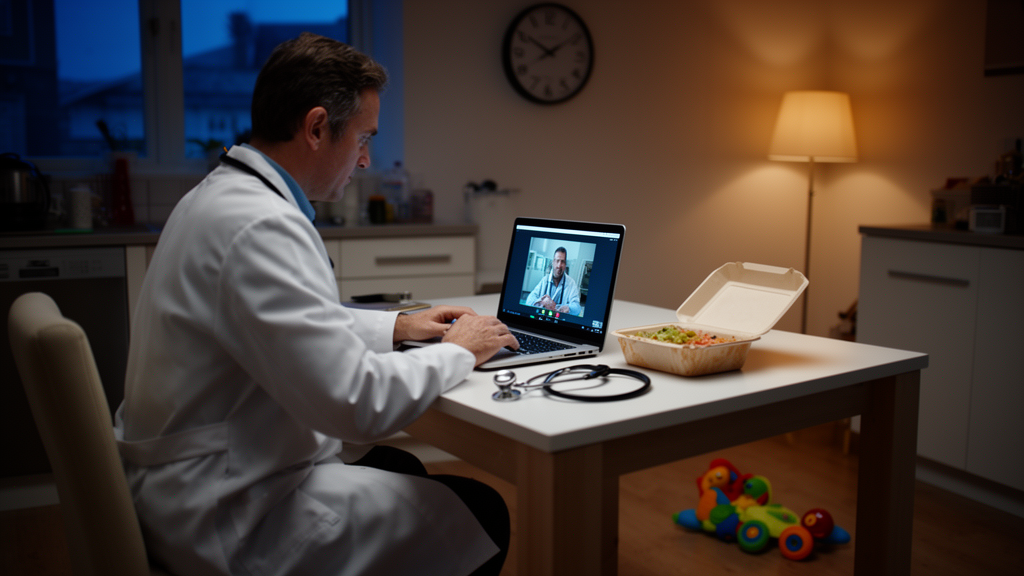
Telemedicine was supposed to be the great liberator of modern medicine. When consultations moved onto video screens during the COVID-19 pandemic, many clinicians and administrators assumed that remote care would hand physicians back their most precious resource: time. A doctor could see patients from a home office, skip the commute, and finally eat dinner with the family instead of the vending machine. But a new scoping review published in BMC Health Services Research suggests that this assumption deserves far more scrutiny than it has received. The review, led by Hujun Jia and Lan Chen with colleagues at institutions in Chengdu, China, systematically examined how telemedicine actually relates to physicians’ work-life integration, and its central finding is deceptively simple: telemedicine should not be assumed to improve physicians’ lives at all. Whether it helps or harms depends almost entirely on how health organizations design, schedule, and count remote work.
The research team followed the Joanna Briggs Institute methodology for scoping reviews and reported their work in line with the PRISMA extension for Scoping Reviews, a standardized framework for transparent evidence synthesis. They searched six major databases, PubMed, Web of Science, Embase, Scopus, CINAHL, and PsycINFO, from their inception to 16 June 2026, supplementing the search with citation searching. To be included, studies had to be peer-reviewed empirical investigations or implementation reports involving physician-delivered or physician-involved telemedicine, and they had to report outcomes related to work-life integration or clearly describe work-design and organizational conditions relevant to physicians. Two reviewers independently screened records and extracted data, a double-checking procedure designed to reduce selection bias. The final evidence base comprised twenty-nine studies published between 2015 and 2026, spanning a decade that includes both the pre-pandemic era of telemedicine experimentation and the explosive, often chaotic, scaling of virtual care after 2020.
One of the most striking technical observations in the review is how rarely the field has actually measured work-life integration as a standardized construct. Instead of using validated instruments for the work-life interface, most studies examined adjacent domains: workload, after-hours work, boundary management, scheduling flexibility, autonomy, burnout, stress, well-being, job satisfaction, professional fulfillment, and retention intention. This fragmentation matters scientifically. When each study defines and measures a different outcome, comparing findings across settings becomes difficult, and the resulting evidence base is heterogeneous in study design, clinical specialty, telemedicine modality, and outcome measurement. The authors synthesized the findings narratively rather than statistically for this reason, and they caution readers that the evidence is uneven in its directness. Some studies directly assessed physician work-life outcomes; others offered only indirect signals inferred from implementation reports. The review team registered the protocol on the Open Science Framework before data extraction, an accountability step that helps guard against post hoc changes in inclusion criteria.
So what did the twenty-nine studies actually show? On the positive side of the ledger, telemedicine was repeatedly associated with greater flexibility, fewer location constraints, and greater control over time. Physicians reported that remote consultations could eliminate commutes, allow them to work from home on designated days, and make it easier to fit clinical duties around caregiving responsibilities. Crucially, however, these benefits appeared most reliably when remote care was formally scheduled and substituted for part of in-person work rather than added on top of it. In other words, a Tuesday afternoon of planned video clinics that replaces an equivalent block of in-person clinic time behaves like a genuine flexibility intervention. A vague expectation that doctors will be available online whenever a patient needs them behaves very differently, and the review suggests it behaves badly.
That darker pattern is where the review’s most consequential findings live. The authors catalogued a set of recurring risks that researchers of occupational health will recognize from other digitally mediated professions: hidden digital work, after-hours electronic health record use, asynchronous messaging burden, clinical uncertainty, responsibility transfer, and reduced team connection. Each of these deserves unpacking. Hidden digital work refers to the labor that never appears on any schedule, the inbox triage, the portal messages, the documentation that migrates into evenings. After-hours EHR use is a well-documented driver of physician burnout, and telemedicine can amplify it by extending the window in which patient-generated data and messages arrive. Asynchronous messaging is particularly insidious because it lacks the natural boundaries of a scheduled appointment; a video visit ends, but an inbox does not. Clinical uncertainty arises when physicians must make decisions without physical examination, potentially increasing cognitive load and anxiety. Responsibility transfer describes situations where telemedicine shifts tasks onto physicians without corresponding resources. And reduced team connection captures the professional isolation that can come when clinicians lose the informal collegial contact of a shared workplace.
The review’s analytical core is its identification of the organizational conditions that determine which pattern, benefit or harm, a given telemedicine program produces. Reported work-life experiences varied according to whether remote care was scheduled, recognized within workload accounting, and clearly bounded. Programs supported by patient triage systems, escalation pathways, robust technology infrastructure, team support, fair compensation arrangements, and explicit after-hours policies tended to preserve or improve physician well-being. Programs lacking these supports tended to convert telemedicine’s flexibility into an always-on obligation. This framing shifts the burden of proof from the individual physician to the institution. A doctor struggling with an overflowing patient inbox is not experiencing a personal failure of resilience; the review suggests such a doctor is experiencing a predictable consequence of a work design decision made by someone else.
There is a broader scientific lesson here about how health systems evaluate digital health technologies. The authors argue that telemedicine should be assessed not only in terms of access and efficiency, the metrics that have dominated telehealth evaluation since the pandemic, but also in relation to physician well-being, job satisfaction, team functioning, and workforce sustainability. This is a significant reframing. Health services research has traditionally treated clinician experience as a secondary outcome, subordinate to patient access, cost, and quality metrics. But the physician workforce is a finite and increasingly strained resource. Burnout drives turnover, reduced clinical hours, and early retirement, and replacing a physician costs far more than retaining one. If telemedicine quietly erodes work-life integration, the efficiency gains measured in a one-year pilot may be repaid, with interest, in attrition a decade later. The review’s emphasis on retention intention as an outcome domain reflects this long-horizon view.
The methodological limitations of the evidence base also carry practical implications. Because few studies measured work-life integration with standardized instruments, and because many were conducted during the pandemic era when telemedicine use was mandated rather than chosen, the review’s conclusions are best understood as a map of what is known and unknown rather than a definitive verdict. The authors’ supplementary materials include detailed assessments of evidence directness and applicability limitations for each study, along with sensitivity notes for the narrative synthesis, reflecting an unusually transparent approach to uncertainty. Future research, the review implies, should measure work-life integration directly, distinguish between scheduled and unscheduled remote work, and track physicians longitudinally rather than in cross-sectional snapshots. Organizations implementing telemedicine today cannot wait for that perfect evidence, but they can apply the review’s clearest finding immediately: flexibility that is not scheduled, counted, and bounded is not flexibility at all.
For hospital administrators and policymakers, the actionable takeaway is a checklist disguised as a conclusion. Before scaling a telemedicine program, health systems should ask whether remote care is formally scheduled, whether it substitutes for or supplements in-person workload, whether patient triage and escalation pathways exist so that virtual encounters have clear endpoints, whether the technology infrastructure works reliably enough to avoid adding friction, whether teams remain connected despite physical distance, and whether compensation and after-hours policies acknowledge that digital care consumes real time. Where those conditions hold, telemedicine can deliver on its promise of autonomy and control. Where they do not, the same technology becomes a conduit for the hidden, boundaryless work that the review identifies as a driver of burnout and dissatisfaction. The pandemic proved that medicine can be practiced through a screen. This review makes the quieter, more important argument that whether that practice heals or harms the healers is a design choice, and it is one that organizations, not individual physicians, must make.
Subject of Research: How telemedicine affects physicians' work-life integration and the organizational conditions that shape it
Article Title: Telemedicine and physicians’ work–life integration: a scoping review of benefits, risks, and organizational conditions
Article References: Jia, H., Chen, L., Xiang, Q., Li, W., & Wang, P. (2026). Telemedicine and physicians’ work–life integration: a scoping review of benefits, risks, and organizational conditions. BMC Health Services Research. https://doi.org/10.1186/s12913-026-15817-z
Image Credits: AI Generated
DOI: 10.1186/s12913-026-15817-z
Keywords: telemedicine, physicians, work-life integration, burnout, digital health, workload, health services management, work design, after-hours work, physician well-being, scoping review, workforce retention
Cite Scienmag News
Ophelia Keating. (October 9, 2026). Telemedicine Promises Flexibility for Doctors, but New Review Warns It Can Blur the Line Between Work and Life. Scienmag. https://scienmag.com/telemedicine-promises-flexibility-for-doctors-but-new-review-warns-it-can-blur-the-line-between-work-and-life/
Ophelia Keating. "Telemedicine Promises Flexibility for Doctors, but New Review Warns It Can Blur the Line Between Work and Life." Scienmag, 9 October 2026, https://scienmag.com/telemedicine-promises-flexibility-for-doctors-but-new-review-warns-it-can-blur-the-line-between-work-and-life/. Accessed 9 October 2026.
Ophelia Keating. "Telemedicine Promises Flexibility for Doctors, but New Review Warns It Can Blur the Line Between Work and Life." Scienmag. October 9, 2026. https://scienmag.com/telemedicine-promises-flexibility-for-doctors-but-new-review-warns-it-can-blur-the-line-between-work-and-life/


