


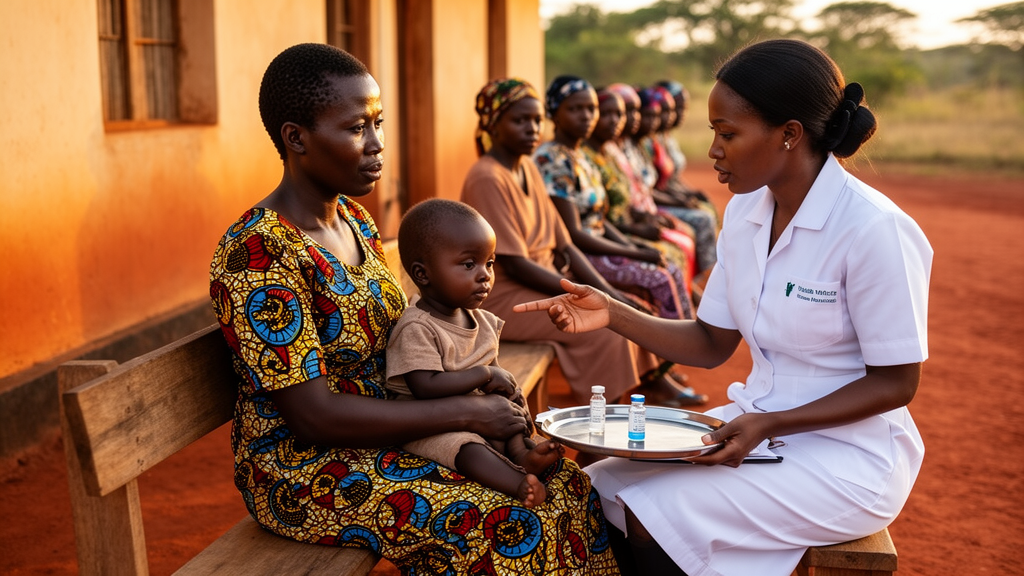
Uganda carries one of the heaviest malaria burdens on Earth, ranking third globally in reported cases, and the disease falls hardest on young children whose immune systems have not yet learned to fight the parasite. In April 2025, the country took a landmark step by introducing a four-dose R21 malaria vaccine for children under five, adding a powerful new tool to a prevention arsenal that has long relied on insecticide-treated bed nets, indoor residual spraying and prompt treatment. Yet a vaccine only saves lives if parents bring their children forward for it, and a new study from Masaka Regional Referral Hospital offers one of the clearest early portraits of how Ugandan caregivers view this novel intervention, revealing both encouraging enthusiasm and subtle barriers that could undermine the rollout if left unaddressed.
The research, published in PLOS Global Public Health, was led by Annet Mary Namusisi and colleagues at the Uganda Public Health Fellowship Program and partner institutions. In March 2025, just as the national campaign was getting underway, the team interviewed 292 caregivers attending the Maternal and Child Health unit of Masaka Regional Referral Hospital, a busy facility serving a region where malaria transmission is intense and year-round. The timing was deliberate: by capturing attitudes at the very start of vaccine introduction, the investigators could measure baseline willingness before mass messaging and early rollout experience had a chance to shape opinion, providing a snapshot of the informational landscape into which the R21 vaccine was being launched.
Methodologically, the study was designed to avoid the biases that often plague clinic-based surveys. Each day, researchers generated complete lists of caretakers attending the unit to serve as sampling frames, then used systematic sampling with a calculated interval to select participants, ensuring that every caregiver had a known chance of inclusion rather than simply interviewing whoever arrived first. The questionnaire assessed whether caregivers were willing to have their children vaccinated with the malaria vaccine, and the team used modified Poisson regression to identify factors statistically associated with willingness, an approach well suited to common outcomes in cross-sectional data because it yields adjusted prevalence ratios that are easier to interpret than odds ratios when the outcome is not rare.
The headline finding was strikingly positive. Of the 292 caretakers interviewed, 250, or 86 percent, were female, reflecting the reality that mothers overwhelmingly accompany children to health facilities in Uganda. Among all respondents, 249, or 85 percent, said they were willing to have their children receive the malaria vaccine. Perhaps most telling, the majority of caretakers had never even heard of the malaria vaccine before the interview, yet expressed readiness to accept it once oriented. This combination of low awareness and high openness suggests that the primary challenge in Uganda is not entrenched opposition to the vaccine but an information gap, one that health authorities can close through deliberate, well-targeted communication.
Beneath the aggregate enthusiasm, however, the regression analysis uncovered a set of factors that significantly raised or lowered willingness, and these carry important lessons for the rollout. On the positive side, caregivers who had received intermittent preventive treatment in pregnancy, known as IPTp, were far more willing to vaccinate their children, with an adjusted prevalence ratio of 6.2 and a 95 percent confidence interval of 1.6 to 23. IPTp involves administering antimalarial medication to pregnant women at routine antenatal visits to protect both mother and fetus, so a history of receiving it signals sustained engagement with antenatal care and familiarity with the idea of using antimalarial interventions preventively. Women who had already benefited from one malaria prevention strategy during pregnancy appear primed to embrace another for their children.
Even more powerful was trust in vaccine safety, which was associated with a thirteenfold increase in willingness, with an adjusted prevalence ratio of 13 and a confidence interval of 4.0 to 43. This finding underscores a truth well documented in immunization research worldwide: confidence in a vaccine’s safety profile is the single strongest driver of acceptance, outweighing general awareness or even perceived benefit. For a brand-new vaccine like R21, which many caregivers had never heard of before the study, safety perceptions are being formed right now, in real time, through conversations with health workers, community leaders and fellow parents. The authors argue that this makes safety-focused messaging, rather than generic awareness campaigns, the most effective communication strategy for the rollout.
Three factors were associated with reduced willingness, and each tells a distinct story. Caregivers who had previously experienced adverse events following immunization, known as AEFIs, with their children were dramatically less willing to accept the malaria vaccine, with an adjusted prevalence ratio of 0.2 and a confidence interval of 0.05 to 0.5. This is a rational response from the caregiver’s perspective: a parent whose child developed fever, swelling or another reaction after a routine vaccine naturally worries about adding a new four-dose series to the schedule. The implication is not that these families are lost causes, but that health workers need to be specifically prepared to discuss AEFI history, explain what side effects the malaria vaccine can cause and how they are monitored, and reassure parents that reactions are typically mild and transient.
Household decision-making dynamics also mattered. When someone other than the child’s biological parent, such as a grandparent or other relative, was the main decision maker for the child’s health, willingness dropped sharply, with an adjusted prevalence ratio of 0.2 and a confidence interval of 0.04 to 0.9. In many Ugandan households, particularly in extended-family arrangements, fathers, mothers-in-law or senior relatives hold final authority over children’s medical care even when mothers do the actual clinic visits. This means that a mother’s positive attitude at the health facility may not translate into vaccination if she must first persuade a decision maker who was never exposed to the health worker’s counseling. Reaching these influential relatives, whether through community dialogues, male engagement strategies or household-level communication, could be essential for converting willingness into actual uptake.
Surprisingly, caregivers with tertiary education were also less willing to vaccinate, with an adjusted prevalence ratio of 0.14 and a confidence interval of 0.04 to 0.6. This inverts the pattern often seen in vaccine acceptance studies, where higher education typically correlates with greater uptake. The authors do not overinterpret this finding, but it is consistent with a growing international literature showing that highly educated parents in some settings express more vaccine hesitancy, sometimes because they consume more diverse information sources, including online content that questions vaccine safety, or because they feel more entitled to question medical authority. Whatever the mechanism, the finding warns Ugandan program planners against assuming that educated urban families will be the easiest to reach, and suggests that communication strategies must be tailored across the education spectrum rather than designed only for those with limited schooling.
The study’s recommendations flow directly from its statistical findings. First, the authors propose delivering malaria vaccine information through antenatal care services, capitalizing on the strong association between IPTp receipt and willingness by embedding vaccine education in the very visits where pregnant women already receive malaria prevention and build trust with health workers. Second, they call for preparing health workers to address AEFI histories and vaccine-safety concerns directly, equipping frontline staff with the facts and counseling skills to convert hesitant parents rather than simply recording refusals. Third, and perhaps most strategically, they recommend prioritizing safety-focused messaging over general awareness messaging, since trust in safety was the strongest single predictor of acceptance while mere awareness left most caregivers unmoved. With Uganda third in the world for malaria cases and children under five bearing the deadliest toll of severe disease, the R21 vaccine represents a genuine turning point, and this early evidence from Masaka suggests that the demand is largely there, waiting to be secured through communication that respects caregivers’ real concerns about safety, family dynamics and personal experience.
Subject of Research: Caregiver willingness and factors influencing uptake of the R21 malaria vaccine among children under five in Uganda
Article Title: Caregivers’ willingness and factors influencing uptake of the malaria vaccine among under-five children at Masaka Regional Referral Hospital, Uganda
Article References: Namusisi, A. M., Migisha, R., Kizza, D., Kwesiga, B., Bulage, L., Tusuubira, V., Nakayiza, L. M., Tageya, S., Nsubuga, F., Atugonza, R., Baganizi, M., & Ario, A. R. (2026). Caregivers’ willingness and factors influencing uptake of the malaria vaccine among under-five children at Masaka Regional Referral Hospital, Uganda. PLOS Global Public Health, 6(10), e0005764. https://doi.org/10.1371/journal.pgph.0005764
Image Credits: AI Generated
DOI: 10.1371/journal.pgph.0005764
Keywords: malaria vaccine, R21 vaccine, Uganda, vaccine hesitancy, caregivers, children under five, vaccine safety, IPTp, adverse events following immunization, Masaka Regional Referral Hospital, PLOS Global Public Health, malaria prevention
Cite Scienmag News
Kristina Jarvis. (October 9, 2026). Malaria Vaccine Wins Over Ugandan Caregivers, but Trust and Safety Fears Shape Uptake. Scienmag. https://scienmag.com/malaria-vaccine-wins-over-ugandan-caregivers-but-trust-and-safety-fears-shape-uptake/
Kristina Jarvis. "Malaria Vaccine Wins Over Ugandan Caregivers, but Trust and Safety Fears Shape Uptake." Scienmag, 9 October 2026, https://scienmag.com/malaria-vaccine-wins-over-ugandan-caregivers-but-trust-and-safety-fears-shape-uptake/. Accessed 9 October 2026.
Kristina Jarvis. "Malaria Vaccine Wins Over Ugandan Caregivers, but Trust and Safety Fears Shape Uptake." Scienmag. October 9, 2026. https://scienmag.com/malaria-vaccine-wins-over-ugandan-caregivers-but-trust-and-safety-fears-shape-uptake/


