


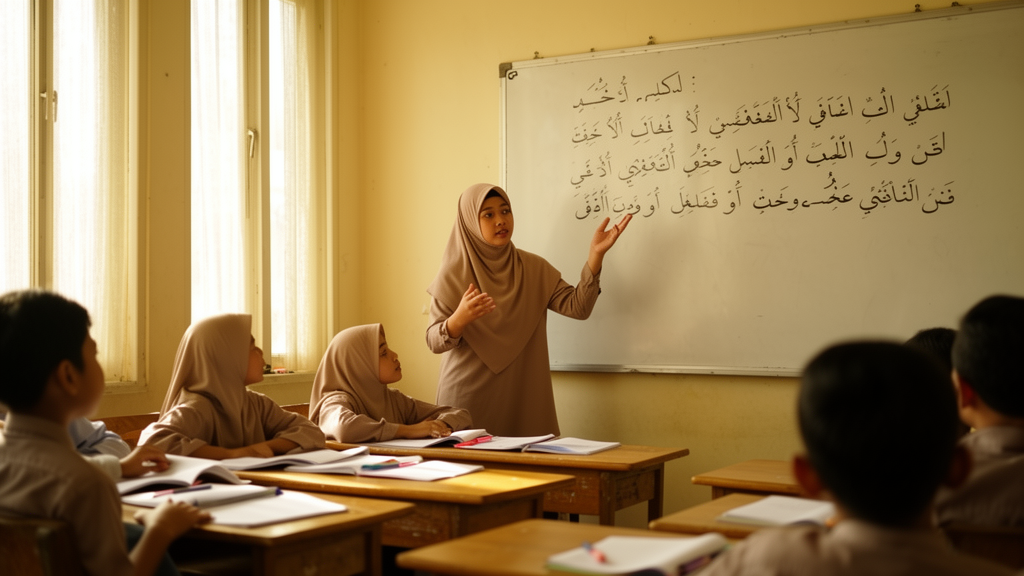
In classrooms across Indonesia, thousands of students are training to become teachers of Arabic, a language that occupies a position unlike any other foreign language in the world’s most populous Muslim-majority nation. Arabic is simultaneously a global lingua franca spoken by hundreds of millions of people, a medium of scientific and scholarly inquiry with a written tradition stretching back more than a millennium, and, most consequentially for these trainees, the sacred liturgical language of Islam. A new study published in SN Social Sciences suggests that this triple identity produces a distinctive psychological landscape among future teachers, one in which spiritual devotion and pragmatic career calculation are not competing motives but intertwined strands of a single orientation.
The research, conducted by Fitria Fitria of UIN Maulana Malik Ibrahim in Malang, Faishol Mahmud Adam Ibrahim of the University of the Holy Quran and Islamic Sciences in Omdurman, Sudan, and Irham Irham of Universiti Sains Malaysia, examined how Indonesian pre-service Arabic teachers perceive the status and role of Arabic and how those perceptions shape their professional aspirations. The team employed a convergent parallel mixed-methods design, a strategy in which quantitative questionnaire data and qualitative semi-structured interview data are collected and analyzed in parallel before being merged into a single interpretive account. This design allowed the researchers to measure broad attitudinal patterns across the participant group while simultaneously probing the personal narratives and ideological commitments that underlie those patterns.
Two theoretical lenses guided the analysis. The first is language ideology, a framework in sociolinguistics concerned with the beliefs, often implicit, that speakers hold about what languages are, what they are for, and who has the authority to speak and teach them. The second is native speakerism, a concept introduced in applied linguistics to describe the assumption that native speakers of a language are, by virtue of birth alone, its ideal owners and therefore its ideal teachers. Native speakerism has been extensively documented in English language teaching, where it structures hiring practices, curriculum design, and student expectations worldwide. Its application to Arabic pedagogy in a non-Arab country adds an important comparative dimension, because Arabic carries a sacral weight that English does not.
The study’s central finding is what the authors describe as a sacred–instrumental duality in participants’ motivations for learning Arabic. On one side of this duality, the future teachers view Arabic as the indispensable key to Islamic knowledge, the language in which the Quran, the hadith corpus, and centuries of religious scholarship are encoded. Learning Arabic is thus framed as an act of religious devotion and a prerequisite for authentic engagement with sacred texts. On the other side, participants treat Arabic as a strategic resource, a form of what the sociologist Pierre Bourdieu called linguistic capital: an asset that can be converted into educational opportunity, international mobility, and professional advantage. The same language that opens the gates of theology also opens doors to scholarships in the Arab world, employment in Islamic institutions, and participation in transnational Muslim networks.
This duality extends into the participants’ geographic imagination. The researchers identified a strong attachment to what they term sacred geography, particularly Saudi Arabia, which participants associated with both linguistic and religious authenticity. In the classical Islamic tradition, scholars developed elaborate mappings of the world organized around the Kaaba in Mecca, a phenomenon historians of science have described as the culmination of Islamic sacred geography. The study suggests that a modern descendant of this orientation persists in the way Indonesian trainee teachers imagine the Arab heartland as the place where Arabic is spoken in its purest and most legitimate form. Mecca and Medina function not merely as pilgrimage destinations but as symbolic centers of linguistic authority, against which local varieties of Arabic and local teaching practices are implicitly measured.
Perhaps the most nuanced finding concerns the participants’ stance toward native speakers. On the surface, the future teachers idealized the native speaker as the authoritative owner of Arabic, reproducing the classic native speakerist hierarchy in which birthplace confers pedagogical legitimacy. Yet when the researchers examined the participants’ actual pedagogical values, they found a pragmatic shift underway. The trainees prioritized academic qualification and professional training over nativeness alone, indicating that they regarded a well-trained non-native teacher with strong credentials as at least equal to, and potentially preferable to, an untrained native speaker. This divergence between ideological idealization and practical evaluation suggests that native speakerism in Arabic teaching operates less as a rigid doctrine than as a negotiable framework, one that yields to considerations of competence, certification, and classroom effectiveness.
The Indonesian context is essential for understanding why these findings matter. Indonesia is home to the world’s largest Muslim population, and Arabic has long been embedded in its educational infrastructure, from the pesantren, the traditional Islamic boarding schools where classical texts are studied, to state Islamic universities where Arabic serves as a medium of instruction in international programs. Previous scholarship has documented persistent methodological problems in teaching Arabic to non-native speakers in Indonesia, as well as debates over the language’s place in the national curriculum. At the same time, research on English in Indonesian Islamic higher education has shown that students routinely weigh the promises of global languages against local religious and cultural commitments. The new study extends this line of inquiry to Arabic, revealing that the same negotiation between global utility and local identity plays out in the religiously charged domain of Arabic pedagogy.
The theoretical implications reach beyond Indonesia. The findings suggest that for many learners in Muslim-majority settings, Arabic pedagogy functions as a site of negotiation between spiritual idealization and localized professional competence. Language ideology and native speakerism, the authors argue, intersect in ways that are specific to sacred languages: the authority of the native speaker is reinforced by religious associations with the language’s places of origin, yet it is simultaneously tempered by the practical recognition that teaching is a skill requiring training. This produces a hybrid professional identity in which the future teacher is both a devotee approaching a sacred tongue and a technician mastering a teachable subject. The duality is not experienced as contradiction by the participants themselves; rather, it appears to be a stable and productive feature of their motivation.
For teacher educators and policymakers, the study carries concrete lessons. If pre-service Arabic teachers are motivated by both religious attachment and career aspirations, then teacher preparation programs that address only one of these dimensions are likely to miss the mark. Curricula that acknowledge the spiritual significance of Arabic while simultaneously building rigorous pedagogical and linguistic competence may be better positioned to develop teachers who can serve Indonesia’s diverse Islamic educational institutions. The finding that participants value qualifications over nativeness also offers support for strengthening local teacher training rather than relying on imported native-speaker models, an approach that has been criticized in English language teaching for marginalizing local expertise.
The study, published on 15 September 2026 as volume 6, article 436 of SN Social Sciences, was conducted as independent research without external funding and followed established ethical protocols, with informed consent obtained from all participants and pseudonyms used throughout to protect privacy. The authors note that the underlying data are not publicly available for confidentiality reasons but can be requested from the first author. As debates over language policy in superdiverse societies continue, the Indonesian case offers a vivid illustration of how a single language can be many things at once: a prayer, a paycheck, a passport, and a profession. For the next generation of Arabic teachers in the world’s largest Muslim-majority country, the classroom is where all of these meanings converge.
Subject of Research: Language ideology and native speakerism among Indonesian pre-service Arabic teachers
Article Title: Intersecting perspectives of Indonesian pre-service Arabic teachers towards Arabic: from a language of communication to expression of religious attachment
Article References: Fitria, F., Ibrahim, F. M. A., & Irham, I. (2026). Intersecting perspectives of Indonesian pre-service Arabic teachers towards Arabic: from a language of communication to expression of religious attachment. SN Social Sciences, 6(9), Article 436. https://doi.org/10.1007/s43545-026-01735-8
Image Credits: AI Generated
DOI: 10.1007/s43545-026-01735-8
Keywords: Arabic language, Indonesia, pre-service teachers, language ideology, native speakerism, linguistic capital, sacred geography, religious identity, Islamic education, mixed methods, language teaching, SN Social Sciences
Cite Scienmag News
Courtney Benton. (October 9, 2026). For Indonesia’s Future Arabic Teachers, the Language of Faith Doubles as Career Capital. Scienmag. https://scienmag.com/for-indonesias-future-arabic-teachers-the-language-of-faith-doubles-as-career-capital/
Courtney Benton. "For Indonesia’s Future Arabic Teachers, the Language of Faith Doubles as Career Capital." Scienmag, 9 October 2026, https://scienmag.com/for-indonesias-future-arabic-teachers-the-language-of-faith-doubles-as-career-capital/. Accessed 9 October 2026.
Courtney Benton. "For Indonesia’s Future Arabic Teachers, the Language of Faith Doubles as Career Capital." Scienmag. October 9, 2026. https://scienmag.com/for-indonesias-future-arabic-teachers-the-language-of-faith-doubles-as-career-capital/


