


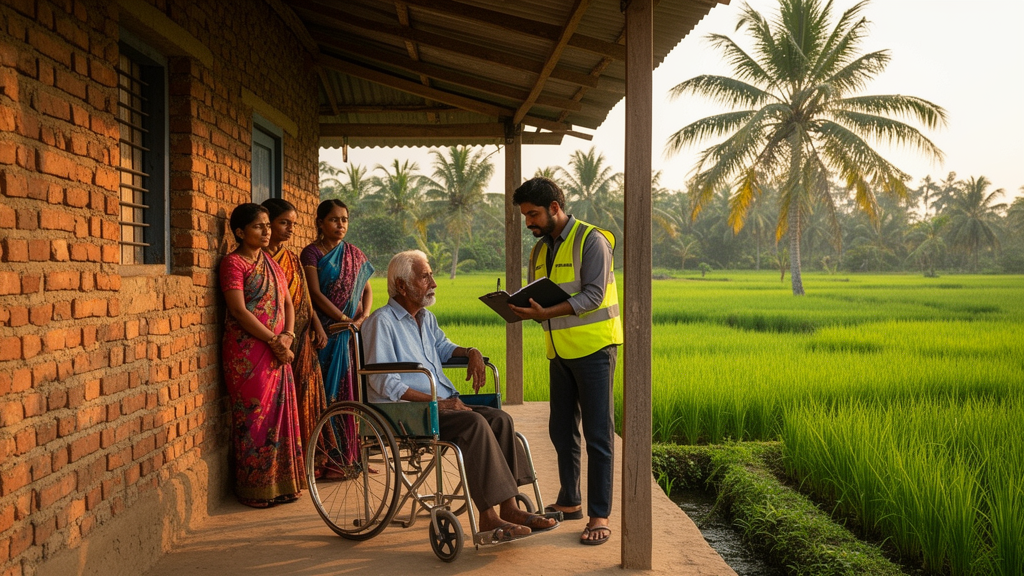
Disability is one of the most consequential yet undercounted public health challenges facing low- and middle-income countries, and Bangladesh is a striking example. Despite a population of more than 170 million and a growing body of research on infectious disease, maternal health, and nutrition, the country has lacked robust, nationally representative evidence on how many people live with disabilities, what forms those disabilities take, and who is most affected. A new analysis published in PLOS Global Public Health now offers the clearest picture to date, drawing on survey responses from 155,025 people collected in the 2021 National Survey on Persons with Disabilities. The findings reveal a prevalence of 2.79 percent, a figure that is likely to sharpen debate about whether official statistics capture the true scale of impairment in the country, and they expose sociodemographic patterns that run counter to many researchers’ expectations.
The study, led by Mizanur Rahman and colleagues, is notable for its sheer scale. The National Survey on Persons with Disabilities was designed to provide population-level estimates rather than the small clinic-based or district-level samples that have dominated the literature on disability in South Asia. By analysing data across individual, household, and community levels, the researchers were able to apply multilevel mixed-effects logistic regression, a statistical approach that accounts for the fact that people are nested within households and communities and that risk factors operate at each of these layers simultaneously. Crucially, they stratified their models by age, analysing children aged 0 to 17 years separately from adults aged 18 to 95, because the biology and social context of disability differ profoundly between these groups.
The headline number, a national disability prevalence of 2.79 percent with a 95 percent confidence interval of 2.69 to 2.91, is lower than estimates from some international organisations, which have suggested that roughly 15 percent of the world’s population lives with some form of disability. That gap almost certainly reflects differences in definition and measurement rather than any genuine scarcity of impairment in Bangladesh. Survey instruments that rely on self-report or household reporting tend to capture moderate and severe functional limitations while missing many milder impairments, and stigma can suppress disclosure, particularly for intellectual and psychosocial disabilities. Even so, the survey’s consistency and size make the 2.79 percent figure an important benchmark, and the patterns within it are arguably more informative than the headline rate itself.
Physical disability dominated the profile, accounting for 42.44 percent of reported cases, followed by visual impairment at 14.11 percent. Notably, 11.60 percent of people with disabilities reported multiple disabilities, a detail with significant implications for service design. A person with both a physical impairment and a visual one faces compounded barriers to education, employment, and health care, and rehabilitation programmes built around a single impairment category may fail such individuals entirely. The prominence of physical and visual disabilities also points toward preventable causes, including injuries, untreated infections, and age-related conditions, that could be addressed through stronger primary care, occupational safety, and eye health services.
One of the most striking findings concerns sex. Overall, disability was more prevalent among males, but this aggregate picture concealed sharply divergent patterns by age. Among children, girls had 31 percent higher adjusted odds of disability than boys, with an adjusted odds ratio of 1.31 and a confidence interval of 1.13 to 1.52. Among adults, however, no significant sex difference emerged, with an adjusted odds ratio of 1.06 and a confidence interval spanning 0.95 to 1.19. The childhood pattern is particularly concerning in a country where daughters have historically faced disadvantages in nutrition, health care utilisation, and educational investment. Higher odds of reported disability among girls may reflect genuine biological or perinatal differences, but they may also signal that families are more likely to identify and report disability in girls in certain contexts, or conversely that girls with disabilities face compounded neglect. Disentangling these mechanisms is a priority for follow-up research.
Perhaps the most counterintuitive result is the relationship between socioeconomic status and disability. In both age groups, the odds of reporting disability increased with years of schooling and household wealth, the opposite of what a purely causal reading of poverty and impairment might predict. Among adults, community-level literacy was likewise associated with higher odds of disability, while among children the association was reversed, with higher community literacy linked to lower odds. The most plausible explanation is detection bias: wealthier, better-educated households are more aware of what constitutes a disability, more willing to report it to surveyors, and more likely to have accessed diagnostic services, while stigma and limited awareness suppress reporting in poorer and less literate communities. If that interpretation is correct, the true burden of disability in Bangladesh’s most disadvantaged communities is likely substantially higher than the survey suggests, and the observed socioeconomic gradient is a map of underreporting rather than of genuine protection.
Occupational patterns among adults reinforce this interpretive caution. Housewives, students, and blue-collar workers all showed higher adjusted odds of disability than agriculture workers, the reference category. Each of these comparisons can be read in multiple ways. Blue-collar workers may face genuinely elevated risk through hazardous working conditions and injuries, a finding consistent with occupational health research across South Asia. Housewives and students, by contrast, are categories whose composition differs systematically by wealth and education, so the elevated odds may partly reflect reporting behaviour rather than causation. Agriculture workers, who form the reference group, are often among the poorest and least educated, meaning that unmeasured impairment in this group could deflate the apparent risk elsewhere. The authors’ call for caution in interpreting these associations is well founded.
The policy implications of the study are concrete. Rahman and colleagues argue for strengthening community-based disability identification and referral through Bangladesh’s existing primary health-care infrastructure, with particular attention to underserved populations and geographic areas where detection is likely weakest. Bangladesh has an extensive network of community clinics and frontline health workers, and embedding disability screening within routine maternal, child health, and general primary care contacts could dramatically improve case finding without requiring new infrastructure. The researchers also highlight the potential of better coordination between the Ministry of Health and Family Welfare, which controls health services, and the Department of Social Services, which administers disability allowances, rehabilitation programmes, and assistive-device distribution. In practice, many Bangladeshis who are identified with a disability never connect to the social protection schemes designed for them, and the study suggests that closing this administrative gap could deliver immediate benefits.
For a country that has made significant progress on poverty reduction, immunisation, and maternal mortality, the persistence of an invisible disability burden represents both a challenge and an opportunity. The 2021 National Survey on Persons with Disabilities provides the statistical foundation that advocates, planners, and researchers have long lacked, and its stratified, multilevel design offers a template for other low- and middle-income countries attempting similar measurement exercises. The paradoxes it documents, from higher reported disability among wealthier households to the reversal of the literacy association between children and adults, are not statistical curiosities. They are warnings that the data we see are shaped by who gets counted, and that the children and adults least likely to appear in disability statistics may be those most in need of services. Turning a 2.79 percent snapshot into a genuinely inclusive national response will require Bangladesh to treat detection itself as a public health intervention.
Subject of Research: National prevalence and sociodemographic correlates of disability in Bangladesh based on the 2021 National Survey on Persons with Disabilities
Article Title: National burden of disabilities in Bangladesh and its socio-demographic correlates: A 2021 cross-sectional analysis
Article References: National burden of disabilities in Bangladesh and its socio-demographic correlates: A 2021 cross-sectional analysis. (n.d.). https://doi.org/10.1371/journal.pgph.0007463
Image Credits: AI Generated
DOI: 10.1371/journal.pgph.0007463
Keywords: disability, Bangladesh, public health, prevalence, cross-sectional study, multilevel regression, health equity, primary health care, social protection, visual impairment, physical disability, LMICs
Cite Scienmag News
Courtney Benton. (October 9, 2026). Disability in Bangladesh: Landmark Survey of 155,000 People Maps a Hidden National Burden. Scienmag. https://scienmag.com/disability-in-bangladesh-landmark-survey-of-155000-people-maps-a-hidden-national-burden/
Courtney Benton. "Disability in Bangladesh: Landmark Survey of 155,000 People Maps a Hidden National Burden." Scienmag, 9 October 2026, https://scienmag.com/disability-in-bangladesh-landmark-survey-of-155000-people-maps-a-hidden-national-burden/. Accessed 9 October 2026.
Courtney Benton. "Disability in Bangladesh: Landmark Survey of 155,000 People Maps a Hidden National Burden." Scienmag. October 9, 2026. https://scienmag.com/disability-in-bangladesh-landmark-survey-of-155000-people-maps-a-hidden-national-burden/


