


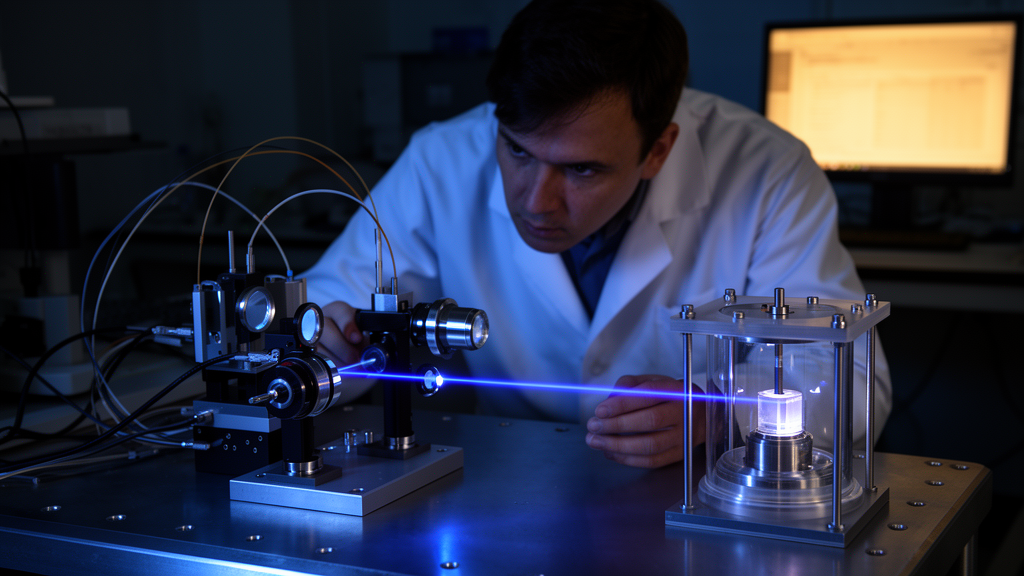
For half a century, the most precise clocks in existence have ticked using electrons. Caesium fountains define the second, and optical atomic clocks now keep time so accurately that they would drift by less than a second over the age of the universe. Yet a small international team in China has now crossed a threshold that clockmakers have chased for decades: they have built a clock whose pendulum is not an electron cloud but an atomic nucleus. By locking a continuous-wave vacuum-ultraviolet laser to the famously elusive isomeric transition of thorium-229, researchers at Tsinghua University and their collaborators have demonstrated an operating nuclear clock, reporting a fractional frequency instability of 5 × 10⁻¹³ divided by the square root of the averaging time in seconds. The result, published in Nature, transforms the thorium-229 nucleus from a spectroscopic curiosity into a working frequency reference.
The reason nuclear clocks have been so hard to build lies in the sheer energy scale of nuclear physics. Almost all nuclear transitions sit at energies of kilo-electronvolts or higher, far beyond the reach of any conventional laser. Thorium-229 is the singular exception. Its lowest excited state, the isomer, lies astonishingly close to the ground state, so close that the transition falls in the vacuum ultraviolet at a wavelength of about 148.4 nanometres. That accident of nuclear structure makes thorium-229 the only known nucleus that can be addressed directly with laser light, opening the door to coherent quantum control of a nucleus and, crucially, to a clock in which the frequency reference is shifted from the electronic shell into the nucleus itself.
Decades of painstaking work established the existence and energy of this low-lying state, and recent years brought a cascade of breakthroughs: direct detection of the isomer, laser excitation of thorium-229 nuclei doped into calcium fluoride crystals, and precision frequency measurements using vacuum-ultraviolet frequency combs referenced to optical atomic clocks. Spectroscopy in crystalline hosts resolved the fine structure of the nuclear resonance, including quadrupole-split components, site-dependent shifts and temperature sensitivities. What remained missing was the final integration: a traceable, narrow-linewidth continuous-wave probe, a thorium-containing reference crystal, a fast and sensitive readout of the weak nuclear response, and a closed feedback loop that turns spectroscopy into timekeeping.
The new experiment supplies every one of those ingredients. The team generates continuous-wave 148.4-nanometre light by resonance-enhanced four-wave mixing in cadmium vapour. Two 375-nanometre photons drive a two-photon resonance in cadmium atoms, and a 710-nanometre photon completes the sum-frequency process, producing 10 microwatts of vacuum-ultraviolet radiation with an estimated linewidth below one hertz. The 375-nanometre light itself comes from second-harmonic generation of a fibre laser in a bow-tie enhancement cavity, while both fundamental lasers are phase-locked to a self-referenced erbium-fibre frequency comb. That comb, in turn, is anchored to a cryogenic-silicon-cavity-stabilized laser at 1397 nanometres and counted against a hydrogen maser, giving the vacuum-ultraviolet frequency absolute traceability.
Equally impressive is the crystal work. Thorium-229 is severely scarce, and the team grew their best crystal, dubbed TS1, from a solution containing only 1.4 micrograms, or 10 kilobecquerels, of the isotope, leaving essentially no room for iterative optimization. Using a temperature-gradient technique in which crystallization is driven by slowly cooling the heater rather than moving the crucible, they produced a bubble-free cylinder 1.09 millimetres in diameter and 4.94 millimetres long, with a thorium concentration of 2.2 × 10¹⁷ per cubic centimetre and a vacuum-ultraviolet transmission of 7 percent. In fluorescence and absorption spectroscopy, the crystal revealed a broad quadrupole-unresolved structure alongside a quadrupole-resolved manifold of five narrow transitions, including the line, known as line b, that serves as the clock reference. The excited-state lifetime measured 631 seconds, an extraordinarily long memory for a nuclear excitation.
Turning that spectroscopy into a clock required a clever readout. Because the on-resonance fractional absorption of the light is tiny, roughly 10⁻⁴, the team modulated the laser frequency sinusoidally and demodulated the transmitted signal with a lock-in amplifier, producing a dispersive error signal whose zero crossing marks the line centre. Detector choice proved decisive. A photomultiplier tube saturated at a few nanowatts of transmitted light, but a simple phototube operated in direct-photocurrent mode tolerated far more power. Combined with the higher-transmission TS1 crystal, the phototube readout boosted the detected photoelectron rate roughly thirtyfold and raised the one-second absorption signal-to-noise ratio about twentyfold compared with the initial configuration.
With the discriminator in hand, closing the loop was straightforward in principle: each cycle, the measured detuning is fed back through an acousto-optic modulator in the comb-referenced optical chain, steering the vacuum-ultraviolet frequency onto the nuclear resonance. The performance improved step by step as the detection scheme and crystal were upgraded, with fitted instabilities falling from 1 × 10⁻¹¹ per root second to 6 × 10⁻¹² and then 2 × 10⁻¹². After further optimization, raising the transmitted power to 350 nanowatts, increasing the measurement duty cycle to about 85 percent, and using a near-optimal modulation amplitude of 12 kilohertz, the clock reached its final instability of 5 × 10⁻¹³ per root second, averaging down toward the 10⁻¹⁵ level. That figure sits within a factor of two of the photon-shot-noise limit calculated from the measured discriminator parameters, meaning the clock is already operating close to the fundamental floor imposed by the quantum statistics of the detected light itself.
Just as important as the instability is the reproducibility of the clock transition. The team compared the centre frequency of line b in two independently fabricated crystals and found agreement at the 10⁻¹³ level, a fractional difference of 2.8 × 10⁻¹³. They then compared their measurements with previous vacuum-ultraviolet-comb data from JILA on entirely different crystals, evaluating the published temperature-dependent fit at their own crystal temperature of 301.4 kelvin. The offsets, −0.50 kilohertz and +0.06 kilohertz respectively, are both consistent with zero within the combined uncertainties. Systematic shifts were kept firmly under control: temperature fluctuations of 3 millikelvin correspond to frequency fluctuations of only about 6 hertz, and residual magnetic fields, suppressed by multilayer shielding, contribute less than 1 hertz of Zeeman shift.
A near-simultaneous independent report has demonstrated thorium-229 clock operation using a different vacuum-ultraviolet source based on randomly quasi-phase-matched strontium tetraborate, underscoring how rapidly the field is converging. The implications stretch well beyond metrology. Because the nucleus is shielded by the electron cloud, nuclear transition frequencies are predicted to be extraordinarily sensitive probes of variations in fundamental constants such as the fine-structure constant, making thorium-229 clocks potential detectors of new physics. And because a solid-state host packs a macroscopic number of nuclei into a crystal the size of a grain of rice, the platform points toward compact, robust, field-deployable frequency references and nuclear quantum sensors that no ion-trap clock could match.
There is still a long road to clocks that rival the best optical atomic standards, which already reach instabilities and accuracies in the 10⁻¹⁸ regime. The present device averages with a 10⁻¹³-level instability, limited by the weak absorption of the nuclear transition and the available vacuum-ultraviolet power. But the conceptual barrier has fallen: laser-addressed nuclei are now operational clock references, not proposals. The thorium-229 nucleus, hidden inside its calcium fluoride host, has joined the ranks of pendulums, quartz crystals and caesium atoms as a keeper of time, and with it comes a new window onto the deepest constants of nature.
Subject of Research: A solid-state nuclear clock based on the laser-locked 229Th isomeric transition
Article Title: A nuclear clock synchronized to 229Th
Article References: Huang, B., Yan, G., Xiao, Q., Bu, W., Zhao, C., Zhang, Z., Yan, C., Chen, Z.-A., Zhang, P., Penyazkov, G., Zhan, Z., Yan, L., Wang, Y., Li, L., Li, S., Jiang, D., Qian, X., Liu, X., He, Q., … Ding, S. (2026). A nuclear clock synchronized to 229Th. Nature. https://doi.org/10.1038/s41586-026-11122-1
Image Credits: AI Generated
DOI: 10.1038/s41586-026-11122-1
Keywords: nuclear clock, thorium-229, vacuum ultraviolet laser, frequency metrology, CaF2 crystal, isomeric transition, atomic clocks, precision spectroscopy, fundamental constants, four-wave mixing, quantum sensing, nuclear
Cite Scienmag News
Katie Riggs. (October 9, 2026). Physicists Build First Working Nuclear Clock Locked to Thorium-229. Scienmag. https://scienmag.com/physicists-build-first-working-nuclear-clock-locked-to-thorium-229/
Katie Riggs. "Physicists Build First Working Nuclear Clock Locked to Thorium-229." Scienmag, 9 October 2026, https://scienmag.com/physicists-build-first-working-nuclear-clock-locked-to-thorium-229/. Accessed 9 October 2026.
Katie Riggs. "Physicists Build First Working Nuclear Clock Locked to Thorium-229." Scienmag. October 9, 2026. https://scienmag.com/physicists-build-first-working-nuclear-clock-locked-to-thorium-229/


