


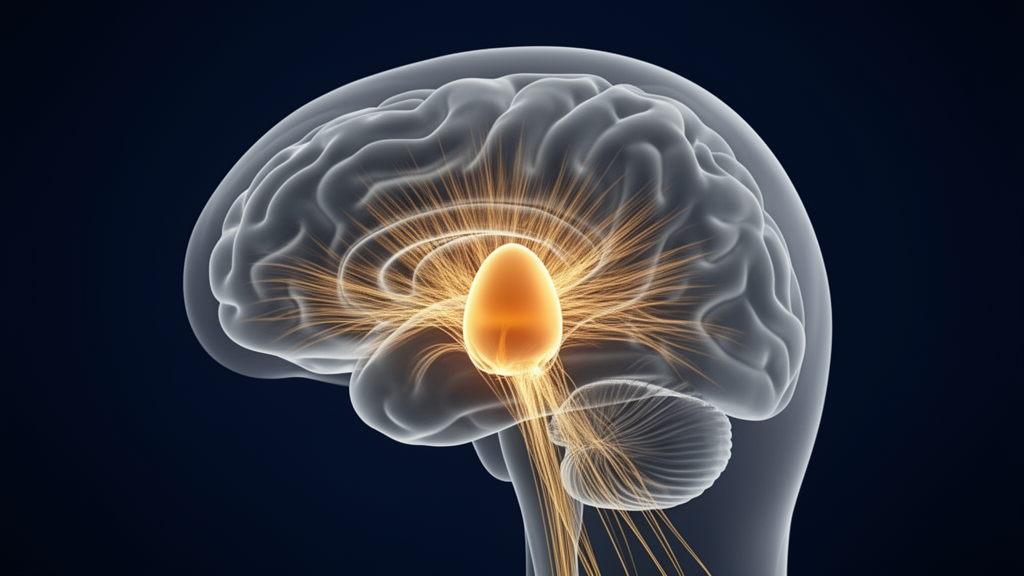
Deep in the brain, a walnut-sized structure called the thalamus acts as the gatekeeper for nearly everything we see, hear, and feel. For decades, neuroscientists have known that this relay station does far more than passively forward signals from the senses to the cortex; it actively filters, shapes, and sometimes blocks the flood of information streaming in from the outside world. What has remained stubbornly unclear is how the thalamus decides, moment to moment, which signals to let through and which to suppress. A new computational study published in PLOS Computational Biology by Kees McGahan, Michelle McCarthy, and Nancy Kopell offers a striking answer: the answer lies in the thalamic cell’s dynamic state, a set of distinct firing regimes that the neuron shifts between depending on chemical signals arriving from the cortex and the brainstem.
The research team built a biophysically detailed model of a single thalamocortical neuron in the lateral geniculate nucleus, the thalamic structure that relays visual information from the retina to the visual cortex. Crucially, every ionic current included in the model was verified against expression data drawn from publicly available datasets, meaning the simulated neuron was constrained by what is actually known to exist in real thalamic cells. This rigor matters because computational neuroscience has often been criticized for producing models that can reproduce a phenomenon only by invoking biologically implausible parameters. By anchoring each conductance to measured expression levels, the authors created what they describe as the first model of its kind capable of producing five experimentally established, distinct dynamic firing regimes within a single, coherent framework.
Those five regimes are not arbitrary mathematical curiosities. Each corresponds to a firing pattern that electrophysiologists have actually recorded from thalamic neurons, ranging from the slow, synchronized bursts characteristic of deep sleep and drowsiness to the tonic, single-spike firing associated with alert wakefulness. The model demonstrates that the thalamocortical cell transitions between these states in response to two families of neuromodulatory inputs: glutamatergic signals descending from the cortex, which can open the gate for specific sensory information, and cholinergic arousal signals ascending from the brainstem, which broadly shift the thalamus into a wake-compatible operating mode. In this view, the thalamus is less like a static switchboard and more like a dynamically tuned filter whose settings are continuously adjusted by the rest of the brain.
The heart of the study concerns what happens in the dynamic states associated with the awake thalamic alpha rhythm, an oscillation in the 8 to 12 hertz range that dominates the electrical activity of the awake, resting brain. Alpha rhythms have long puzzled researchers: they are robustly present during quiet wakefulness, yet their functional role has been contested for nearly a century. Some have dismissed alpha as an epiphenomenon, a byproduct of idle neural circuitry with no causal significance. The new model suggests a subtler picture. In the alpha-bursting state, the ability of retinal inputs to generate thalamic spikes depends on a delicate balance among three factors: the precise timing of incoming retinal spikes, an excitability brake imposed by the M-current, and the decay time of the L-type calcium current.
Each of these three players deserves attention. The M-current is a potassium current, carried by channels of the KCNQ family, that activates slowly and persistently, effectively clamping the membrane and resisting sudden depolarization. It acts as a kind of rheostat on the cell’s excitability, preventing the neuron from firing too readily in response to transient inputs. The L-type calcium current, by contrast, is a high-threshold calcium conductance that activates when the cell is sufficiently depolarized and then lingers, decaying over a timescale that shapes how the neuron responds to rhythmic drive. When retinal spikes arrive at the right moment relative to the interplay of these two currents, they can push the thalamocortical cell over threshold and trigger a burst of output; when they arrive at the wrong moment, the same input is filtered out. The alpha rhythm, in this framework, is not itself doing the gating but rather marks the ongoing interaction between the M-current and the L-type calcium current, serving as an indirect signature of the cell’s filtering state.
This reframing of alpha as an indirect causal marker rather than a direct mechanism is one of the study’s most provocative implications. It suggests that when electroencephalographers observe strong alpha oscillations over the visual cortex, they are witnessing the outward trace of an internal tug-of-war between ionic currents that determines how much visual information the thalamus is willing to transmit. The finding could help reconcile decades of seemingly contradictory results about whether alpha reflects suppression or facilitation of perception. In the model, both interpretations capture part of the truth: the alpha state is a genuine working mode of the thalamus, one in which transmission is possible but tightly constrained by timing, neither the wide-open relay of full attention nor the near-total blockade of sleep.
Beyond the alpha rhythm, the authors explored how the thalamus handles extra-retinal rhythmic inputs, signals that arrive from other brain regions rather than from the eyes. The model produces entrainment to slower rhythms, both inhibitory and excitatory, meaning the thalamic cell can lock its firing to periodic drives at frequencies below its own natural oscillation. More intriguingly, the simulations detail the importance of nesting faster frequency rhythms within slow cycles for successful thalamic transmission. When a fast oscillation is embedded inside a slower one, the slow cycle effectively opens windows of opportunity during which the fast rhythm can drive thalamic spikes. This nesting principle, sometimes called cross-frequency coupling, has been observed across the brain, and the new work provides a concrete biophysical account of how a single thalamic neuron can implement it through the dynamics of its own membrane currents.
Because the model is constrained by verified expression data, it does more than reproduce known phenomena; it generates testable predictions. The authors highlight several. The model predicts how rhythmic dynamics in the thalamus should change under different arousal states, offering experimenters specific patterns to look for as animals transition from drowsy to alert. It predicts how the thalamus controls retinogeniculate transmission, the precise relay from retina to visual cortex, under different combinations of cortical and brainstem drive. And it points toward possible impacts of neurological disorders on thalamic processing, with schizophrenia singled out as a condition in which thalamic filtering and thalamocortical rhythms are thought to be disrupted. If the balance between the M-current and the L-type calcium current is altered in disease, the model provides a framework for understanding how such alterations would propagate into changes in perception and cognition.
The implications reach further still. The lateral geniculate nucleus is often treated as a special case, a sensory relay studied for its convenience and the precision of its inputs. But the thalamus contains many nuclei, including higher-order thalamic nuclei that participate in complex cognitive processes rather than simple sensory relay. The authors note that variations of their model could be used to explore the functions of these higher-order nuclei, extending the framework from vision to attention, consciousness, and executive control. A modeling approach that ties a cell’s dynamic state to its information-filtering behavior, grounded in measured ion channel expression, could become a template for understanding how the entire thalamus negotiates between the competing demands of sensory fidelity and cortical context.
What emerges from this study is a vision of the thalamus as an active, state-dependent participant in perception, whose gatekeeping behavior is written in the language of ionic currents and neuromodulation. The awake alpha rhythm, far from being neural noise, appears to be the visible signature of a working state in which timing, excitability brakes, and calcium dynamics jointly decide what reaches the cortex. As computational models of this kind grow more faithful to biology, they promise not only to explain what we observe in the brain but to predict it, opening a path toward understanding, and perhaps eventually correcting, the thalamic dysfunctions that accompany disorders of perception and thought.
Subject of Research: Computational modeling of dynamic firing states and sensory filtering in lateral geniculate thalamocortical neurons
Article Title: Awake alpha bursting emerges as the dynamic working state in a lateral geniculate thalamocortical cell model
Article References: McGahan, K., McCarthy, M., & Kopell, N. (2026). Awake alpha bursting emerges as the dynamic working state in a lateral geniculate thalamocortical cell model. PLOS Computational Biology, 22(10), e1014654. https://doi.org/10.1371/journal.pcbi.1014654
Image Credits: AI Generated
DOI: 10.1371/journal.pcbi.1014654
Keywords: thalamus, lateral geniculate nucleus, alpha rhythm, computational neuroscience, M-current, L-type calcium current, thalamocortical relay, retinogeniculate transmission, arousal, schizophrenia, neuromodulation, cross-frequency coupling
Cite Scienmag News
Cassandra Pierce. (October 9, 2026). Awake Alpha Bursts Reveal the Thalamus’s Hidden Working State. Scienmag. https://scienmag.com/awake-alpha-bursts-reveal-the-thalamuss-hidden-working-state/
Cassandra Pierce. "Awake Alpha Bursts Reveal the Thalamus’s Hidden Working State." Scienmag, 9 October 2026, https://scienmag.com/awake-alpha-bursts-reveal-the-thalamuss-hidden-working-state/. Accessed 9 October 2026.
Cassandra Pierce. "Awake Alpha Bursts Reveal the Thalamus’s Hidden Working State." Scienmag. October 9, 2026. https://scienmag.com/awake-alpha-bursts-reveal-the-thalamuss-hidden-working-state/


