


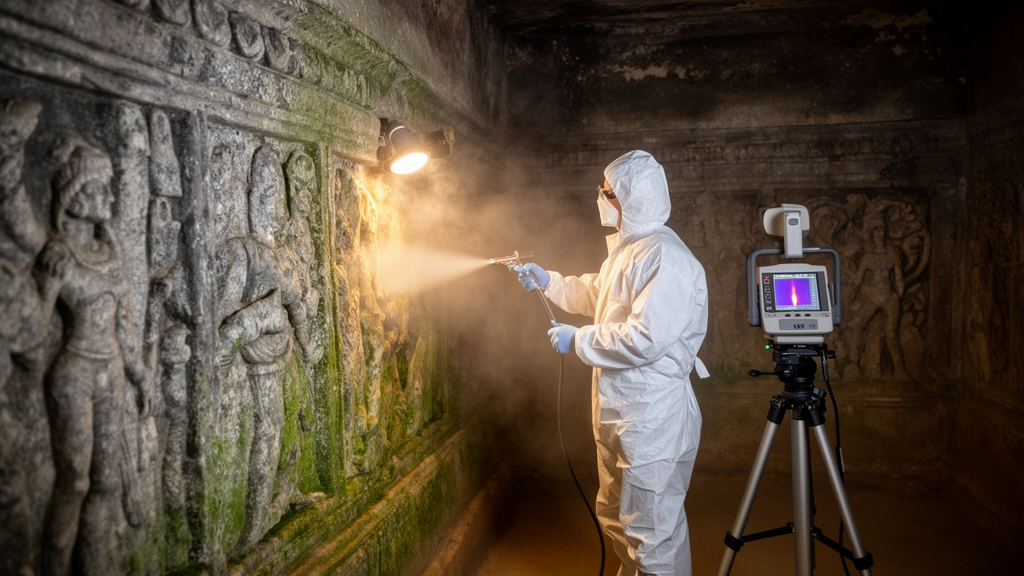
At the Tomb of Yue Fei, one of China’s most revered national heritage sites, conservators have long faced a deceptively simple question: when you clean a centuries-old stone surface, how do you prove the cleaning actually worked without harming the relic itself? A new study published in PLOS One by Ting Zhang, Sheng Ye, Liang Ye, and Zekai Qian offers a strikingly practical answer. The research team combined controlled steam cleaning with infrared thermography, a technique more familiar from industrial diagnostics and medical imaging, to evaluate the removal of surface contaminants from limestone relics. Their findings suggest that a thermal camera, pointed at a stone surface before and after treatment, can serve as a non-destructive arbiter of conservation quality, capturing evidence that the naked eye and even conventional colorimetry can miss.
The Tomb of Yue Fei commemorates the famous Song dynasty general whose loyalty has made him an enduring symbol in Chinese culture. Like many stone monuments exposed to decades, if not centuries, of open-air conditions, the site’s limestone surfaces carry a layered record of environmental and human interaction. The researchers catalogued five principal categories of contamination: dust accumulation from airborne particles, surface encrustation formed by mineral deposits, erosion patterns driven by water runoff, bioerosion caused by organisms such as lichens and microbial films, and anthropogenic graffiti left by visitors. Each of these pollutants interacts differently with the stone substrate, and each demands a cleaning approach calibrated to remove the deposit while preserving the original material beneath it.
Steam cleaning has gained favor among conservators because it relies on little more than heated water vapor, avoiding the aggressive solvents and mechanical abrasion that can permanently scar delicate stone. Yet the technique is not without risk. Steam delivered at excessive pressure, temperature, or proximity can drive moisture into pores, thermally shock the surface, or strip away original patina that carries historical information. To manage these variables, the team conducted field experiments using a steam cleaner whose operating parameters, including pressure, temperature, nozzle angle, working distance, and duration of application, were systematically controlled. By varying these inputs across treatment trials on different pollutant types, they could map which combinations produced effective cleaning and which pushed the stone toward damage.
The genuinely novel element of the study lies in its evaluation method. Rather than judging cleaning success solely by visual inspection, the researchers proposed analyzing temperature variation, denoted as T, measured by infrared thermography before and after treatment. The underlying physics is elegant: different surface materials and contaminants absorb, retain, and emit thermal energy in distinct ways. A stone surface coated with dust, encrustation, or biological film will display a different thermal signature than clean limestone. When steam treatment alters the surface, the corresponding change in its thermal response provides a quantitative, spatially resolved record of what was removed and how the substrate itself responded to the intervention.
To validate what the thermal camera was telling them, the team cross-checked their results with three complementary assessment techniques. Visual inspection provided the traditional conservator’s judgment, documenting obvious changes in appearance. Chromatic aberration measurement, which quantifies shifts in color between the pre-cleaning and post-cleaning states, offered an objective numerical index of how much the surface’s optical properties had changed. Microscopic imaging then allowed the researchers to examine the stone’s microstructure at magnification, confirming whether contaminants had been lifted away and, critically, whether the cleaning process had introduced scratches, pitting, or other substrate damage invisible at normal viewing distances. The convergence of these methods with the thermographic data strengthened confidence in the infrared approach.
The results were encouraging on both fronts of the conservation dilemma. Steam cleaning, applied with appropriately chosen parameters, effectively removed most of the contaminant categories identified at the site without causing significant damage to the limestone substrate. This is a meaningful finding for heritage practice, because limestone is a sedimentary rock whose calcite matrix can be vulnerable to both acidic agents and mechanical stress. The fact that a water-vapor-based method could handle everything from dust films to graffiti suggests that steam technology deserves a central place in the toolkit for maintaining stone monuments, particularly at sites that receive heavy visitor traffic and therefore accumulate anthropogenic soiling rapidly.
Equally valuable is the study’s practical output: a set of recommended steam cleaning parameters tailored to different pollutant types on limestone surfaces. This kind of parameter guidance addresses a chronic weakness in conservation practice, where treatment decisions have often depended on the individual experience and intuition of the conservator. By specifying, for each contamination class, the pressure, temperature, angle, distance, and duration ranges that produced safe and effective results in the field, the researchers have taken a concrete step toward standardized protocols. Standardization matters enormously in heritage science, because reproducible treatments allow results from one site to inform practice at another, and they reduce the risk that a well-intentioned cleaning becomes an irreversible loss of original material.
The thermographic evaluation method itself may prove to be the study’s most exportable contribution. Traditional post-cleaning assessment often relies on subjective visual comparison, which varies between observers and cannot detect subsurface or microstructural changes. Infrared thermography, by contrast, is fast, contactless, and produces full-field data across an entire treated area rather than sampling isolated points. For a nationally protected site like the Tomb of Yue Fei, where every intervention must be justified and documented, a tool that quantifies cleaning efficacy without touching the relic represents a significant advance. The method could, in principle, be adapted to other stone types and other cleaning technologies, from laser ablation to chemical poultices, provided the thermal signatures of the relevant materials are characterized.
The broader significance of this work extends beyond a single monument. Stone cultural relics worldwide face mounting pressures from urban air pollution, climate-driven moisture cycles, biological colonization, and the sheer volume of tourism. Conservation agencies increasingly seek methods that are both effective and verifiable, and studies like this one demonstrate that diagnostic technologies borrowed from other engineering fields can be repurposed for heritage applications. The combination of a gentle cleaning technology with a rigorous, non-destructive evaluation framework creates a closed loop: treat, measure, adjust, and treat again only as needed. That iterative, evidence-based workflow is precisely what international conservation charters have long demanded, and it is now demonstrably achievable with relatively affordable equipment.
For the Tomb of Yue Fei itself, the study offers a path toward preserving the physical fabric of a site that carries deep cultural and historical meaning for visitors from around the world. The limestone surfaces that have weathered centuries of exposure can now be cleaned with documented confidence that the original stone survives intact, and each future intervention can be recorded thermally, building a longitudinal archive of the monument’s condition. As the researchers conclude, their findings validate infrared thermography as a feasible non-destructive evaluation tool for cleaning efficacy and contribute to the development of standardized conservation protocols for stone heritage. In a field where every scrape of the surface is history that cannot be recovered, the ability to see, in thermal detail, exactly what a cleaning accomplished may prove as important as the cleaning itself.
Subject of Research: Non-destructive infrared thermographic evaluation of steam cleaning for stone relic conservation
Article Title: Infrared thermographic evaluation of cleaning stone relics at tomb of Yue Fei
Article References: Zhang, T., Ye, S., Ye, L., & Qian, Z. (2026). Infrared thermographic evaluation of cleaning stone relics at tomb of Yue Fei. PLOS One, 21(10), e0359835. https://doi.org/10.1371/journal.pone.0359835
Image Credits: AI Generated
DOI: 10.1371/journal.pone.0359835
Keywords: infrared thermography, steam cleaning, stone conservation, cultural heritage, Tomb of Yue Fei, limestone, non-destructive testing, chromatic aberration, bioerosion, graffiti removal, PLOS One, conservation science
Cite Scienmag News
Courtney Benton. (October 9, 2026). Steam and Infrared Cameras Team Up to Restore China’s Ancient Stone Tomb. Scienmag. https://scienmag.com/steam-and-infrared-cameras-team-up-to-restore-chinas-ancient-stone-tomb/
Courtney Benton. "Steam and Infrared Cameras Team Up to Restore China’s Ancient Stone Tomb." Scienmag, 9 October 2026, https://scienmag.com/steam-and-infrared-cameras-team-up-to-restore-chinas-ancient-stone-tomb/. Accessed 9 October 2026.
Courtney Benton. "Steam and Infrared Cameras Team Up to Restore China’s Ancient Stone Tomb." Scienmag. October 9, 2026. https://scienmag.com/steam-and-infrared-cameras-team-up-to-restore-chinas-ancient-stone-tomb/


