


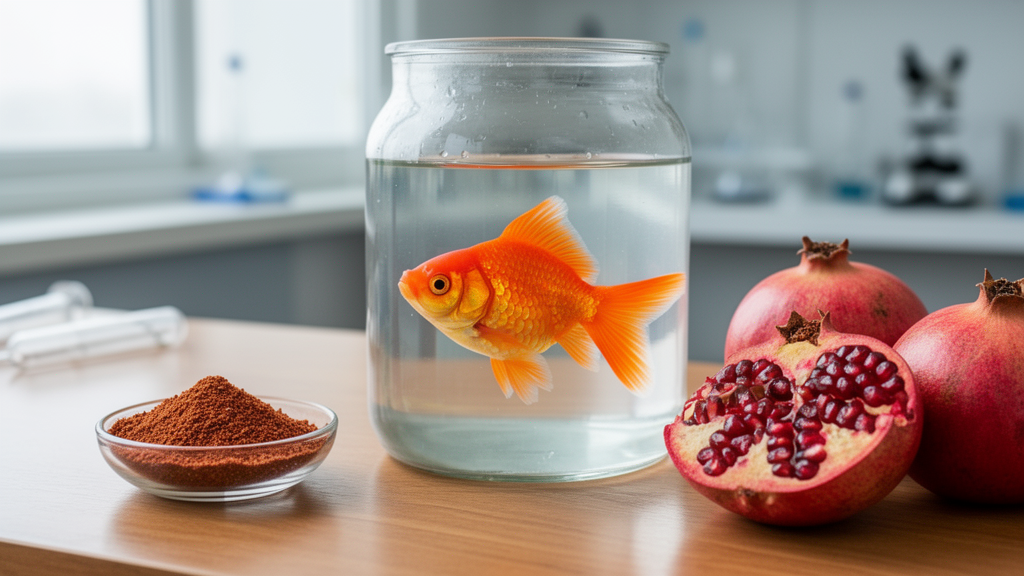
Every year, the global juice industry strips millions of tonnes of pomegranates of their skins and throws them away. Those peels, however, are loaded with polyphenols, tannins, and flavonoids, including punicalagin and ellagic acid, compounds that have long attracted attention for their antioxidant and immunomodulatory properties. A new preliminary study published in Discover Animals suggests that this overlooked agricultural waste could become a powerful functional feed additive in aquaculture, with the potential to strengthen fish immune systems, reduce oxidative stress, and even improve reproductive performance.
Researchers at Gorgan University of Agricultural Sciences and Natural Resources in Iran, led by Delara Sepehrfar, fed goldfish (Carassius auratus) diets supplemented with pomegranate peel powder, or PPP, at inclusion levels of 1, 2, and 4 percent for 70 days. A control group received the basal commercial diet without any supplementation. The team distributed 240 goldfish, each weighing roughly 17 grams at the start, across twelve tanks with three replicate tanks per treatment. Water quality was tightly controlled throughout the trial, with temperature held at 25 degrees Celsius, dissolved oxygen above 6 milligrams per litre, and pH between 7.5 and 8.0. The work was approved by the university’s ethics committee and conducted in accordance with the ARRIVE guidelines for animal research.
Before the feeding trial began, the researchers chemically characterised the pomegranate peel powder using high-performance liquid chromatography. The analysis revealed a remarkably rich bioactive profile: a total phenolic content of 187 milligrams of gallic acid equivalents per gram, along with measurable quantities of punicalagin alpha at 24.8 milligrams per 100 grams and ellagic acid at 6.7 milligrams per 100 grams. These compounds are the chemical workhorses behind the peel’s reputation as a potent antioxidant, capable of scavenging free radicals and modulating endogenous defence pathways in living tissue.
The results, published on 9 October 2026, point to a striking dose-dependent pattern, with the strongest effects concentrated at the 4 percent inclusion level. Fish fed the highest dose of PPP showed a significant increase in total white blood cell counts, rising from 10.53 to 14.16 thousand cells per microlitre compared with controls. Serum lysozyme activity, a key marker of innate antibacterial defence, climbed from 32.85 to 51.62 units per millilitre, while total immunoglobulin concentration increased from 22.02 to 35.09 milligrams per decilitre. Notably, the differential leukocyte counts remained unchanged, suggesting that PPP stimulates overall leukocyte production rather than selectively expanding particular immune cell populations.
The antioxidant findings were equally compelling. Malondialdehyde, or MDA, a well-established marker of lipid peroxidation and oxidative damage, dropped by roughly half in the 4 percent PPP group, falling from 8.42 to 4.18 nanomoles per millilitre. At the same time, the activities of the enzymatic antioxidants superoxide dismutase and catalase rose significantly, and levels of reduced glutathione, the cell’s principal non-enzymatic antioxidant, more than doubled. Together, these shifts indicate that dietary PPP bolsters both arms of the antioxidant defence system, protecting cellular membranes, proteins, and nucleic acids from reactive oxygen species generated during normal metabolism and stress.
Serum biochemistry told a complementary story. Total protein and albumin concentrations increased markedly in the highest-dose group, while the activities of the liver enzymes aspartate aminotransferase and alkaline phosphatase declined, patterns consistent with improved hepatic function and protein synthesis. Cholesterol, triglycerides, and glucose all showed downward trends, although these did not reach statistical significance. Interestingly, alanine aminotransferase fell significantly at the 2 percent dose but returned toward control levels at 4 percent, a non-linear response the authors suggest could reflect complex dose-dependent effects of polyphenols on hepatic metabolism.
Perhaps the most eye-catching results concerned reproduction. After the feeding period, broodstock were injected with human chorionic gonadotropin to synchronise gamete maturation. Males fed 4 percent PPP produced sperm at significantly higher concentrations, with greater spermatohematocrit, longer motility duration, and a higher percentage of motile cells than controls. Females on the same diet produced larger eggs with more yolk space, achieved a fertilisation rate of 93.16 percent versus 88.26 percent in controls, and showed a gonadosomatic index of 5.33 percent compared with 3.36 percent. Relative fecundity jumped from roughly 1,237 to 2,066 oocytes per gram of body weight, and gonad weight more than doubled. The authors propose that the antioxidant protection afforded by PPP may safeguard gametes from oxidative damage, while certain phenolics such as ellagic and syringic acids may interact with endocrine pathways involved in vitellogenin synthesis and oocyte maturation.
Not every parameter responded. Mucosal immune markers measured in skin mucus, including lysozyme, alkaline phosphatase, and total immunoglobulin, showed positive numerical trends but no statistically significant differences among treatments. The authors suggest that the 70-day feeding period may have been too short, that inter-individual variability in mucosal responses was high, or that polyphenol metabolites simply do not reach mucosal surfaces in sufficient concentrations. Red blood cell counts, haematocrit, and haemoglobin were also unaffected, which the researchers interpret as evidence that PPP does not disrupt erythropoiesis at the tested doses.
The team is careful to frame these findings as preliminary and hypothesis-generating rather than definitive. The experimental diets were not formulated to be isonitrogenous or isoenergetic, meaning that adding PPP altered the overall protein, fat, and fibre content of the feed, so some metabolic changes could reflect altered nutrition rather than PPP bioactivity alone. The commercial basal diet may also have contained undisclosed additives that could interact with the supplement. All broodstock received HCG injections, so the reproductive gains might partly reflect enhanced responsiveness to the hormone rather than direct effects on reproductive physiology. Only three replicate tanks per treatment limited statistical power, no disease challenge test was performed, and no positive control such as vitamin E or beta-glucan was included for comparison.
Despite these caveats, the consistency of the responses across immune, antioxidant, metabolic, and reproductive endpoints lends weight to the idea that pomegranate peel could serve as a sustainable, multi-functional feed ingredient. Because the peel is an abundant, low-cost by-product that would otherwise be discarded, its use aligns with circular economy principles and could reduce reliance on synthetic additives at a time when antimicrobial resistance and environmental contamination have made the aquaculture industry eager for phytogenic alternatives. The authors call for confirmatory trials using semi-purified, nutritionally standardised diets, wider dose ranges, molecular measurements of cytokines and reproductive hormones, and pathogen challenge studies. If those trials bear out the preliminary signals, the humble pomegranate peel, currently destined for the landfill, may find a second life boosting the health and fertility of farmed fish around the world.
Subject of Research: Effects of dietary pomegranate peel powder supplementation on immunity, antioxidant status, and reproduction in goldfish
Article Title: Preliminary evaluation of dietary pomegranate (Punica granatum) peel powder effects on systemic immunity, antioxidant status, and reproductive performance in goldfish (Carassius auratus)
Article References: Sepehrfar, D., Sudagar, M., Siahkalroodi, S. Y., & Jafarnodeh, A. (2026). Preliminary evaluation of dietary pomegranate (Punica granatum) peel powder effects on systemic immunity, antioxidant status, and reproductive performance in goldfish (Carassius auratus). Discover Animals, 3(1), Article 102. https://doi.org/10.1007/s44338-026-00262-3
Image Credits: AI Generated
DOI: 10.1007/s44338-026-00262-3
Keywords: pomegranate peel, goldfish, aquaculture, immunity, antioxidant, oxidative stress, reproductive performance, phytogenic feed additive, polyphenols, Carassius auratus, functional feed, fish nutrition
Cite Scienmag News
Kristina Jarvis. (October 9, 2026). Pomegranate Peel Powder Boosts Immunity and Fertility in Goldfish, Study Finds. Scienmag. https://scienmag.com/pomegranate-peel-powder-boosts-immunity-and-fertility-in-goldfish-study-finds/
Kristina Jarvis. "Pomegranate Peel Powder Boosts Immunity and Fertility in Goldfish, Study Finds." Scienmag, 9 October 2026, https://scienmag.com/pomegranate-peel-powder-boosts-immunity-and-fertility-in-goldfish-study-finds/. Accessed 9 October 2026.
Kristina Jarvis. "Pomegranate Peel Powder Boosts Immunity and Fertility in Goldfish, Study Finds." Scienmag. October 9, 2026. https://scienmag.com/pomegranate-peel-powder-boosts-immunity-and-fertility-in-goldfish-study-finds/


