


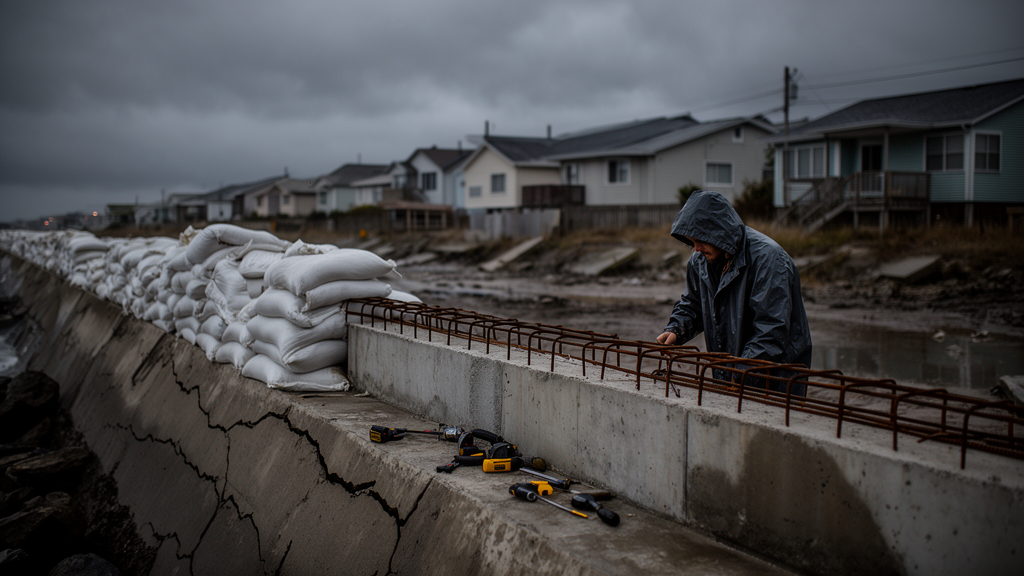
Adaptation to climate change is quietly failing, and not primarily because of engineering shortfalls or scientific uncertainty. According to a new argument published in the journal PLOS Climate by an interdisciplinary team led by Helen Adams of King’s College London and Giovanna Gini, the dominant model of adaptation is trapped in a costly cycle: governments and institutions spend ever-larger sums protecting existing infrastructure, assets and ways of life from worsening hazards, while the underlying vulnerabilities that turn hazards into disasters remain untouched. The researchers contend that this trajectory is not merely inefficient but structurally doomed, because it collides head-on with the fiscal austerity that defines the political economy of many countries today. Their provocative conclusion is that adaptation must be reframed as a political force for social change, one that challenges the logic of austerity itself rather than accommodating it.
The technical core of the problem, as the authors describe it, lies in what economists would recognize as a maladaptive investment pattern. When adaptation budgets are directed toward defending the status quo—raising sea walls, hardening flood defenses, retrofitting drainage systems—each successive intervention tends to cost more than the last as climate hazards intensify. Meanwhile, the social determinants of vulnerability, such as degraded housing, precarious livelihoods and weakened public services, continue to accumulate risk beneath the surface. The team argues that this gap between spending and genuine risk reduction is widened dramatically by austerity programs, which have hollowed out the public infrastructure, civic services and shared spaces that historically buffered societies against shocks. In their framing, austerity is not a neutral fiscal backdrop to adaptation; it is an active generator of vulnerability.
This diagnosis draws attention to a mechanism that is often invisible in hazard modeling: the slow, everyday erosion of societal resilience. Cuts to local government budgets, maintenance backlogs on public assets, and the closure of libraries, community centers and social services do not appear in flood maps or heatwave projections, yet they determine how badly a community fares when a hazard strikes. The authors describe this as an everyday lack of opportunity, a condition in which people have neither the material resources nor the institutional support to prepare for, respond to and recover from climate impacts. Neglected infrastructure and thinned-out civic life create a population that is fragile not only to extreme events but to ordinary stresses, and this fragility compounds with every budget cycle that prioritizes short-term savings over long-term capacity.
The researchers’ central claim is therefore stark: without addressing economic austerity, the viability of current approaches to adaptation is severely compromised. This is a challenge to the prevailing technocratic consensus, in which adaptation is treated as a portfolio of engineering projects and policy instruments that can be scaled up given sufficient finance. Instead, Adams and her colleagues—whose team includes climate scientists, engineers, social scientists and practitioners such as Richard Dawson, Hayley Fowler, Shona Paterson and Ruth Wolstenholme—argue that the binding constraint is not knowledge or technology but the political and economic values that decide whose safety is worth investing in. Adaptation planning that ignores this reality, they suggest, will continue to produce rising costs and deepening inequality regardless of how sophisticated the underlying science becomes.
What would a viable alternative look like? The authors propose that shifting societal values, norms and objectives in decision-making must become central to adaptation, rather than an afterthought. In practical terms, this means that the goals of adaptation policy should be negotiated openly with the communities they affect, and that those goals should extend beyond hazard response to encompass investment in people and the advancement of their wellbeing. Adaptation, in this reframing, still includes concrete measures against floods, storms and heat, but it also becomes a vehicle for restoring public services, rebuilding civic spaces and expanding the opportunities available to vulnerable populations. The return on such investment is measured not only in avoided damages but in the strengthened social fabric that allows communities to absorb shocks.
A crucial element of this vision is the amplification of the political voice of communities who often lack the power to effect change. The authors point out that adaptation decisions are typically made by institutions—national governments, municipal authorities, development banks—that are far removed from the lived experience of climate vulnerability. When those institutions operate under austerity mandates, the communities most exposed to climate hazards are frequently the least represented in the rooms where budgets are allocated. Redressing this imbalance is not, in the authors’ view, a matter of procedural nicety; it is a precondition for cost-effective adaptation, because local knowledge about how vulnerability is produced and maintained is essential for designing interventions that actually reduce risk rather than displace it onto the marginalized.
The argument carries significant implications for how adaptation finance is conceptualized and measured. If the true drivers of climate vulnerability include austerity-induced degradation of public systems, then counting only expenditures on physical defenses dramatically understates both the need and the opportunity. Investment in people—through health care, education, social protection and participatory planning—functions as adaptation in the fullest sense, building the adaptive capacity that allows societies to reorganize in the face of unavoidable change. The authors suggest that this broader portfolio is likely to be more cost-effective and to produce a more orderly form of adaptation than the current pattern of escalating defensive spending, because it addresses the root conditions that convert hazards into catastrophes.
The timing of this intervention is notable. As climate impacts accelerate, adaptation has moved from the margins of climate policy to its center, with international frameworks calling for scaled-up finance and national governments drafting increasingly detailed adaptation plans. Yet the PLOS Climate authors warn that scaling up the current model simply scales up its flaws: more money channeled into protecting the status quo, under political conditions that are simultaneously dismantling the social infrastructure on which resilience depends. By naming austerity as a central obstacle, the paper connects climate adaptation to debates about public spending, inequality and democratic participation that are usually treated as separate policy domains. In doing so, it reframes adaptation not as a technical appendage to climate mitigation but as a political project in its own right.
For researchers, the paper opens a concrete agenda: measuring how fiscal policy shapes climate vulnerability, tracing the pathways by which cuts to public services translate into disaster losses, and testing whether participatory decision-making genuinely produces more durable adaptation outcomes. For practitioners and policymakers, the message is more immediate. Every adaptation plan drafted under austerity assumptions, the authors imply, is built on sand, because the societal capacity it presupposes is being actively eroded. The choice they present is between an adaptation regime that grows ever more expensive while protecting an increasingly fragile status quo, and one that treats the climate crisis as an impetus for social transformation—investing in people, redistributing political voice, and challenging the economic orthodoxy that has made societies vulnerable in the first place. Adaptation, they conclude, can be a catalyst for social change, but only if it is allowed to become one.
Subject of Research: The relationship between climate change adaptation, fiscal austerity and social change
Article Title: Adaptation as a catalyst for social change
Article References: Adams, H., Gini, G., Dawson, R., Fowler, H., Jenkins, K., Jones, S., Krishnamoorthy, S., Pant, R., Paterson, S., Toney, J., Yule, E., Witton, R., & Wolstenholme, R. (2026). Adaptation as a catalyst for social change. PLOS Climate, 5(9), e0001052. https://doi.org/10.1371/journal.pclm.0001052
Image Credits: AI Generated
DOI: 10.1371/journal.pclm.0001052
Keywords: climate adaptation, austerity, social change, vulnerability, resilience, PLOS Climate, adaptation finance, public infrastructure, community voice, climate policy, adaptive capacity, wellbeing
Cite Scienmag News
Sloane Callahan. (October 9, 2026). Climate Adaptation Fails While Austerity Strips Communities of Resilience, Researchers Warn. Scienmag. https://scienmag.com/climate-adaptation-fails-while-austerity-strips-communities-of-resilience-researchers-warn/
Sloane Callahan. "Climate Adaptation Fails While Austerity Strips Communities of Resilience, Researchers Warn." Scienmag, 9 October 2026, https://scienmag.com/climate-adaptation-fails-while-austerity-strips-communities-of-resilience-researchers-warn/. Accessed 9 October 2026.
Sloane Callahan. "Climate Adaptation Fails While Austerity Strips Communities of Resilience, Researchers Warn." Scienmag. October 9, 2026. https://scienmag.com/climate-adaptation-fails-while-austerity-strips-communities-of-resilience-researchers-warn/


