


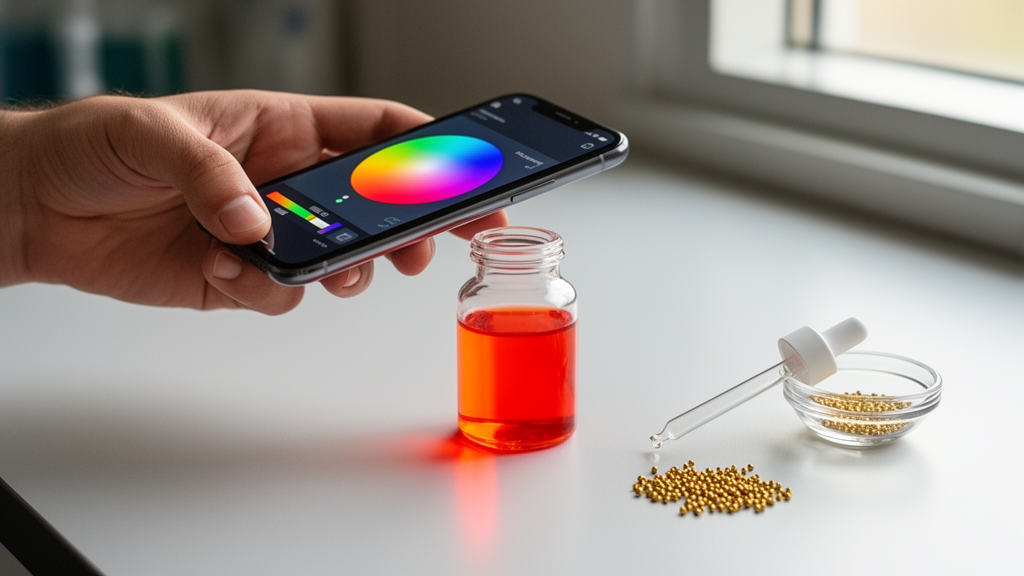
A team of chemists in India has built a pesticide sensor out of two of the most familiar objects in modern life: a vial of gold nanoparticles and a smartphone. In work published in Discover Chemistry, researchers led by Nidhi Kumari and Satish Kumar of St. Stephen’s College, University of Delhi, together with Rajesh Kumar of the Defence Laboratory in Jodhpur and M. Thirumal of the University of Delhi, showed that citrate-capped gold nanoparticles change color in the presence of ethion, one of the most widely used organophosphorus insecticides in agriculture. The shift from wine red to blue is dramatic enough to see with the naked eye, but the real innovation lies in what happens next. By photographing the vial with an ordinary iPhone and analyzing the pixel intensities of the image, the team converted a simple color change into a quantitative measurement of pesticide concentration, achieving detection limits that rival conventional laboratory instrumentation.
The target molecule, ethion, is a small lipophilic organophosphate with the chemical formula C9H22O4P2S4, applied to crops to control aphids, mites, and other insect pests. Like other organophosphorus pesticides, it works by inhibiting cholinesterase enzymes, blocking nerve transmission in insects and, at sufficient doses, in humans as well. Acute exposure is associated with skin irritation, nausea, headaches, and dizziness, while chronic exposure has been linked to cancer and neurological disorders. The mechanism underlying this toxicity involves reactive oxygen species: pesticides drive their overproduction, overwhelming cellular antioxidants and generating oxidative stress that damages cells and disrupts signaling pathways. The United Nations Environment Programme and the World Health Organization have estimated that pesticide exposure accounts for roughly three million cases of poisoning in developing countries, making cheap and accessible detection tools a genuine public health priority.
The ecological toll of ethion extends well beyond human health. Previous studies cited by the team found that the compound reduces enzyme activity in honeybees, increases mortality, and disrupts pollination, while fish exposed to ethion exhibited slowed swimming, reduced gill movement, and loss of body coloration, with effects worsening over time and dose. Although organophosphorus pesticides generally decompose relatively quickly in the environment, they persist in soil and leach into groundwater, meaning contamination can linger in the water and food that people actually consume. Conventional detection methods, including gas and liquid chromatography, nuclear magnetic resonance and mass spectrometry, fluorescence spectroscopy, ELISA, and electrochemical sensing, are accurate but demand expensive instruments, specialized personnel, and considerable time. What has been missing, the researchers argue, is a technique simple enough for anyone to perform anywhere.
The sensor’s active ingredient is a colloid of spherical gold nanoparticles prepared by the Turkevich method, a synthesis first developed decades ago and still prized for its reliability. The team dissolved chloroauric acid in boiling distilled water and rapidly added a solution of trisodium citrate, which serves simultaneously as the reducing agent that converts Au3+ to metallic Au0 and as the stabilizing cap that keeps the growing particles dispersed. Within twenty minutes of boiling, the pale yellow solution turned wine red, the signature of well-formed gold nanoparticles. That color arises from localized surface plasmon resonance, the collective oscillation of conduction electrons that absorb light near 520 nanometers. Because this resonance is exquisitely sensitive to the distance between particles, any process that pulls nanoparticles together produces an immediate and visible color change, making plasmonic gold colloids ideal platforms for colorimetric sensing.
The chemical logic of the ethion sensor hinges on sulfur. Ethion contains phosphorus-sulfur and sulfur-sulfur bonds, and sulfur atoms have a strong affinity for gold surfaces. When ethion molecules encounter the citrate-capped nanoparticles, the sulfur atoms displace citrate ions from the surface, dismantling the electrostatic repulsion that keeps the particles apart. As the particles aggregate, their plasmon resonance red-shifts dramatically toward 700 nanometers, and the solution turns from red to bluish-purple. The selectivity of this response is what makes the result striking. The team tested atrazine, chlorpyrifos, malathion, monocrotophos, and quinalphos alongside ethion, and only ethion triggered the color change. Atrazine’s nitrogen atoms bind poorly to gold; malathion, monocrotophos, and quinalphos carry phosphorus-oxygen rather than phosphorus-sulfur bonds, and oxygen interacts only weakly with the gold surface; chlorpyrifos does contain sulfur, but its sulfur atom is partly blocked by a ring structure and cannot bind as freely. The response, in other words, reflects specific gold-sulfur chemistry rather than random adsorption.
Quantitatively, the sensor performed impressively across three readout modes. Using a USB4000 Ocean Optics spectrophotometer, the team titrated ethion into nanoparticle solutions and tracked the growing absorbance band near 730 nanometers, obtaining a linear response between 0.15 and 1.5 micromolar and a limit of detection of 0.060 plus or minus 0.002 micromolar, calculated from three determinations using the standard three-sigma-over-slope formula. The smartphone route proved even more sensitive. Photographs taken with an iPhone 13 at a distance of about 40 centimeters were analyzed in ImageJ, and both the grayscale pixel intensity and the red color component of the images correlated linearly with ethion concentration between 0.3 and 1.2 micromolar. The red component yielded a detection limit of 0.052 plus or minus 0.003 micromolar, while the grayscale method gave 0.055 plus or minus 0.008 micromolar. Notably, these values fall well below regulatory thresholds: India’s Food Safety and Standards Authority permits up to 13 micromolar of ethion in tea and 0.65 micromolar in cucumber, and the sensor’s sensitivity comfortably undercuts both limits.
Selectivity was further stress-tested in interference experiments that mixed ethion with one equivalent each of the competing pesticides and with a panel of common metal ions including aluminum, calcium, iron, cobalt, potassium, magnesium, zinc, and sodium. Even in these crowded mixtures, the color flipped from red to blue and the absorbance at 727 nanometers reached approximately 0.6 to 0.8, compared with less than 0.2 for samples lacking ethion. The nanoparticles also proved robust across a pH range of 4 to 10, with the strongest colorimetric response at pH 4 and stable behavior elsewhere. For a sensor intended for real agricultural samples, where multiple contaminants coexist, this resilience matters as much as raw sensitivity.
Microscopy and light-scattering measurements independently confirmed the aggregation mechanism. High-resolution transmission electron microscopy on a JEM-F200 showed freshly prepared nanoparticles as discrete, round particles, while samples mixed with ethion contained only clustered aggregates with no separate particles remaining. Dynamic light scattering told the same story in solution: pristine nanoparticles showed a z-average hydrodynamic diameter of 25.1 nanometers with a polydispersity index of 0.281, indicating a stable colloid, whereas the ethion-treated sample ballooned to a z-average of 2176.2 nanometers with a polydispersity index of 0.907 and a scattering peak at 748.8 nanometers. Zeta potential measurements completed the picture, showing the surface charge shifting from minus 43.4 millivolts for the stable, well-dispersed particles to minus 29.0 millivolts after ethion exposure, consistent with the loss of the citrate layer and the collapse of electrostatic stabilization.
Perhaps most importantly, the sensor worked outside idealized solutions. The team spiked tap water with ethion and quantified the contaminant using both UV-visible spectroscopy and smartphone-based digital colorimetry, with the grayscale pixel intensity method delivering the best recovery results. They then turned to soil, drying and crushing common farm soil and contaminating it with ethion at varying percentages to replicate conditions a farmer might actually encounter. After a three-hour aqueous extraction, determined to be sufficient through time-course experiments, the soil extracts were analyzed by both techniques. Rising absorbance in the 600 to 700 nanometer region confirmed the sensor’s affinity for ethion extracted from soil, and the smartphone captured and quantified the corresponding RGB color changes across a series of extract volumes. The researchers suggest that in the future, a phone could photograph a test sample and automatically match the image against a database to deliver instant contamination results.
The broader significance of the work lies in its economics and accessibility. Gold nanoparticles can be synthesized in a boiling flask with two inexpensive reagents, the color change requires no instrument to observe, and the quantitative readout requires only a phone that billions of people already carry. By combining a detection limit below regulatory limits with demonstrated performance in tap water and soil, the study offers a credible template for field-deployable environmental monitoring, particularly in agricultural regions of the developing world where laboratory chromatography is out of reach. The work does not replace confirmatory analytical chemistry, but it could transform the first line of defense against pesticide contamination from a laboratory procedure into something closer to a snapshot, putting the ability to ask whether water or soil carries a dangerous insecticide literally into anyone’s pocket.
Subject of Research: Smartphone-integrated colorimetric detection of the pesticide ethion using gold nanoparticles
Article Title: Cost-effective smartphone-integrated colorimetric sensor for the detection of ethion using gold nanoparticles
Article References: Kumari, N., Kumar, R., Thirumal, M., & Kumar, S. (2026). Cost-effective smartphone-integrated colorimetric sensor for the detection of ethion using gold nanoparticles. Discover Chemistry, 3(1), Article 485. https://doi.org/10.1007/s44371-026-00944-7
Image Credits: AI Generated
DOI: 10.1007/s44371-026-00944-7
Keywords: gold nanoparticles, ethion, pesticide detection, colorimetric sensing, smartphone sensor, organophosphorus pesticides, surface plasmon resonance, Turkevich method, water contamination, soil analysis, limit of detection, environmental monitoring
Cite Scienmag News
Bethany Barker. (October 9, 2026). Gold Nanoparticles Turn a Smartphone Into a Pesticide Detector. Scienmag. https://scienmag.com/gold-nanoparticles-turn-a-smartphone-into-a-pesticide-detector/
Bethany Barker. "Gold Nanoparticles Turn a Smartphone Into a Pesticide Detector." Scienmag, 9 October 2026, https://scienmag.com/gold-nanoparticles-turn-a-smartphone-into-a-pesticide-detector/. Accessed 9 October 2026.
Bethany Barker. "Gold Nanoparticles Turn a Smartphone Into a Pesticide Detector." Scienmag. October 9, 2026. https://scienmag.com/gold-nanoparticles-turn-a-smartphone-into-a-pesticide-detector/


