


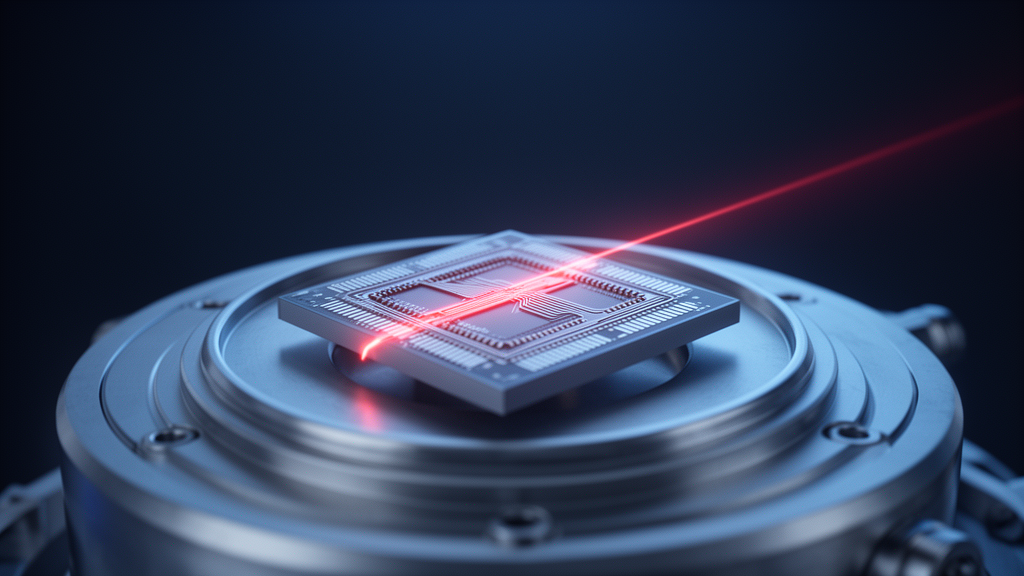
Quantum technologies promise a future in which information is carried and processed in ways that no classical computer can match, but the field remains hostage to a stubbornly practical problem: photons, the particles of light that carry quantum information, refuse to sit still. In a quantum processor or a future quantum internet, photons must often be held in place temporarily while slower operations elsewhere in the system catch up. That pause, seemingly trivial in the everyday world, is one of the hardest engineering challenges in quantum information science. Now a team at the University of Illinois Urbana-Champaign’s Grainger College of Engineering reports a chip-based quantum memory that stores photons for longer than a microsecond, a duration that may sound modest but represents a major milestone for integrated quantum photonics.
The research, led by physics professor Elizabeth Goldschmidt and published in Nano Letters, describes an integrated nanophotonic platform built on thin-film lithium niobate, one of the leading materials for modern quantum optics experiments. The device dopes this waveguide with erbium atoms and uses a technique called spectral hole burning to arrange those atoms into an atomic frequency comb, a carefully spaced pattern of absorption frequencies that can catch incoming photons and re-emit them after a predetermined delay. According to the team, the device preserved quantum information with high fidelity, stored multiple photons simultaneously, and exceeded storage times of one microsecond, all on a chip that could in principle be manufactured commercially at scale.
To appreciate why a microsecond matters, it helps to consider the scale involved. The storage region on such a chip is roughly a centimeter across, a distance that light crosses in a few tens of trillionths of a second. Holding a photon for a full microsecond therefore means delaying it by a factor of tens of thousands relative to its natural transit time, effectively compressing meters of optical delay line into a device small enough to fit on a fingertip. For quantum chips, where operations must be synchronized and photons must wait their turn in a queue of quantum logic steps, that kind of on-demand delay is not a luxury. It is a prerequisite for building processors and networks that actually work.
There are, broadly speaking, two established routes to delaying light, and each has failed the quantum community in a different way. The first is the brute-force approach of conventional photonics: send the light down a longer path, using coiled optical fibers or arrangements of mirrors to stretch its journey. The trouble is that photons are easily absorbed by matter, and every additional meter of travel increases the odds that a photon simply vanishes. For the long delays relevant to quantum information processing, the survival probability of a photon in a conventional delay line becomes vanishingly small, making the approach hopelessly inefficient. A quantum memory cannot afford to lose the very qubits it is supposed to protect.
The second route is more elegant in principle. Instead of making light travel farther, one can couple photons to atoms whose quantum states are highly coherent, allowing the photonic information to be transferred into an atomic excitation, stored there, and later retrieved. Atomic ensembles can hold quantum states for far longer than a photon can survive in a fiber. But integrating such coherent atoms with scalable nanophotonic platforms has remained largely out of reach, because the exotic materials and cryogenic laboratory conditions that make long atomic coherence possible rarely coexist with the fabrication demands of chip manufacturing. This gap between laboratory demonstrations and manufacturable technology has been one of the defining bottlenecks of the field.
The Illinois team’s platform attempts to close that gap by combining two ingredients that had previously lived in separate worlds. Thin-film lithium niobate offers strong optical confinement, low loss, and wafer-scale integration, which is why it has become a workhorse material for both classical and quantum photonic chips. Erbium atoms, meanwhile, are prized in quantum memory research because their electronic transitions sit in the telecommunications band and can exhibit long coherence times, particularly when embedded in suitable crystalline hosts. By doping erbium into the lithium niobate waveguide itself, the researchers created a structure in which the light and the atoms that store it share the same nanoscale volume, maximizing their interaction without requiring the photon to leave the chip.
The storage mechanism relies on spectral hole burning, a technique in which a tunable laser is used to selectively excite and shelve subsets of atoms according to the precise frequencies they absorb. Rather than letting the erbium ensemble absorb light in a broad, featureless band, the researchers sculpted its absorption spectrum into a comb-like pattern with evenly spaced frequency peaks. When a photon enters the device, its energy is coherently shared among the comb’s teeth, and the resulting quantum interference causes the excitation to rephase after a fixed interval, at which point the photon is re-emitted in its original form. The storage time is set by the spacing of the comb, giving the researchers a knob with which to control how long the light waits.
Priyash Barya, an electrical engineering graduate student and co-first author of the paper, emphasized that no one else has stored light on a chip in a platform with this potential for scalability, describing the approach as the only way of achieving this result on one of the leading platforms for quantum optics and quantum information systems. Daren Chen, a physics graduate student and the paper’s other co-first author, framed the achievement in terms of the field’s central difficulty, noting that long delays remain an outstanding problem in quantum information processing and that the team wanted to demonstrate a promising approach using their nanophotonic platform. The demonstration of storage exceeding one microsecond, with multiple photons held at once, positions the device among the most capable integrated quantum memories reported to date.
What may ultimately matter as much as the performance numbers is the device’s manufacturability. Goldschmidt stressed that this is not a one-off bespoke device, arguing that its promise lies in its simplicity: the team has taken something that could typically only be done in a highly specialized laboratory environment and recast it in a platform that can be made commercially at scale by people who know nothing about quantum optics. That framing points toward a future in which quantum memories are not hand-built instruments but standard components, fabricated in the same facilities that produce telecommunications hardware and integrated into larger quantum systems by engineers rather than specialists.
Challenges remain before the platform can anchor a practical quantum computer or network. Goldschmidt noted that a useful version of the device will need better retrieval efficiency and longer storage times, goals the group plans to pursue by refining the atomic frequency comb and experimenting with erbium isotopes that are more resistant to noise. Her lab is also exploring additional applications for spectrally tailoring atomic ensembles to build other devices for quantum photonics, treating the memory as one component in a broader program of building capabilities on the integrated lithium niobate platform. If those efforts succeed, the humble act of making a photon wait could become one of the quiet foundations of the quantum internet, a piece of engineering so routine that the extraordinary physics inside it is all but invisible.
Subject of Research: On-chip quantum memory for photon storage in erbium-doped thin-film lithium niobate
Article Title: Illinois researchers give quantum light a place to wait
Article References: Illinois researchers give quantum light a place to wait. (n.d.). Original publication
Image Credits: AI Generated
DOI: Not provided
Keywords: quantum memory, photon storage, thin-film lithium niobate, erbium doping, atomic frequency comb, spectral hole burning, nanophotonics, quantum information, integrated photonics, quantum networks, telecom photons, University of Illinois
Cite Scienmag News
Katie Riggs. (October 9, 2026). Chip-Based Quantum Memory Stores Light for Over a Microsecond. Scienmag. https://scienmag.com/chip-based-quantum-memory-stores-light-for-over-a-microsecond/
Katie Riggs. "Chip-Based Quantum Memory Stores Light for Over a Microsecond." Scienmag, 9 October 2026, https://scienmag.com/chip-based-quantum-memory-stores-light-for-over-a-microsecond/. Accessed 9 October 2026.
Katie Riggs. "Chip-Based Quantum Memory Stores Light for Over a Microsecond." Scienmag. October 9, 2026. https://scienmag.com/chip-based-quantum-memory-stores-light-for-over-a-microsecond/


