


Perovskite solar cells have spent the past decade smashing efficiency records while simultaneously frustrating engineers with their tendency to fall apart. Now a team led by researchers at City University of Hong Kong, together with collaborators at Jilin University and Sun Yat-sen University, has reported a deceptively simple fix that draws on an idea borrowed from metallurgy: embrace disorder. By blending three structurally similar self-assembled molecules into a single hole-selective contact, the group created what they call a high-entropy molecular contact, and the resulting inverted perovskite solar cells reached a champion power conversion efficiency of 27.50 percent, with a certified steady-state efficiency of 27.31 percent. More striking still, the devices showed negligible efficiency loss after 1,300 hours of continuous operation at maximum power point tracking at 85 degrees Celsius in ambient air. The work, published in Nature Photonics, suggests that the road to durable perovskite photovoltaics may run not through ever-more-perfect molecular order, but through carefully engineered molecular chaos.
To understand why the result matters, it helps to look closely at the architecture of an inverted perovskite solar cell. In this configuration, light enters through a transparent electrode and first encounters a hole-selective layer that extracts positive charge carriers from the perovskite absorber. In state-of-the-art devices, that layer is typically a self-assembled monolayer: a single molecular layer in which each molecule anchors to the oxide substrate through a phosphonic acid group and presents an energy-aligned frontier orbital to the perovskite above. These monolayers use vanishingly small amounts of material, coat rough surfaces uniformly, and have been central to the efficiency surge of recent years. But they carry a structural vulnerability. A monolayer built from a single molecular species tends to pack into one dominant motif, and when that motif is stressed, by heat, by mechanical strain, or by the chemical pressure of the perovskite crystallizing on top of it, the packing can collapse. When the packing collapses, the pathways that holes use to hop from the perovskite into the electrode are disrupted, and the device begins to degrade.
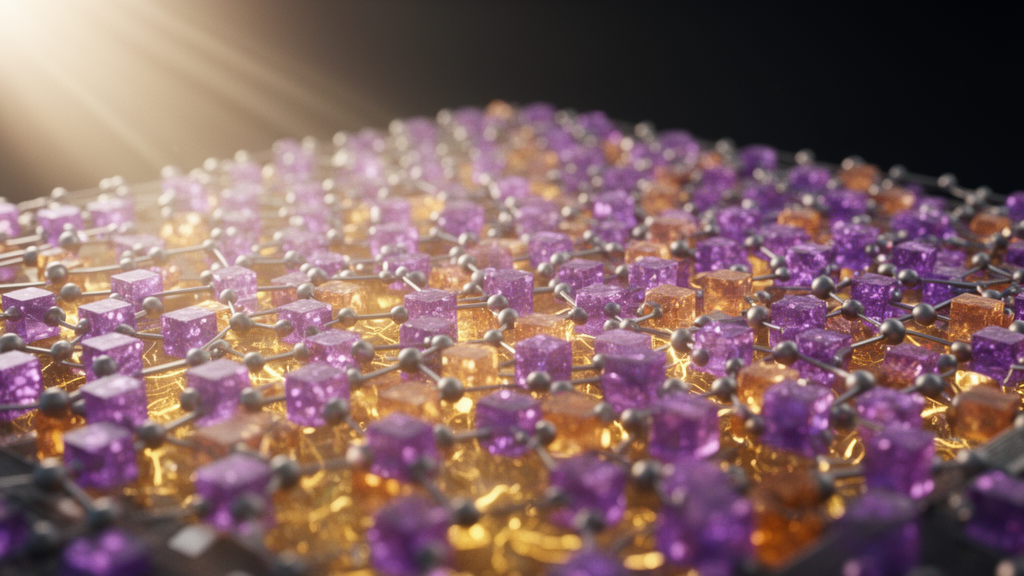
The Hong Kong-led team, including co-first authors Deng Wang, Mingqian Chen and Jiacong Feng, attacked this vulnerability by mixing three carbazole-naphthalene self-assembled molecules that share similar chemical skeletons but differ in their intermolecular interactions and packing preferences. The strategy mirrors the high-entropy concept that transformed alloy design, where mixing multiple elements in near-equimolar ratios stabilizes materials through configurational entropy rather than through a single dominant crystal structure. Here, the entropy is not in atomic positions but in packing modes. Because each of the three molecules prefers a slightly different way of stacking against its neighbors, the blended film cannot settle into one brittle, long-range-ordered arrangement. Instead, it forms a dense mosaic of coexisting packing motifs, a high-entropy system in which no single failure mode can propagate easily. The result is a contact that extracts holes efficiently while remaining remarkably resilient under external stress.
Proving that such a high-entropy molecular contact actually forms, rather than simply producing a phase-separated mess, required a battery of complementary techniques. Single-crystal analysis of the individual molecules revealed the distinct intermolecular interactions, hydrogen bonding patterns and π-stacking geometries that each species brings to the blend. Molecular dynamics simulations, run on the blended films, showed how the three components interpenetrate and how the resulting diversity of local environments suppresses the large-scale structural rearrangements that plague single-component monolayers. Interfacial characterizations of the actual devices then confirmed that the mixed contact maintains intimate, robust contact with the perovskite layer. Together, these measurements painted a consistent picture: the ternary blend does not segregate or compete, it cooperates, producing an interface whose structural heterogeneity is precisely the source of its mechanical and thermal toughness.
The charge-transport consequences of that heterogeneity are subtle but favorable. In an idealized, perfectly ordered monolayer, holes move through well-defined electronic coupling pathways between adjacent molecules. Disorder might seem like the enemy of such transport, and in amorphous organic semiconductors it often is. But the high-entropy contact occupies a sweet spot: the three molecules are chemically similar enough that their energy levels remain aligned, so no deep traps are introduced, while their diverse packing modes create multiple, redundant percolation pathways for hole extraction. Transient absorption spectroscopy measurements on the devices supported this picture, showing efficient hole transfer at the contact. In effect, the team traded a single elegant highway for a dense network of smaller roads, and the network proved far harder to knock out. The approach also echoes recent work on high-entropy hybrid perovskites, in which disordered organic moieties within the perovskite lattice itself have been shown to enhance stability, suggesting a broader design principle spreading across the field.
The photovoltaic numbers place the devices at the very front of the inverted perovskite pack. The champion cell delivered a power conversion efficiency of 27.50 percent, and an independent certified steady-state efficiency of 27.31 percent was recorded, a figure that stands among the highest reported for single-junction perovskite devices and compares favorably with entries on established efficiency charts. Efficiency alone, however, has never been the bottleneck for perovskite commercialization; stability has. Here the high-entropy contact earned its keep. Under maximum power point tracking at 85 degrees Celsius in ambient air, a punishing accelerated-ageing protocol that combines thermal stress, continuous illumination and electrical bias, the devices retained essentially all of their initial efficiency after 1,300 hours. The team also reported extended stability under a range of other accelerated ageing tests, consistent with the consensus ISOS procedures that the perovskite community uses to standardize stability reporting.
That combination of certified efficiency and heat tolerance addresses the two criteria that investors and module manufacturers scrutinize most closely. Perovskite modules must survive decades of outdoor service, during which rooftop temperatures can exceed 70 degrees Celsius in summer and internal junctions run hotter still. A contact layer that structurally collapses under such thermal load becomes a device-wide liability, initiating delamination and accelerating the decomposition of the perovskite itself. By hardening the molecular interface at its weakest scale, the single molecular layer, the high-entropy strategy protects the entire stack. The fact that the improvement required no exotic materials, only a ternary blend of closely related carbazole-based molecules that can be deposited from solution, makes the approach attractive for scalable manufacturing, where process simplicity and material cost weigh as heavily as laboratory performance.
The authors emphasize that the framework is broadly applicable beyond the specific molecules they synthesized. The underlying principle, that blending species with similar electronic structures but distinct packing motifs generates entropy-stabilized interfaces, could in principle be applied to electron-selective contacts, to the buried interfaces of tandem devices, and to other solution-processed thin-film technologies that rely on self-assembled monolayers, including organic electronics and emerging tandem architectures that pair perovskites with silicon. Recent parallel reports of ternary self-assembled molecular contacts for perovskite-silicon tandems and of entropy-regulating molecular locks that stabilize the perovskite lattice indicate that high-entropy thinking is rapidly spreading through molecular-level photovoltaic engineering. The present work adds a rigorous structural and mechanistic foundation to that trend, linking single-crystal chemistry, molecular simulation and device-level certification in a single coherent study.
Challenges remain before high-entropy contacts reach the factory floor. The long-term behavior of ternary blends over years rather than months, their behavior in full-size modules with large areas and interconnects, and the reproducibility of blend stoichiometry in industrial coating processes will all need to be demonstrated. Yet the conceptual shift is hard to overstate. For years, interfacial engineering in perovskite solar cells has pursued purity and order, one molecule, one packing mode, one optimized monolayer. This study demonstrates that controlled multiplicity can outperform perfection, converting the very disorder that engineers once feared into a shield against degradation. If the high-entropy design rule generalizes as broadly as the authors suggest, the molecular interfaces of future solar cells may look less like crystalline lattices and more like entropy-toughened mosaics, quietly extracting charge under a blazing sun for decades without complaint.
Subject of Research: High-entropy molecular hole-selective contacts for efficient and stable inverted perovskite solar cells
Article Title: High-entropy molecular contacts enable high-efficiency and stable perovskite solar cells
Article References: Wang, D., Chen, M., Feng, J., Li, Q., Wong, C.-T., Lei, G., Jiang, Q., Wang, T., Jiang, W., & Jen, A. K.-Y. (2026). High-entropy molecular contacts enable high-efficiency and stable perovskite solar cells. Nature Photonics. https://doi.org/10.1038/s41566-026-02028-5
Image Credits: AI Generated
DOI: 10.1038/s41566-026-02028-5
Keywords: perovskite solar cells, self-assembled monolayers, high-entropy materials, hole-selective contacts, power conversion efficiency, operational stability, molecular packing, inverted architecture, charge transport, molecular dynamics simulations, thermal ageing, Nature Photonics
Cite Scienmag News
Denise Maddox. (October 9, 2026). Molecular Chaos Becomes a Strength in Record-Breaking Perovskite Solar Cells. Scienmag. https://scienmag.com/molecular-chaos-becomes-a-strength-in-record-breaking-perovskite-solar-cells/
Denise Maddox. "Molecular Chaos Becomes a Strength in Record-Breaking Perovskite Solar Cells." Scienmag, 9 October 2026, https://scienmag.com/molecular-chaos-becomes-a-strength-in-record-breaking-perovskite-solar-cells/. Accessed 9 October 2026.
Denise Maddox. "Molecular Chaos Becomes a Strength in Record-Breaking Perovskite Solar Cells." Scienmag. October 9, 2026. https://scienmag.com/molecular-chaos-becomes-a-strength-in-record-breaking-perovskite-solar-cells/


