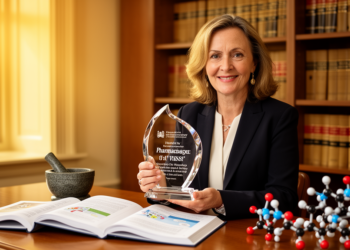
Springer Nature has announced the recipients of its 2026 Editor of Distinction Awards, an annual program that recognizes the editors whose behind-the-scenes labor keeps the scientific literature trustworthy, efficient, and responsive to the communities it serves. Among the journals celebrating honorees this year is BMC Pharmacology and Toxicology, part of the BMC series of open access titles, which named contributors recognized across two of the program’s flagship categories: the Springer Nature Editorial Contribution Award and the Springer Nature Author Service Award. The announcement, published on the journal’s updates page, frames the awards as a celebration of work that rarely makes headlines but fundamentally shapes what gets published, how quickly, and with how much scientific rigor.
The Editorial Contribution Award is described as recognizing meticulous assessment of submissions and rigorous management of the peer review process, with an explicit emphasis on safeguarding the scientific accuracy of the published record. In practical terms, this is the work of triaging manuscripts the moment they arrive, judging whether a study’s methods can support its conclusions, selecting and steering reviewers whose expertise matches the paper’s questions, and adjudicating when reviewer reports conflict. Editors who do this well act as the first and last line of defense against error, bias, and overinterpretation before a paper ever reaches readers. The 2026 honorees in this category span a wide range of research fields and geographies, reflecting the breadth of the portfolio they serve.
The recipients of the Springer Nature Editorial Contribution Award named in the announcement are Abdelwahab Omri, Anshuman Chandra, Catherine Sherwin, Giovanni Tarantino, Hualin Cai, Imran Khan, Jeffrey Raj, Josef Yayan, Koushik Debnath, Marcelo Arbo, Md Jakaria, Zhengwei Huang, and Zhenwei Yu. Thirteen names on a list may look like a simple roster, but each represents hundreds of hours of unpaid or lightly compensated intellectual labor. Handling editors typically manage dozens of manuscripts a year, each requiring them to master a new subfield quickly, evaluate statistical and experimental design choices, and write decision letters that must be simultaneously critical and constructive. It is a role that rewards judgment, diplomacy, and an unwillingness to let marginal science slide through.
The second category, the Springer Nature Author Service Award, recognizes exceptional service in improving the author experience and ensuring that the peer review process is efficient, constructive, and fair. This year’s honorees are Anindya Bose, Josef Yayan, Simone Brogi, and Zhenwei Yu. Notably, two names appear on both lists: Josef Yayan and Zhenwei Yu received recognition for both their editorial contribution and their service to authors, a dual distinction that suggests editors who excel at protecting scientific accuracy can also excel at making the publishing process humane for the people submitting to it. The overlap is a useful corrective to the assumption that rigor and kindness are opposing forces in editorial work.
What does author service actually look like inside a journal like BMC Pharmacology and Toxicology? It begins with clear, timely communication: telling authors quickly when a paper is out of scope rather than letting it languish for months, and writing rejection or revision letters that explain the reasoning rather than issuing a bare verdict. It includes shepherding manuscripts through rounds of revision in which reviewers may demand additional experiments, reanalysis of data, or substantial rewriting, and intervening when a reviewer’s demands are unreasonable or outside the paper’s scope. Editors recognized for author service are often those who treat early-career researchers, for whom a single publication can determine a career trajectory, with particular care and clarity.
The journal context matters here. BMC Pharmacology and Toxicology publishes open access research across pharmacology and toxicology, fields in which the stakes of publication accuracy are unusually concrete. Pharmacological studies inform drug development decisions, dosing debates, and safety evaluations; toxicological findings feed into regulatory assessments of chemicals, contaminants, and environmental exposures. A flawed paper in these disciplines does not merely clutter the literature; it can be cited in ways that influence how compounds are studied, approved, or restricted. That is why the award language emphasizes safeguarding the scientific accuracy of the published record rather than simply celebrating productivity or speed. In preclinical biomedical research, where reproducibility problems have been extensively documented, the editor’s gatekeeping role carries measurable weight.
The mechanics of modern peer review also explain why editorial excellence deserves formal recognition. Most manuscripts at a journal like this one pass through a handling editor who assigns two or more external reviewers, synthesizes their often divergent reports, and makes a recommendation. Reviewers are volunteers, frequently overcommitted, and their reports vary enormously in quality. A skilled editor must distinguish a substantive methodological critique from a stylistic preference, spot when a reviewer has missed a critical flaw, and decide when a third opinion is needed. They must also enforce ethical standards: checking for concerns about plagiarism, image manipulation, salami slicing, undisclosed conflicts of interest, and the increasingly urgent question of undisclosed use of generative artificial intelligence in manuscript preparation. None of this is glamorous, and all of it determines the integrity of what the community reads.
The awards also highlight a structural reality of scientific publishing: the system runs on a distributed network of working scientists who take on editorial duties alongside their research, teaching, and clinical obligations. Springer Nature’s announcement acknowledges this explicitly, noting that editorial teams develop networks for authors and peer reviewers, help authors improve their papers, and advocate for their journal communities. Building a reviewer network is itself a significant skill; editors must maintain a roster of qualified, willing reviewers across a fast-moving field, recruit new ones as subfields emerge, and retire overused ones to prevent reviewer fatigue. Advocacy for a journal community means representing its interests within the larger publisher, shaping scope decisions, and responding when the community’s needs change.
For the honorees themselves, the recognition carries professional weight. Editorial service is increasingly scrutinized in hiring, promotion, and grant evaluation, particularly for mid-career scientists whose contributions to the community extend beyond their own publication lists. An award of this kind provides documented, third-party validation of that service, which has historically been invisible on a curriculum vitae beyond a bare line listing an editorial appointment. It also signals to the broader community that the journal values the qualities the awards name: rigor, fairness, efficiency, and constructive engagement with authors. Journals compete for submissions and for reviewer goodwill, and signaling that editorial labor is respected is one way to attract scientists willing to take it on.
The 2026 list also offers a snapshot of how global and collaborative editorial work has become. The named editors are affiliated with institutions across multiple continents, and several serve journals beyond a single title, as the dual recognition of Yayan and Zhenwei Yu illustrates. As open access publishing has expanded, the volume of submissions to BMC-series journals has grown substantially, increasing the load on editorial boards and making the quality of individual editors more consequential. A journal that can triage accurately and communicate quickly retains authors; one that cannot loses them. Awards like these are, in part, a publisher’s acknowledgment that the human judgment layer of peer review, not just the platform or the workflow software, is what determines whether a journal earns and keeps scientific trust.
For readers of the pharmacology and toxicology literature, the practical takeaway is straightforward: the papers they rely on have passed through editors whose names they will rarely see, and the quality of that filtering varies with the skill and diligence of those editors. Recognizing them publicly is a small but meaningful step toward making editorial work visible, valued, and accountable. The full list of this year’s Editor of Distinction recipients, including the thirteen Editorial Contribution Award honorees and the four Author Service Award honorees celebrated by BMC Pharmacology and Toxicology, is available on the journal’s updates page, alongside the publisher’s broader announcement of award recipients across its portfolio.
Subject of Research: Springer Nature Editor of Distinction Awards 2026
Article Title: Springer Nature Editor of Distinction Awards 2026
Article References: Springer Nature Editor of Distinction Awards 2026. (n.d.). Original publication
Image Credits: AI Generated
DOI: Not provided
Keywords: Springer, Nature, Editor, Distinction, Awards, scientific research
Cite Scienmag News
Ophelia Keating. (October 9, 2026). Springer Nature Honors Standout Editors Shaping the Scientific Record in 2026. Scienmag. https://scienmag.com/springer-nature-honors-standout-editors-shaping-the-scientific-record-in-2026-3/
Ophelia Keating. "Springer Nature Honors Standout Editors Shaping the Scientific Record in 2026." Scienmag, 9 October 2026, https://scienmag.com/springer-nature-honors-standout-editors-shaping-the-scientific-record-in-2026-3/. Accessed 9 October 2026.
Ophelia Keating. "Springer Nature Honors Standout Editors Shaping the Scientific Record in 2026." Scienmag. October 9, 2026. https://scienmag.com/springer-nature-honors-standout-editors-shaping-the-scientific-record-in-2026-3/