


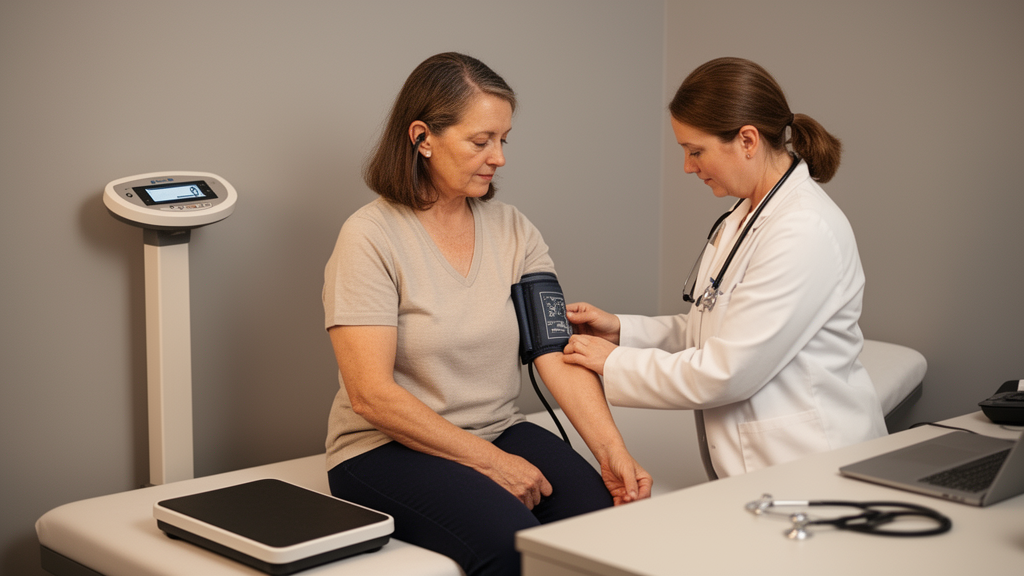
Hearing loss affects more than 1.5 billion people worldwide, and most of us assume it is simply an unavoidable consequence of aging, loud workplaces, or the earbuds we never quite turn down. A new analysis of national survey data from China suggests a different and more actionable picture: a meaningful share of hearing loss may be traced back to everyday health factors that doctors already know how to measure and manage. The findings, published in BMC Public Health, point to body weight and blood pressure as two of the most promising starting points for keeping ears functioning longer.
The study, led by Haibo Huang of Peking Union Medical College Hospital and Guangliang Shan of the Chinese Academy of Medical Sciences, drew on the China National Health Survey 2023, a cross-sectional survey that included 6,291 participants aged 20 to 88 years. Rather than asking people whether they thought their hearing was slipping, the researchers measured it directly using air-conduction pure-tone audiometry, the standard clinical technique in which listeners respond to tones delivered through headphones at specific frequencies. This objective measurement matters, because self-reported hearing problems are notoriously unreliable and tend to understate the true scale of the problem.
To characterize hearing loss in detail, the team calculated pure-tone averages, known as PTAs, across three frequency ranges. Low and mid-frequency hearing loss was defined as an average threshold above 20 decibels at 0.5, 1, and 2 kilohertz, the frequencies that carry much of the energy of everyday speech. Speech-frequency hearing loss added the 4 kilohertz tone to that average, while high-frequency hearing loss was assessed at 4, 6, and 8 kilohertz, the region where age-related damage typically appears first and where consonants become hard to distinguish. In every case, the definition used the better ear, reflecting the hearing that actually matters for communication in daily life.
The central innovation of the study lies in its statistical framing. Instead of simply asking which risk factors are associated with hearing loss, the researchers estimated population attributable fractions, or PAFs, for a set of socioeconomic and cardiometabolic factors. The PAF answers a deceptively simple question: if this risk factor were eliminated from the entire population, what percentage of hearing loss cases would disappear? The estimates were derived from multivariable logistic regression models, which adjust for the influence of other measured variables, and were reported with 95 percent confidence intervals to convey the precision of each figure. The analysis was then stratified by age, sex, and menopausal status to reveal how the burden attributable to each factor shifts across different groups.
The headline result is that roughly 10 to 19 percent of hearing loss in this population could be attributed to the socioeconomic and cardiometabolic risk factors studied. That may sound modest next to the enormous contribution of noise exposure and aging, but it represents millions of people when scaled to a country the size of China, and it points to levers that public health systems can actually pull. Crucially, the ranking of risk factors and the size of their attributable fractions were broadly consistent across low, speech, and high-frequency hearing loss, suggesting the same underlying mechanisms may be at work regardless of which part of the cochlea is examined.
Two factors stood out at the top of the list. Abnormal body mass index accounted for approximately 3.0 to 6.5 percent of hearing loss, and low educational attainment accounted for roughly 2.7 to 5.5 percent, making these the leading attributable risk factors in the analysis. Hypertension also carried a substantial attributable fraction, particularly among older adults and men. The connection between cardiometabolic health and hearing is biologically plausible: the delicate hair cells of the inner ear and the tiny vessels that feed them are exquisitely sensitive to blood flow, and the same vascular damage that elevates the risk of heart attack and stroke may quietly starve the cochlea over decades.
The stratified results add a layer of nuance that could reshape how prevention campaigns are targeted. The attributable fractions of the selected risk factors were generally higher in younger adults than in older adults, higher in men than in women, and higher in premenopausal women than in postmenopausal women. In other words, the same risk factor does not carry the same weight everywhere. In younger people, whose hearing loss is less likely to be driven by age alone, modifiable factors account for a larger share of the disease burden, which means interventions aimed at weight and blood pressure in early and mid-adulthood could pay outsized dividends later in life.
The sex and menopausal patterns hint at possible biological modulation. Estrogen is thought to have protective effects on cochlear function and vascular health, and the lower attributable fractions observed among postmenopausal women may reflect a shift in the dominant causes of hearing loss in that group, with aging and other unmeasured factors taking a larger role. The researchers are careful to frame these as observations that suggest priorities rather than definitive causal proofs. Cross-sectional data capture a single moment in time, so they cannot establish that changing a risk factor today will change hearing tomorrow, and residual confounding by factors such as occupational noise exposure cannot be excluded.
Even with those caveats, the practical implications are striking. Weight management and blood pressure control are already cornerstones of cardiovascular prevention, supported by decades of evidence and existing health infrastructure. If the same interventions also preserve hearing, the case for investing in them becomes stronger still, and hearing preservation could be added to the long list of benefits that clinicians cite when counseling patients about diet, exercise, and antihypertensive treatment. The finding that low education is a leading attributable factor also underscores that hearing loss is not purely a biomedical problem; socioeconomic circumstances shape health trajectories in ways that policy, not just medicine, must address.
For a condition long treated as an inevitable companion of growing old, the message from this study is quietly radical: a measurable slice of the world’s hearing loss is tied to risks we already track in every routine checkup. The authors conclude that the disparities in how risk factors contribute across age, sex, and menopausal status should guide prevention priorities, and they identify weight and blood pressure management as logical initial targets for hearing loss prevention strategies. With more than 1.5 billion people affected globally and numbers expected to rise as populations age, even a ten to twenty percent reduction in preventable cases would represent a public health victory measured in hundreds of millions of ears.
Subject of Research: Population attributable fractions of socioeconomic and cardiometabolic risk factors for hearing loss in a Chinese national health survey
Article Title: Priorities for hearing loss prevention based on population attributable fraction estimates: a cross-sectional analysis within the China national health survey 2023
Article References: Huang, H., Fan, Y., Yan, F., Hu, Y., He, H., Liu, Y., Xu, T., Zhu, X., Zhu, Y., Diao, W., Xia, X., Tu, J., Li, A., Lin, B., Liu, Q., Lu, Z., Wang, W., Xu, D., Chen, Z., … Shan, G. (2026). Priorities for hearing loss prevention based on population attributable fraction estimates: a cross-sectional analysis within the China national health survey 2023. BMC Public Health. https://doi.org/10.1186/s12889-026-28506-7
Image Credits: AI Generated
DOI: 10.1186/s12889-026-28506-7
Keywords: hearing loss, population attributable fraction, body mass index, hypertension, pure-tone audiometry, China National Health Survey, cardiometabolic risk factors, public health prevention, cross-sectional study, BMC Public Health, low education, menopausal status
Cite Scienmag News
Ophelia Keating. (October 9, 2026). Weight and Blood Pressure Emerge as Top Targets for Preventing Hearing Loss. Scienmag. https://scienmag.com/weight-and-blood-pressure-emerge-as-top-targets-for-preventing-hearing-loss/
Ophelia Keating. "Weight and Blood Pressure Emerge as Top Targets for Preventing Hearing Loss." Scienmag, 9 October 2026, https://scienmag.com/weight-and-blood-pressure-emerge-as-top-targets-for-preventing-hearing-loss/. Accessed 9 October 2026.
Ophelia Keating. "Weight and Blood Pressure Emerge as Top Targets for Preventing Hearing Loss." Scienmag. October 9, 2026. https://scienmag.com/weight-and-blood-pressure-emerge-as-top-targets-for-preventing-hearing-loss/


