


Electron paramagnetic resonance (EPR) spectroscopy lives and dies by one number: the signal-to-noise ratio. The technique detects the faint microwave whispers of unpaired electrons, molecules that carry a single dangling spin and act as exquisitely sensitive reporters of structure, dynamics and chemical environment in chemistry, physics, biology and materials science. Every improvement in sensitivity translates directly into smaller samples, shorter measurement times and new classes of experiments that were previously out of reach. Now, a team at Goethe University Frankfurt, working with a colleague at the Institute of Applied Physics in Nizhny Novgorov, has reported a probehead design for Q-band pulse EPR that combines two sensitivity-boosting strategies long pursued separately: a bimodal resonator operating in transmission mode and a low-noise amplifier placed directly behind the detection channel. The result, published in the journal Magnetic Resonance, is at least a twofold improvement in spectrometer sensitivity that holds independent of sample temperature, achieved on a commercial Bruker ELEXSYS E580 spectrometer without any modification of its microwave bridge.
To understand why this matters, it helps to look at how conventional EPR spectrometers work. In almost all instruments, a single-mode cavity or dielectric resonator operates in reflection mode: the same microwave port is used both to excite the spins and to detect the signal they emit. The resonator amplifies the microwave magnetic field inside the sample, sharpening both the excitation pulses and the induced signal, and its performance largely determines the sensitivity of the whole instrument. But reflection mode carries an inherent penalty. After each excitation pulse, the resonator rings down, and a significant fraction of the microwave power reflects back toward the receiver. Protection switches must be deployed to shield the sensitive detection electronics from this reflected pulse, and every switch adds insertion loss and noise. In continuous-wave operation, microwave source noise leaking into the detection channel further erodes the signal-to-noise ratio. For decades, instrument builders have traded off these losses against the need to protect their amplifiers.
The bimodal cavity offers an elegant escape from this dilemma. The concept, first explored by James Hyde and coworkers in the late 1960s, exploits two microwave modes with orthogonal magnetic-field polarizations that resonate at the same frequency. The excitation pulse drives one mode, tipping the magnetization along one axis, while the circularly polarized induction signal emitted by the spins is picked up by the orthogonal mode. Because the two channels are physically decoupled, the powerful excitation pulse never travels down the detection path, and the ringing problem largely disappears. Bimodal cavities, bimodal loop-gap resonators and cross-loop resonators have all been built on this principle. What has been missing, however, is a way to combine this transmission-mode architecture with a modern low-noise amplifier at Q-band frequencies, roughly 34 gigahertz, in a package that drops straight into a commercial spectrometer.
The low-noise amplifier, or LNA, is the second half of the Frankfurt team’s strategy. Placing an LNA as the very first element after the resonator means that every downstream component, including circulators, switches and cables, contributes negligibly to the overall noise figure. This approach has gained momentum in recent years, with several groups demonstrating impressive sensitivity gains at X-band and beyond, including cryogenic amplifiers that approach the quantum limit of spin detection. The catch is compatibility: a strong reflected or ring-down pulse can saturate or even destroy an LNA, so most implementations require protection switches whose losses eat into the gain, or else demand invasive modifications to the spectrometer’s microwave bridge. The Frankfurt design sidesteps the problem by exploiting the isolation of the bimodal cavity itself. Because the excitation and detection modes are orthogonal, the LNA connected to the cavity output never sees the full excitation power and does not need a protective switch in front of it.
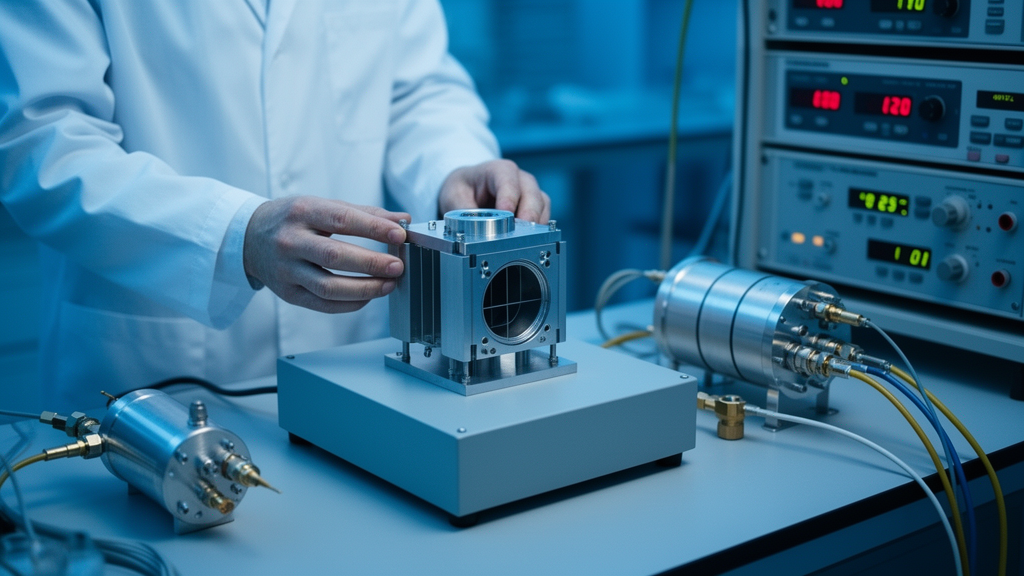
The new probehead is built around a bimodal cavity based on two polarization-crossed rectangular TE103 modes that share two half-wavelengths, scaled up from Hyde’s original design for Q-band operation. The cavity accepts sample volumes of 20 to 50 microliters, and the finished probe matches the dimensions of Bruker flexline Q-band resonators, fitting directly into an Oxford CF935 helium-flow cryostat for operation between 5 and 300 kelvin. A manual waveguide switch lets the user select reflection or transmission mode. In transmission mode, the signal from the cavity output passes through a uniline that guards against residual reflected power and then into a commercial LNA with a noise figure of 1.9 decibels at room temperature, equivalent to a noise temperature of 160 kelvin. A circulator with 0.13 decibels of insertion loss and 33 decibels of isolation routes the amplified signal back to the spectrometer receiver.
Finite-element simulations of the loaded cavity, performed with CST Suite for a frozen aqueous solution in a quartz tube, predicted an isolation of about 51 decibels between the input and output ports when both modes are tuned to 33.192 gigahertz. Network-analyzer measurements on real samples came close: the experimental decoupling reached approximately 46 decibels, a few decibels shy of the simulation, which the authors attribute to imperfections in the inner surfaces of the fabricated resonator and slight misalignment of the sample tube. The loaded quality factors were deliberately kept low, at 250 for the input mode and 180 for the output mode, to allow broad EPR excitation. The team also found that deliberately detuning the output mode by 134 megahertz increased the isolation by 5 decibels, a quirk they turned into a practical tool: the isolation level can be monitored indirectly from the spectrometer console to fine-tune the output mode against the input mode.
The performance tests delivered striking numbers. Using a BDPA:PS powder sample containing roughly 10^15 spins at room temperature, the bimodal probehead operating in transmission mode with the LNA showed a fourfold improvement in signal-to-noise ratio compared with the same probehead running in reflection mode without the amplifier. Against the commercial Bruker EN 5107D2 probehead available in the laboratory, measured with matched pulse conditions, the bimodal probe still delivered a twofold signal-to-noise advantage, thanks to the combination of the LNA and the isolation of the detection channel from the excitation path. Even when the commercial probe was driven at full microwave power with its optimal short pulses, the bimodal probe retained a twofold edge in peak echo amplitude, and the advantage persisted when integrated echo intensities were compared.
A second test at 80 kelvin, using a 0.1 millimolar solution of the nitroxide radical OXO TEMPO in toluene, pushed the enhancement to a factor of seven. Here the geometry of the bimodal cavity played a decisive role: its 2.8-millimeter sample tube holds about 20 microliters of solution, roughly 3.5 times the 6-microliter volume of the 1.6-millimeter tube required by the commercial probe. The authors therefore decompose the gain into a 3.5-fold contribution from the larger sample volume and an additional twofold contribution from the LNA and channel isolation. They also note a caveat that speaks to the honesty of the comparison: their EN 5107D2 probe is not new and may have a slightly degraded microwave power conversion factor compared with fresh commercial units, so the exact margin over commercial hardware may vary between laboratories.
The design is not yet at its ceiling. The 46-decibel isolation, while sufficient to protect the amplifier, still forces the experimenters to run with reduced microwave attenuation, meaning the full 150 watts of their traveling-wave-tube amplifier cannot yet be applied. The team plans to introduce tuning paddles into the resonator, a modification known from earlier bimodal designs, to push the isolation higher and unlock full-power operation. A cryogenic LNA placed inside the cryostat could cut the noise temperature from 160 kelvin to an estimated 10 to 50 kelvin, although strong magnetic fields can degrade such amplifiers through the Hall effect, requiring careful shielding or orientation, and repeated cooling cycles may shorten the amplifier’s lifetime. Even in its present form, the probehead is immediately attractive for time-resolved EPR methods that do not demand maximum microwave power, including transient EPR and non-adiabatic rapid-scan EPR, and the transmission-mode geometry may help suppress standing waves in experiments with broadband shaped pulses. As a proof of principle, the work demonstrates that two old ideas, crossed microwave modes and preamplification, can be married into a drop-in upgrade that makes every existing Q-band spectrometer quietly, dramatically better at hearing what electrons have to say.
Subject of Research: A bimodal Q-band EPR probehead with a low-noise amplifier that improves pulse electron paramagnetic resonance sensitivity
Article Title: Bimodal Q-band probehead with improved signal-to-noise ratio in pulse electron paramagnetic resonance
Article References: Denysenkov, V., Fedotov, A., Endeward, B., & Prisner, T. F. (2026). Bimodal Q-band probehead with improved signal-to-noise ratio in pulse electron paramagnetic resonance. Magnetic Resonance, 7(1), 21-28. https://doi.org/10.5194/mr-7-21-2026
Image Credits: AI Generated
DOI: 10.5194/mr-7-21-2026
Keywords: electron paramagnetic resonance, EPR spectroscopy, bimodal cavity, low-noise amplifier, Q-band, signal-to-noise ratio, pulse EPR, resonator design, instrumentation, spectrometer sensitivity, spin echo, microwave engineering
Cite Scienmag News
Denise Maddox. (October 9, 2026). Bimodal Cavity and Low-Noise Amplifier Double the Sensitivity of Q-Band Pulse EPR. Scienmag. https://scienmag.com/bimodal-cavity-and-low-noise-amplifier-double-the-sensitivity-of-q-band-pulse-epr/
Denise Maddox. "Bimodal Cavity and Low-Noise Amplifier Double the Sensitivity of Q-Band Pulse EPR." Scienmag, 9 October 2026, https://scienmag.com/bimodal-cavity-and-low-noise-amplifier-double-the-sensitivity-of-q-band-pulse-epr/. Accessed 9 October 2026.
Denise Maddox. "Bimodal Cavity and Low-Noise Amplifier Double the Sensitivity of Q-Band Pulse EPR." Scienmag. October 9, 2026. https://scienmag.com/bimodal-cavity-and-low-noise-amplifier-double-the-sensitivity-of-q-band-pulse-epr/


