


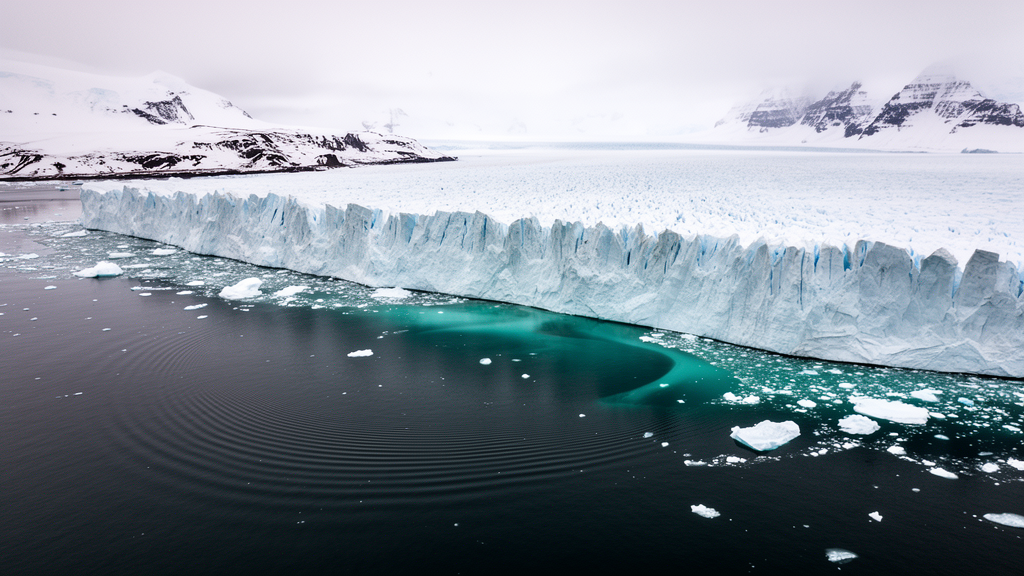
For decades, the East Antarctic Ice Sheet has been treated as the stable sibling in Antarctica’s family of ice, a vast frozen reservoir assumed to be largely insulated from the ocean-driven losses that have battered West Antarctica and the Antarctic Peninsula. A new study published in The Cryosphere by Matilda Weatherley of Durham University and colleagues now adds weight to a growing body of evidence that this confidence may be misplaced. By combining satellite imagery, radar interferometry, altimetry and ocean data spanning more than six decades, the team has documented thinning ice, retreating grounding lines and accelerating flow at the outlet glaciers draining into Porpoise Bay, a 150-kilometre-wide embayment in Wilkes Land that sits atop the eastern Aurora Subglacial Basin, one of the most potentially unstable regions of the entire ice sheet.
The stakes are considerable. The Antarctic Ice Sheet as a whole holds the equivalent of 57.9 metres of global sea level rise, and the East Antarctic Ice Sheet alone accounts for 52.2 metres of that total, an order of magnitude more than its western counterpart. While West Antarctica has dominated headlines with losses concentrated around Pine Island and Thwaites glaciers, Wilkes Land has quietly emerged as the region of East Antarctica losing the most mass. Previous work identified Frost and Holmes glaciers, both of which drain into Porpoise Bay, as among the top contributors to cumulative ice loss in East Antarctica between 1979 and 2017, behind only Totten and Denman glaciers. Yet despite this signal, the glaciers of Porpoise Bay had never been examined in the detail that their importance demands.
Weatherley and her colleagues set out to close that gap by measuring four key parameters across four outlet glaciers: Frost, Holmes East, Holmes West, and a smaller flow feature the team calls Glacier 1. They mapped the position of the ice-shelf calving fronts using imagery from Landsat, ASTER and Sentinel satellites, extending the record back to 1963 with declassified ARGON photography. They tracked ice surface elevation using multiple satellite altimetry datasets, measured ice velocity from the ITS_LIVE product, and located the grounding lines, the critical boundary where grounded ice begins to float, using differential synthetic aperture radar interferometry, or DInSAR, supplemented by a neural network trained to delineate grounding lines automatically from interferograms.
The results reveal a pattern of change that is hard to dismiss as noise. Frost Glacier’s grounding line retreated 17.17 kilometres between 1996 and 2014, an average rate of roughly 0.95 kilometres per year, with the fastest retreat, more than two kilometres per year, occurring between 1996 and 2004. Holmes East Glacier retreated up to 15.24 kilometres in just five years at the start of that period. If the estimates hold, Frost would rank among the fastest-retreating glaciers in East Antarctica on decadal timescales, with rates comparable to those recorded at Thwaites and Pine Island glaciers in West Antarctica. The authors are careful to flag substantial uncertainties, since the comparison combines datasets that delineate different parts of the grounding zone using different methods, but the retreat is broadly consistent with independent estimates from other studies.
The thinning signal is equally striking. Between 2003 and 2017, the grounded ice at Holmes West Glacier lowered at an average rate of up to 1.22 metres per year at the grounding line, a figure that places it among the most rapidly thinning glaciers in East Antarctica, rivalled in the published record only by Totten Glacier. The thinning propagated inland, reaching 0.34 metres per year ten kilometres up-ice, a spatial pattern characteristic of dynamic thinning driven by changes at the coast rather than by shifts in local snowfall. Because no long-term trends in precipitation or firn densification have been reported for the region, the researchers attribute the elevation loss to the ice itself flowing faster and drawing down its surface, a hallmark of dynamically forced mass loss.
What is driving these changes? The evidence points firmly toward the ocean. Warm, salty modified Circumpolar Deep Water, or mCDW, was detected at the continental shelf break near Porpoise Bay through measurements collected by instrumented seals from the MEOP consortium and by Argo profiling floats between 2004 and 2021. The water masses observed there, with temperatures above freezing at depth and salinities exceeding 34.5 grams per kilogram, match the signature of mCDW in East Antarctica. Reanalysis data from the EN4 dataset further suggest that water warmer than zero degrees Celsius has been present below roughly 450 metres depth on the continental shelf since at least the 1990s. Crucially, gravity-derived bathymetry reveals deep sub-ice-shelf cavities, between 650 and 750 metres deep and deepening inland, beneath Frost, Holmes East and Holmes West glaciers, providing plausible pathways for this warm water to reach the ice from below.
The melt rates implied by this oceanic heat delivery are extraordinary. Previous work calculated an average basal melt rate of 13.3 metres per year beneath the Holmes Ice Shelf between 1994 and 2018, the highest of any ice shelf in East Antarctica and fourth highest in all of Antarctica, exceeding even the melt rate beneath the Totten Ice Shelf. The ice shelf has also been thinning at its surface, with satellite altimetry recording losses of up to 3.07 metres per year on the floating ice, and pinning-point analysis suggests the thinning began at least fifty years ago. The picture that emerges is one of warm water circulating beneath the ice, melting it from below, thinning the floating tongues, reducing their buttressing effect, and allowing the grounded glaciers upstream to accelerate, thin and retreat.
The study also documents a striking rhythm of calving. The ice shelves of Porpoise Bay underwent near-synchronous calving events in 2006 to 2008, again in 2016 to 2017, and in a previously unidentified episode in 2021 to 2022, each time advancing back to within about a kilometre of their previous maximum extent before calving again. The team found that these events coincided with unusually low sea-ice concentrations in the preceding winter and spring, and with the break-up of the iceberg mélange, the jumble of sea ice and icebergs that presses against the ice front. Sea ice and mélange exert a resistive backstress on calving fronts, and their removal has been linked to ice-shelf breakup elsewhere in Antarctica. Because calving events at Porpoise Bay removed more than the roughly 18 percent of ice-shelf area that modelling identifies as dynamically passive, the losses translated into measurable speed-ups of the glaciers behind them, with velocity increases of several percent following the largest events.
Perhaps the most consequential finding concerns Holmes West Glacier. Its grounding line currently rests on a local bedrock high that appears to have shielded it from the full force of the warm water, which may explain its comparatively modest retreat rate of around 70 metres per year. But that pinning point sits at the very edge of a steep retrograde bed. Within two kilometres of inland retreat, the bed drops by 650 to 700 metres, and different bathymetric datasets suggest the reverse slope may continue for 25 to 35 kilometres inland. If the glacier unpins from its bedrock high, which the authors suggest could happen within a decade at current retreat rates, warm water would gain access to deep grounded ice, potentially initiating marine ice sheet instability, the same self-reinforcing retreat mechanism feared at Thwaites Glacier. The Holmes catchment holds the equivalent of roughly 11 centimetres of global sea level rise, and an adjacent ice rise that currently buttresses the flow could also lose its grip.
The authors emphasise that urgent improvements to bed elevation data are needed before the region’s future can be modelled with confidence, since the bathymetric uncertainties in this poorly surveyed corner of Antarctica are large enough to change the prognosis entirely. Nevertheless, the convergence of evidence, thinning that propagates inland, grounding lines retreating across retrograde slopes, modest but persistent flow acceleration, warm water at the shelf break, and deep cavities connecting ocean to ice, paints a coherent picture of a region responding to oceanic forcing. As Antarctic sea ice enters an era of record lows and increasing anomaly persistence, the stabilising seasonal blanket that has repeatedly broken and reformed over Porpoise Bay may grow thinner and less reliable. What happens next at these unassuming glaciers could help determine how much of East Antarctica’s enormous ice reservoir stays put in a warming world.
Subject of Research: Ocean-driven dynamic thinning and grounding line retreat at outlet glaciers in Porpoise Bay, Wilkes Land, East Antarctica
Article Title: Dynamic thinning and grounding line retreat in Porpoise Bay, Wilkes Land, East Antarctica
Article References: Weatherley, M., Stokes, C. R., Jamieson, S. S. R., Ramanath, S., & Silvano, A. (2026). Dynamic thinning and grounding line retreat in Porpoise Bay, Wilkes Land, East Antarctica. The Cryosphere, 20(9), 5509-5532. https://doi.org/10.5194/tc-20-5509-2026
Image Credits: AI Generated
Keywords: East Antarctic Ice Sheet, Porpoise Bay, Wilkes Land, grounding line retreat, dynamic thinning, Circumpolar Deep Water, ice shelf calving, sea ice, marine ice sheet instability, Aurora Subglacial Basin, satellite remote sensing, sea level rise
Cite Scienmag News
Violet Maxwell. (October 9, 2026). Hidden Warm Water Is Eating Away at East Antarctica’s Porpoise Bay Glaciers. Scienmag. https://scienmag.com/hidden-warm-water-is-eating-away-at-east-antarcticas-porpoise-bay-glaciers/
Violet Maxwell. "Hidden Warm Water Is Eating Away at East Antarctica’s Porpoise Bay Glaciers." Scienmag, 9 October 2026, https://scienmag.com/hidden-warm-water-is-eating-away-at-east-antarcticas-porpoise-bay-glaciers/. Accessed 9 October 2026.
Violet Maxwell. "Hidden Warm Water Is Eating Away at East Antarctica’s Porpoise Bay Glaciers." Scienmag. October 9, 2026. https://scienmag.com/hidden-warm-water-is-eating-away-at-east-antarcticas-porpoise-bay-glaciers/


