


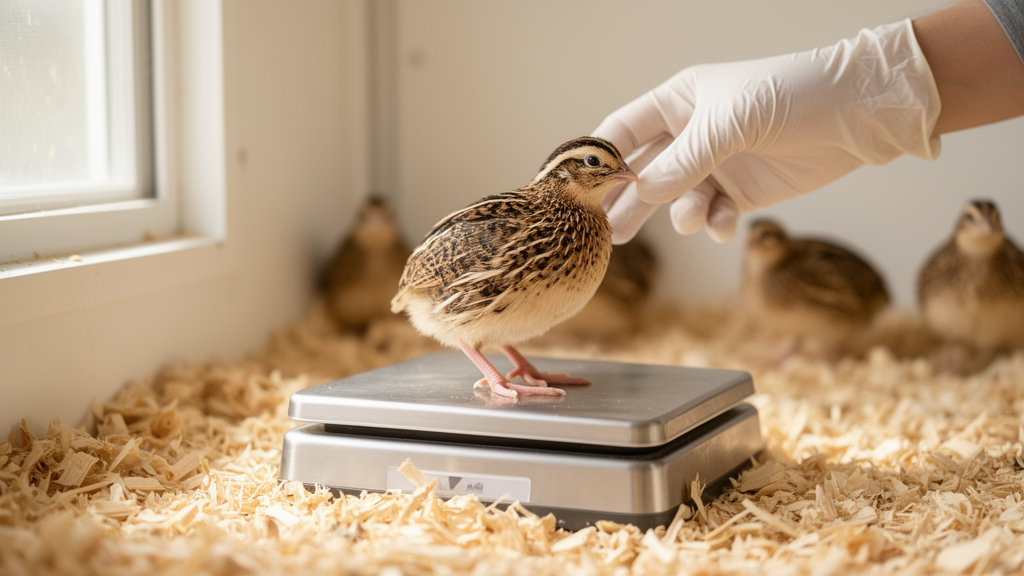
Japanese quail grow at a breathtaking pace. In just nine weeks, a hatchling weighing a few grams transforms into a near-mature bird, passing through distinct phases of explosive juvenile growth and eventual plateau. For breeders, that compressed timeline is both an opportunity and a puzzle: at which point in development should selection decisions be made to extract the most genetic improvement across the whole growth trajectory? A new study by Arzu Üçtepe of Isparta University of Applied Sciences in Turkey and Antonios Kominakis of the Agricultural University of Athens in Greece offers a remarkably precise answer. By applying a sophisticated statistical framework known as random regression modelling with orthogonal Legendre polynomials to 5745 weekly body weight records from 575 quails, the researchers found that selection between 21 and 35 days of age delivers the most balanced genetic response across the entire growth curve, identifying this three-week window as the optimal selection period for quail breeding programmes.
The study, published in the journal Archives Animal Breeding, goes beyond simply asking how heritable body weight is. Traditional genetic analyses of growth have treated measurements at different ages as separate traits, using univariate or multivariate models that ignore the biological continuity of development. Such approaches overlook the fact that weights recorded at neighbouring ages are strongly correlated and that genetic and environmental influences shift in intensity as an animal matures. Random regression models, or RRMs, solve this problem by describing each animal’s phenotype as a continuous function of time, with individual differences captured through random regression coefficients. The result is a smooth, biologically coherent picture of how genetic control over body weight emerges, peaks, and fades across the growth trajectory, and it allows breeders to estimate genetic merit even at ages that were never actually measured.
The choice of basis functions is critical to the success of any random regression analysis, and the Turkish-Greek team turned to orthogonal Legendre polynomials, mathematical curves first applied to growth trajectories in 1990 and later popularized in animal breeding. Their orthogonality minimizes collinearity among regression coefficients, producing stable estimates and interpretable covariance structures with relatively few parameters. The researchers fitted polynomials of orders two through six to the quail data and compared them using the Akaike and Bayesian information criteria. While higher orders progressively improved the fit, the Bayesian information criterion, which penalizes model complexity more harshly, reached its minimum at the fifth order. The sixth-order model achieved a marginally higher likelihood but required fourteen additional parameters, a cost the data could not justify. A fifth-order polynomial with nine classes of heterogeneous residual variance, one for each week of life, was therefore selected as the optimal model.
The predictive performance of this model was striking. The symmetric mean absolute percentage error came in at just 2.6 percent, and the coefficient of variation of the root mean square error was 5.0 percent. At every age, the predicted mean body weights fell within the 95 percent confidence intervals of the observed means, indicating that the model tracked the real growth curve faithfully from hatch through the plateau near maturity. This level of accuracy matters because the entire downstream analysis, from heritability estimates to simulated selection, depends on the model’s ability to separate genuine genetic signals from noise in a longitudinal dataset spanning ten weekly measurements per bird.
The heritability results revealed a clear temporal architecture of genetic influence. Heritability was estimated at 0.25 at hatch, climbed to a peak of roughly 0.30 at day 21, and then declined steadily to about 0.15 by day 63. The authors interpret the mid-growth peak as the developmental stage at which maternal and incubation-related influences have largely dissipated, allowing differences in intrinsic growth potential to be expressed most fully. The later decline likely reflects the growing weight of cumulative environmental effects and individual variation in how resources are allocated during the final phases of growth. Importantly, a parallel ten-variate analysis, in which each weekly weight was treated as a discrete trait, produced broadly consistent estimates, lending robustness to the findings even though the multivariate approach tended to yield slightly higher heritabilities after 42 days.
Genetic correlations across ages followed a classic pattern: strongest between adjacent ages and progressively weaker as the interval between measurements widened. One intriguing exception was a slightly negative genetic correlation of −0.13 between hatch weight and weight at day seven, together with near-zero correlations between hatch weight and most subsequent weights. This suggests that hatch weight is under partly different genetic control than post-hatch growth, and, given its strong dependence on maternal and egg-related effects, may have limited value as a selection criterion for improving later body weight. Sex-specific analyses showed that heritability did not differ significantly between males and females, but permanent environmental effects did, with higher values in males during early growth, a difference the authors attribute cautiously to the small male sample and to possible sex-specific sensitivity to early-life stress.
Perhaps the most conceptually rich part of the study is its eigenfunction decomposition of the additive genetic covariance matrix. This technique, borrowed from the mathematics of covariance functions, identifies the principal modes of genetic variation underlying the growth trajectory. Two eigenfunctions jointly explained 95 percent of the total additive genetic variance. The first, accounting for 84.8 percent, remained essentially constant across all ages, representing a general growth factor: some birds are simply genetically predisposed to be heavier at every stage of development. The second eigenfunction, explaining 10.2 percent, changed sign across age, positive early and negative late or vice versa, revealing a genuine genetic trade-off between early and late growth. Birds genetically primed for rapid juvenile growth are not necessarily the same birds with the greatest genetic potential for high final body weight, echoing similar early-versus-late growth antagonisms documented in beef cattle and sheep.
This trade-off has direct practical consequences, which the researchers explored through simulated selection scenarios. They ranked birds by their estimated breeding values, or EBVs, computed at each age from the random regression coefficients, and selected the top 10 percent within three growth windows: early (1 to 14 days), intermediate (21 to 35 days), and late (42 to 63 days). The resulting EBV curves diverged sharply. Early selection identified birds with high genetic merit at young ages that plateaued or declined later in life. Late selection produced birds with modest juvenile EBVs that climbed continuously toward maximum final weight. Intermediate selection, by contrast, yielded balanced trajectories with favourable genetic performance expressed throughout both early and late development. In an UpSet analysis of the selected groups, 53 of the 68 animals in each top-10 percent group were shared across all three phases, indicating substantial stability in rankings, yet a meaningful subset of birds showed phase-specific genetic advantages that could be exploited for targeted breeding objectives.
The bottom line for breeders is that timing is everything, and the optimal timing depends on the goal. Programmes chasing early market weight and rapid genetic turnover may benefit from selecting young birds, accepting some loss of late-growth response, while schemes focused on maximizing mature weight would need to wait, paying for longer evaluation periods and higher maintenance costs. But for most practical purposes, the study concludes, selection between 21 and 35 days of age offers the best compromise among prediction accuracy, overall genetic response across the trajectory, and generation interval. The authors also acknowledge limitations: maternal genetic effects, cage-level micro-environmental heterogeneity, and other unmodelled environmental sources may have influenced early-growth estimates, and the moderate population size and pedigree depth constrain precision. Future work incorporating genomic relationship matrices or alternative basis functions such as B-splines could sharpen the picture further. Even so, the study demonstrates how a mathematically elegant modelling framework can turn thousands of weekly weighings into a developmental map of genetic control, and a practical timetable for building better quail.
Subject of Research: Genetic modelling of growth trajectories in Japanese quails using random regression and Legendre polynomials
Article Title: Genetic modelling of the weekly weight of Japanese quails using orthogonal Legendre polynomials
Article References: Üçtepe, A., & Kominakis, A. (2026). Genetic modelling of the weekly weight of Japanese quails using orthogonal Legendre polynomials. Archives Animal Breeding, 69(3), 441-454. https://doi.org/10.5194/aab-69-441-2026
Image Credits: AI Generated
Keywords: Japanese quail, random regression models, Legendre polynomials, heritability, growth trajectory, estimated breeding values, genetic correlations, eigenfunction decomposition, animal breeding, selection window, body weight, quantitative genetics
Cite Scienmag News
Juliet Wilcox. (October 9, 2026). Quail Growth Study Pinpoints Day 21 to 35 as the Sweet Spot for Genetic Selection. Scienmag. https://scienmag.com/quail-growth-study-pinpoints-day-21-to-35-as-the-sweet-spot-for-genetic-selection/
Juliet Wilcox. "Quail Growth Study Pinpoints Day 21 to 35 as the Sweet Spot for Genetic Selection." Scienmag, 9 October 2026, https://scienmag.com/quail-growth-study-pinpoints-day-21-to-35-as-the-sweet-spot-for-genetic-selection/. Accessed 9 October 2026.
Juliet Wilcox. "Quail Growth Study Pinpoints Day 21 to 35 as the Sweet Spot for Genetic Selection." Scienmag. October 9, 2026. https://scienmag.com/quail-growth-study-pinpoints-day-21-to-35-as-the-sweet-spot-for-genetic-selection/


