


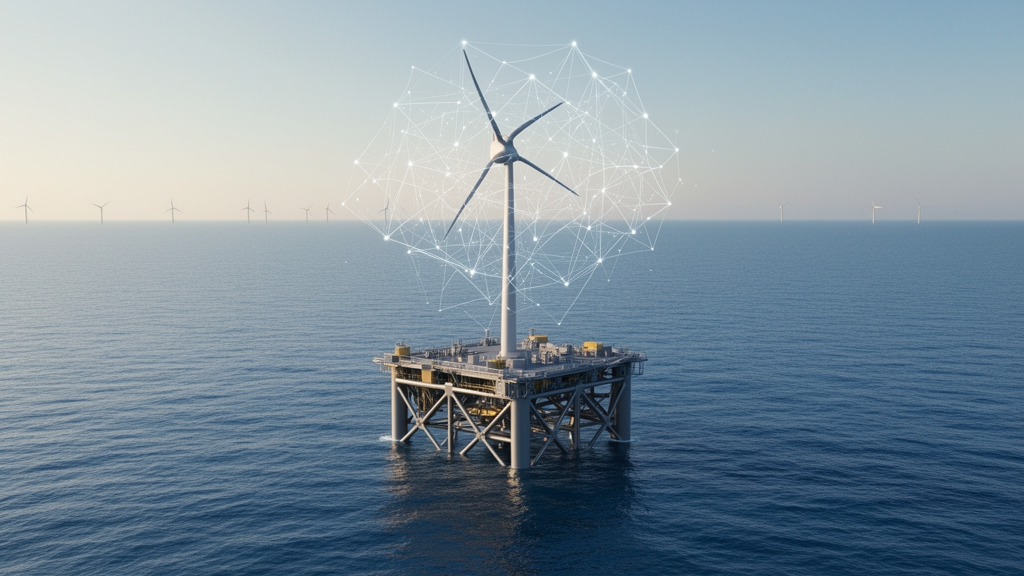
Floating offshore wind has long promised to unlock the vast wind resources of deep waters far from shore, but the technology has hit a stubborn economic wall. A new study published in the journal Wind Energy Science by Craig White of WavEC Offshore Renewables and colleagues demonstrates a way through that wall by combining two very different computational tools: a genetic algorithm that slims down the steel skeleton of a giant floating platform, and a machine learning forecasting system that predicts how the price of steel will swing in the years ahead. The result is a 15 megawatt semi-submersible platform that sheds hundreds of tonnes of steel while still riding out the worst seas the North Atlantic can throw at it, together with a far clearer picture of what the electricity it produces will actually cost.
The team started from a well-known reference design, the Volturn-US-S platform developed at the University of Maine, paired with the International Energy Agency’s 15 megawatt reference wind turbine. That turbine is a monster by any measure, with a rotor diameter of 240 metres and a hub height of 150 metres, and it rests on a steel platform built around a central column connected to three outer columns through pontoons and upper supports. The researchers defined six continuous design variables, including the main platform diameter, the diameters of the central and outer columns, and the height, width and thickness of the pontoons, and then let an optimization algorithm search that design space for the lightest structure that could still survive.
The search itself was conducted with a genetic algorithm, a computational technique that mimics biological evolution. A population of candidate platform designs, each described by its six geometric parameters, is evaluated for fitness, and the fittest individuals are combined through simulated binary crossover and polynomial mutation to produce offspring designs. Infeasible solutions that violate physical constraints are handled with a penalty scheme that lets the algorithm compare them purely on how badly they fail. Because the algorithm is inherently random, the team ran the entire optimization ten separate times, each starting from a population of one hundred individuals and running for up to one thousand generations, to gather statistics and confirm the results were not a fluke of a single lucky run.
Evaluating each candidate design required a physics model, and for that the researchers turned to RAFT, an open-source frequency-domain code that models the full floating wind turbine system as a rigid body with six degrees of freedom: surge, sway, heave, roll, pitch and yaw. Rather than simulating every turbulent gust and extreme wave in the time domain, which would be computationally prohibitive across thousands of design iterations, RAFT linearizes the dynamic equations around a mean steady state, computing how the platform responds to each excitation frequency under steady winds and stochastic sea states described by a JONSWAP wave spectrum. Aerodynamic loads on the rotor come from a steady-state blade-element momentum solver, while mooring forces are handled with a quasi-static approach. The code has been validated against higher-fidelity tools such as OpenFAST and showed good agreement, making it an ideal engine for rapid design iteration.
Crucially, the optimization was not allowed to produce a flimsy platform that would capsize or batter its turbine. The team imposed hard constraints on maximum platform offset, platform pitch, and nacelle acceleration at the tower top, along with limits on the fore-aft bending moment at the tower base and the static stress at the critical junction where the central column meets the pontoons. These quantities were computed for a set of representative load cases, including the turbine’s rated wind speed and harsh sea states typical of European waters, with the worst result across all cases checked against each limit. A static stress analysis using a free-body approach estimated bending stresses at the pontoon base from structure weight and buoyancy loads. The outcome was striking: primary steel mass fell from 3916 tonnes to 3273 tonnes, a reduction of roughly 16 percent, while every dynamic and structural constraint remained satisfied. The optimized design features slightly larger outer columns and pontoons but a smaller overall platform diameter.
With a leaner platform in hand, the researchers confronted a problem that engineering alone cannot solve: the price of steel. Commodity markets have been violently volatile in recent years, particularly after the global pandemic, and steel prices feed directly into the capital expenditure of any floating wind project, since primary steel accounts for around 83 percent of total platform cost. To bring order to this uncertainty, the team built a hybrid time series forecasting tool that blends two complementary models. The first is XGBoost, a gradient-boosted decision tree algorithm that excels at capturing short-term stochastic fluctuations in market data. The second is SARIMAX, a seasonal autoregressive statistical model that tracks longer-term trends and seasonal cycles while incorporating exogenous variables, external economic indicators such as rebar and copper prices, coal costs, and London Metal Exchange indices that act as leading indicators for steel.
The selection of those supporting variables was itself a rigorous filtering exercise. Candidate exogenous datasets were compared against the target hot-rolled coil steel prices using correlation metrics, monthly lag testing, and rolling stability analysis, with multiple transformations including log-differences applied to the data. Only indicators that passed thresholds for predictive strength, stability, sign consistency and non-redundancy made it into the final model. When tested against hindcast data covering the turbulent market period from 2022 to 2024, the hybrid approach clearly outperformed either model alone. Without supporting data, forecasts failed to revert to the mean after the 2020 price spike; with them, the hybrid model achieved a mean absolute error of 187.5, kept its average bias close to zero, and produced the most consistent performance across root mean square error and symmetric mean absolute percentage error metrics. Interestingly, the statistical SARIMAX model actually performed best in the earliest forecast months, while the machine learning model showed a tendency to overpredict and SARIMAX alone to underpredict, suggesting the two errors partially cancel in the blend.
The forecasting results were then translated into money. Monthly steel price predictions were aggregated into yearly values, converted to marine-grade steel prices, and multiplied by the platform mass to yield capital costs, with other components such as secondary steel, ballast and controls costed from published industry references. For a one gigawatt floating wind farm using a net capacity factor of 0.4925, the team calculated the levelized cost of energy over a thirty-year project lifetime with an eight percent discount rate. The numbers that emerged carry a sobering message for the industry: uncertainty in steel prices alone swings total capital expenditure by roughly 150 to 200 million euros at the gigawatt scale, a variation of 40 to 50 percent across the forecast scenarios. The XGBoost forecast, which sees prices rebounding 10 to 15 percent, represents a market recovery upper bound, while the SARIMAX forecast with its continued downward drift forms the lower bound, and the hybrid model provides a balanced baseline.
Against that backdrop of market turbulence, the engineering gains look meaningful but partial. The optimized platform achieved cost savings of approximately 10 to 15 percent across all scenarios, and structural optimization reduced the levelized cost of energy by around one euro per megawatt-hour or more in high-price scenarios. The overall LCoE variation across the steel price forecasts was more moderate, at roughly 3 to 5 euros per megawatt-hour, because the long project lifetime and high discount rate dampen the effect of upfront capital swings. The authors are careful to note the limits of their structural analysis, which uses a relatively simple static stress check rather than a full dynamic finite-element assessment, and they deliberately selected the least successful of their ten optimization runs to build in a safety margin. Still, the framework demonstrates that design improvements are possible for reference platforms while respecting real load constraints, and that hybrid forecasting can give developers and investors a defensible range of future costs.
What makes this study notable is its refusal to treat engineering and economics as separate silos. Floating offshore wind grew rapidly from its first full-scale prototype in 2009 to 88 megawatts of installed capacity by 2023, but progress has since stagnated as costs have risen in a difficult macroeconomic climate. To compete in renewable energy auctions, floating wind must cut costs across dimensions, materials and site-specific design, and the floating substructure has been identified as one of the highest-potential areas for savings. By showing that a genetic algorithm can carve 643 tonnes of steel out of a commercial-scale platform, and that machine learning can put credible bounds on the commodity price risk that dominates the remaining bill, the research offers the industry a template for making both the hardware and the financial case for floating wind more robust at the same time. The forecasting code, the genetic algorithm and the RAFT model are all openly available, inviting other teams to push the approach further.
Subject of Research: Structural and economic optimization of a 15 MW floating offshore wind platform using genetic algorithms and time series forecasting of steel prices
Article Title: Economic and design optimization of a 15 MW floating offshore wind platform using time series forecasting
Article References: White, C., Benifla, V., Cândido, J., & Gato, L. M. C. (2026). Economic and design optimization of a 15 MW floating offshore wind platform using time series forecasting. Wind Energy Science, 11(9), 3703-3717. https://doi.org/10.5194/wes-11-3703-2026
Image Credits: AI Generated
Keywords: floating offshore wind, semi-submersible platform, genetic algorithm, time series forecasting, steel price volatility, levelized cost of energy, 15 MW wind turbine, structural optimization, XGBoost, SARIMAX, CAPEX, renewable energy economics
Cite Scienmag News
Juliet Wilcox. (October 9, 2026). AI and Genetic Algorithms Shrink Giant Floating Wind Platforms While Predicting Steel Costs. Scienmag. https://scienmag.com/ai-and-genetic-algorithms-shrink-giant-floating-wind-platforms-while-predicting-steel-costs/
Juliet Wilcox. "AI and Genetic Algorithms Shrink Giant Floating Wind Platforms While Predicting Steel Costs." Scienmag, 9 October 2026, https://scienmag.com/ai-and-genetic-algorithms-shrink-giant-floating-wind-platforms-while-predicting-steel-costs/. Accessed 9 October 2026.
Juliet Wilcox. "AI and Genetic Algorithms Shrink Giant Floating Wind Platforms While Predicting Steel Costs." Scienmag. October 9, 2026. https://scienmag.com/ai-and-genetic-algorithms-shrink-giant-floating-wind-platforms-while-predicting-steel-costs/


