


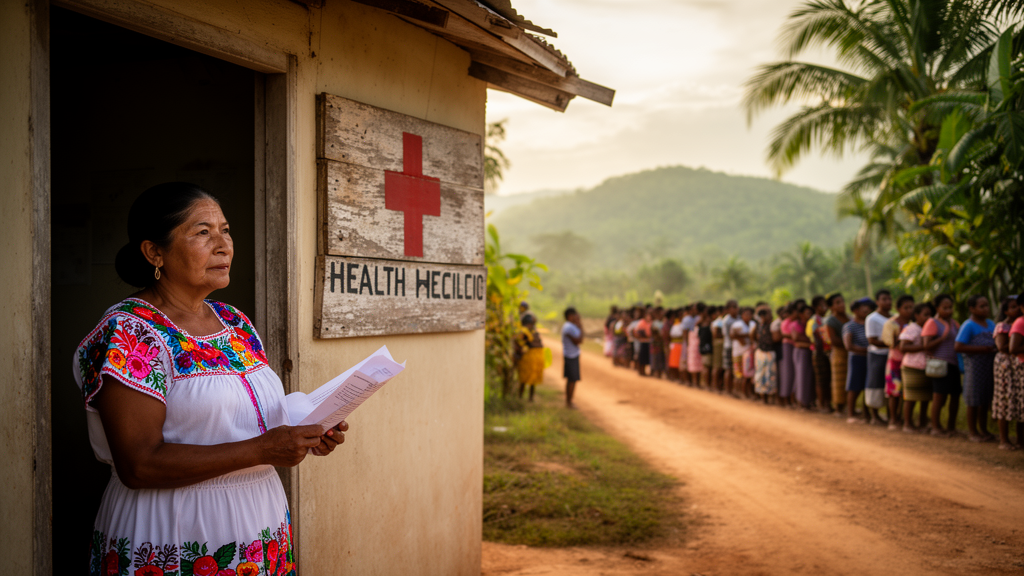
Belize promises universal healthcare to everyone within its borders, regardless of nationality or ethnicity. On paper, that promise is enshrined in the country’s constitutional guarantees and reflected in the policies of its Ministry of Health and Wellness. Yet a new qualitative study published in BMC Health Services Research reveals that for the roughly one in five Belizeans who are foreign nationals or members of Maya communities, the journey from the front door of a clinic to actual treatment is riddled with obstacles that no statute can remove. The research, led by Camilo Sánchez Meertens of the Inter-American Development Bank together with colleagues from Belize’s Ministry of Health and Wellness, offers one of the most detailed portraits to date of how healthcare inequity operates not through formal exclusion, but through the quiet accumulation of friction inside the health system itself.
The scale of the populations involved makes the findings consequential far beyond Belize’s borders. Foreign nationals make up 11.5 percent of the country’s population, while Maya communities account for 9.8 percent. Together, these groups represent a substantial share of the national population, yet Belize’s current strategic health plans contain no systematic consideration of how their access patterns differ from those of the general population. Most existing research on health inequity in similar settings has concentrated on barriers that arise in communities, such as poverty, geography, or distrust. This study deliberately shifted the analytical lens toward the health facility itself, asking what happens to patients once they arrive, and what they encounter along every step of their journey through the system.
Methodologically, the research triangulated three distinct forms of evidence. The team conducted a narrative literature review to establish the policy and epidemiological context, carried out semi-structured interviews with 67 participants, and performed structured direct observation of patient journeys at five health facilities across Belize. Data collection took place in September 2025. The researchers used maximum variation sampling, deliberately recruiting participants across migration status, gender, ethnicity, and professional roles, so that the analysis would capture the widest possible range of experiences rather than a narrow demographic slice. Ethical approval was granted by the Institutional Review Board of Belize’s Ministry of Health and Wellness, and all participants gave written informed consent in English or Spanish, in accordance with the Declaration of Helsinki.
The analytical engine of the study was a hybrid coding approach. Deductive codes were drawn in advance from the World Health Organization’s accessibility framework, giving the team a structured vocabulary for known categories of access barriers such as availability, affordability, and acceptability. Inductive codes were then allowed to emerge from the fieldwork itself, capturing patterns the pre-existing framework did not anticipate. This combination matters technically because purely deductive designs can miss locally specific phenomena, while purely inductive designs risk losing comparability with the international literature. By running both in parallel, the researchers could anchor their findings in established global frameworks while still letting Belize’s particular realities shape the analysis.
The headline finding is deceptively simple: care in Belize is formally free, but practically expensive. The study documents how extensive waiting times impose hidden costs on patients who must sacrifice wages or daily work to sit in queues, and how financial barriers such as transportation expenses and the cost of medications erode the promise of free care. For some patients living near the border, these cumulative costs become so burdensome that seeking care across the border becomes the rational choice, despite the formal availability of services at home. This dynamic illustrates a concept well known in health services research: the effective price of care is not the fee charged at registration, but the total cost, in money and time, of completing a patient journey.
Communication emerged as a second, deeply structural barrier. Elderly Maya patients who speak Q’eqchi’ or Mopan frequently cannot communicate with health staff, and interpretation within facilities remains informal and unsystematic, often depending on whoever happens to be available, including family members or bystanders. In clinical settings, informal interpretation is a recognized patient safety risk, since medical terminology, dosing instructions, and consent conversations can be distorted or lost. Compounding this, system navigation is hindered by a scarcity of multilingual information about available services and procedures, meaning that patients who already face language barriers must also decipher an unfamiliar bureaucratic landscape without adequate signage, leaflets, or guidance in languages they understand.
The study also identified a feedback problem that quietly silences the very populations most affected. Patient feedback mechanisms in Belizean facilities are available only in English and lack anonymity, which discourages migrants and Maya patients from filing complaints or suggestions even when their experiences are poor. In the architecture of health system accountability, feedback channels function as sensors; when those sensors are linguistically inaccessible and socially risky to use, facility managers lose the information they need to detect and correct inequities. The result is a system that can appear responsive on paper while remaining blind to the experiences of its most vulnerable users.
Perceived discrimination, the researchers found, arises primarily from interpersonal dynamics during registration, the very first point of contact between patient and institution. This finding is significant because registration is a routine, high-volume interaction, and small failures of courtesy or cultural understanding there can color a patient’s entire perception of the health system. The problem is exacerbated by chronic staff shortages, which stretch personnel thin, lengthen queues, and heighten tensions at reception desks. In other words, what patients may experience as disrespect is often rooted in a resourcing problem, a distinction that matters for policy because the remedy is not simply sensitivity training but also adequate staffing levels.
The study’s central conclusion reframes the problem in a way that carries lessons for multicultural health systems across low- and middle-income countries. Healthcare inequities affecting migrants and Maya populations in Belize do not stem from formal exclusion, since no rule bars anyone from care. Instead, they emerge from the cumulative effect of structural, linguistic, cultural, and resource barriers encountered throughout the journey to and through the health system. Each individual barrier might seem minor, but their interaction produces outcomes as severe as outright exclusion, including cross-border care seeking and untreated illness. This cumulative framing shifts the policy target from changing eligibility rules, which are already inclusive, to redesigning the patient journey itself.
To translate diagnosis into action, the researchers propose a three-layered framework. The first layer addresses the facility environment, improving the physical and informational conditions patients encounter, from multilingual signage to streamlined registration. The second layer focuses on staff capacity development, equipping health workers with the linguistic and cultural competencies needed to serve a diverse population, while also confronting the underlying staff shortages that strain every interaction. The third layer anchors solutions in communities themselves, building on Community Health Workers, trusted local figures who can bridge the gap between households and facilities, provide interpretation, and guide patients through the system. Because the framework was developed with Belize’s Ministry of Health and Wellness as a partner and funded through the Inter-American Development Bank, it is positioned for direct policy uptake rather than academic shelf life. For a small country with a diverse population and limited resources, the study’s message is ultimately optimistic: the barriers are real, but they are specific, mappable, and fixable, and strengthening universal access for everyone may require nothing more radical than paying close attention to the journeys of those the system currently serves worst.
Subject of Research: Barriers to healthcare access for migrant and Maya populations in Belize
Article Title: A qualitative study identifying barriers and policy solutions for healthcare access among migrants and Maya populations in Belize
Article References: Sánchez Meertens, C., Cho, K., Terry, C., Bell, L., Diaz-Musa, M., Arriaga, A., & Góngora-Salazar, P. (2026). A qualitative study identifying barriers and policy solutions for healthcare access among migrants and Maya populations in Belize. BMC Health Services Research. https://doi.org/10.1186/s12913-026-15792-5
Image Credits: AI Generated
DOI: 10.1186/s12913-026-15792-5
Keywords: Belize, healthcare access, migrant health, indigenous health, Maya populations, health equity, qualitative research, patient journey, Community Health Workers, health policy, language barriers, health services research
Cite Scienmag News
Phoebe Ingram. (October 9, 2026). Free on Paper, Blocked in Practice: Why Migrants and Maya Communities Struggle to Reach Care in Belize. Scienmag. https://scienmag.com/free-on-paper-blocked-in-practice-why-migrants-and-maya-communities-struggle-to-reach-care-in-belize/
Phoebe Ingram. "Free on Paper, Blocked in Practice: Why Migrants and Maya Communities Struggle to Reach Care in Belize." Scienmag, 9 October 2026, https://scienmag.com/free-on-paper-blocked-in-practice-why-migrants-and-maya-communities-struggle-to-reach-care-in-belize/. Accessed 9 October 2026.
Phoebe Ingram. "Free on Paper, Blocked in Practice: Why Migrants and Maya Communities Struggle to Reach Care in Belize." Scienmag. October 9, 2026. https://scienmag.com/free-on-paper-blocked-in-practice-why-migrants-and-maya-communities-struggle-to-reach-care-in-belize/


