


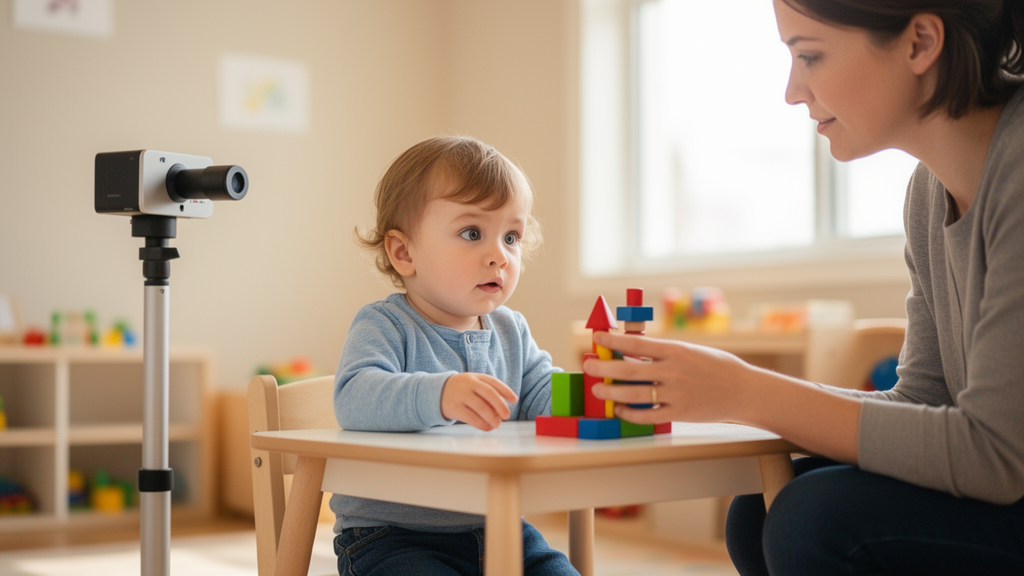
Every glance a toddler makes carries information. The speed at which their eyes snap toward a new face, the milliseconds they linger on a smiling mouth, the way their gaze darts between competing images — all of it reflects a nervous system under construction. Now a team of researchers at the INFANT Research Centre at University College Cork, Ireland, has shown that these tiny eye movements, recorded with clinical precision, line up with scores on one of the most widely used developmental assessments in the world. In a prospective study of 53 healthy term-born children, published in Pediatric Research, the team found that eye-tracking measures captured at 18 months of age were significantly associated with performance on the Griffiths Scales of Child Development, Third Edition, known as Griffiths-III. The findings suggest that a camera and a carefully designed task could one day complement — and in some contexts partially replace — the lengthy, examiner-dependent assessments currently used to chart early development.
The problem the researchers set out to address is a familiar one in developmental pediatrics. Standard neurodevelopmental assessments such as the Griffiths-III are powerful tools, but they are labor-intensive, require trained clinicians, and depend heavily on the child’s cooperation on the day of testing. A tired, cranky, or shy toddler can distort a profile that is meant to reflect underlying ability. Screening tools designed to be quicker sacrifice sensitivity, and the field has long debated which cut-off scores best identify children who genuinely need support. What clinicians lack is an objective, quantitative measure of how a young child’s brain is processing the world — one that does not rely on a toddler’s willingness to stack blocks or point at pictures. Eye-tracking has long been proposed as exactly that kind of measure, particularly in research on infants at risk for autism, where gaze patterns have proven informative years before behavioral symptoms emerge.
The Cork team recruited healthy children born at term and followed them prospectively to 18 months of age, a deliberately conservative design choice. By studying typically developing children rather than a high-risk cohort, the researchers could ask a more fundamental question: do eye-tracking measures carry meaningful signal about development even within the normal range? At the 18-month visit, each child completed both an eye-tracking battery and the full Griffiths-III assessment. The eye-tracking tasks were designed to probe three domains that are foundational to early cognition: working memory, visual attention, and social cognition. Among them was a so-called happy task, in which children viewed images of faces, and a pop-out task that tested how rapidly their eyes were drawn to salient targets in a visual field.
From these tasks, the researchers extracted classic oculomotor and attentional metrics: the latency of the first fixation toward a target, the mean duration of individual fixations, and saccadic reaction time — the speed of the rapid eye movements that shift gaze from one point to another. In the social tasks, they also measured where on the face children looked, distinguishing fixations on the eyes from fixations on the mouth. These are not arbitrary choices. Saccadic reaction time indexes the efficiency of attentional orienting circuits; fixation duration reflects how long the brain allocates processing resources to a stimulus; and the balance between eye and mouth looking is a well-studied signature of social attention that changes across development and differs in conditions such as autism spectrum disorder.
The headline result concerned the happy task, the measure of social cognition. Mean fixation duration on the mouth region of faces showed the strongest and most consistent associations with Griffiths-III performance. Children who looked longer at mouths scored higher on subscale A of the Griffiths-III, Foundations of Learning, with a correlation coefficient of 0.30. The association with subscale B, Language and Communication, was strikingly stronger, at r = 0.57, a large effect by conventional standards and highly statistically significant. Mouth looking also correlated with subscale D, Personal-Social-Emotional development, at r = 0.37, and with the overall General Development score at r = 0.39. In other words, a single, objectively recorded behavior — how long an 18-month-old fixates the mouth of a pictured face — tracked language ability, social-emotional maturity, and general developmental standing simultaneously.
That the language association was the strongest is biologically plausible rather than coincidental. Developmental scientists have long argued that attentional abilities constrain language learning: infants must attend to faces, and specifically to the moving mouth, to extract the phonetic and visual cues that scaffold word learning. A child who devotes longer fixations to mouths at 18 months is, in effect, demonstrating an attentional system tuned to the richest source of linguistic input. The Cork findings give that theoretical framework a quantitative foothold in a typically developing cohort, echoing earlier work in clinical populations where atypical face-scanning patterns were linked to language impairment and to autism. They also align with cross-syndrome studies showing that visual attention measured in infancy predicts later vocabulary profiles.
Correlations alone, however, can be misleading, so the team went further, building multivariable linear regression models that combined several eye-tracking measures to predict Griffiths-III outcomes. These combined models were notably more powerful than any single metric. Eye-tracking variables explained 36 percent of the variance in the Foundations of Learning subscale, 41 percent of the variance in Language and Communication, and a remarkable 55 percent of the variance in Personal-Social-Emotional development. For a set of brief, nonverbal, computer-administered tasks to account for over half of the variability in a clinician-rated social-emotional domain is a striking result, and it suggests that gaze behavior captures a substantial portion of what traditional assessments are measuring — through an entirely independent channel.
The study has limits that the authors themselves acknowledge, and honest interpretation requires keeping them in view. Fifty-three children is a modest sample, adequate for detecting the reported associations but small enough that replication in larger and more diverse cohorts is essential. The participants were healthy term-born children, so the findings cannot yet be assumed to generalize to preterm infants or children with known developmental risk, groups in whom eye-tracking has often shown even greater predictive value. The researchers also note that the field lacks age-appropriate eye-tracking tasks with standardized scoring, which currently limits clinical translation. And, as with any correlational design, the direction of the relationship remains open: gaze patterns may shape development, reflect it, or both. The authors call for future work focused on developing standardized, age-calibrated tasks, particularly for language, communication, and social development.
Even with those caveats, the implications are considerable. An objective, scalable measure of early neurodevelopment could transform how developmental problems are detected. Current screening misses many children with delays, and by the time a formal diagnosis is secured, valuable windows of neuroplasticity may have narrowed. Eye-tracking requires no verbal response, no motor cooperation, and no examiner judgment, making it usable in preverbal infants, in children with motor impairments, and potentially in primary care or community settings far from specialist clinics. It also produces continuous, quantitative data rather than pass-fail judgments, which could allow clinicians to track a child’s trajectory over time with far finer resolution than repeated standardized tests permit.
What this study adds is a crucial piece of validation: evidence that in ordinary, healthy toddlers, the eyes already know something the clinic measures. The strongest signal came from social attention — the simple act of looking at a mouth — and it resonated across language, social-emotional, and general developmental domains. If larger studies confirm these associations and standardized task batteries emerge, eye-tracking could move from the research laboratory into the pediatric toolkit as a complementary objective marker of early development, one that turns a toddler’s fleeting glances into durable, measurable evidence of a growing mind.
Subject of Research: Association between infant eye-tracking measures and Griffiths-III neurodevelopmental assessment scores at 18 months of age
Article Title: Association between eye-tracking measures and Griffiths-III developmental scores at 18 months in healthy term-born children
Article References: Lenehan, S. M., Livingstone, V., O’Toole, J. M., Mathieson, S. R., Dempsey, E. M., Murray, D. M., & Boylan, G. B. (2026). Association between eye-tracking measures and Griffiths-III developmental scores at 18 months in healthy term-born children. Pediatric Research. https://doi.org/10.1038/s41390-026-05421-6
Image Credits: AI Generated
DOI: 10.1038/s41390-026-05421-6
Keywords: eye-tracking, neurodevelopment, Griffiths-III, toddlers, social cognition, language development, visual attention, saccadic reaction time, developmental assessment, pediatrics, fixation duration, early screening
Cite Scienmag News
Denise Maddox. (October 9, 2026). Where Toddlers Look Reveals How Their Minds Are Developing, Study Finds. Scienmag. https://scienmag.com/where-toddlers-look-reveals-how-their-minds-are-developing-study-finds/
Denise Maddox. "Where Toddlers Look Reveals How Their Minds Are Developing, Study Finds." Scienmag, 9 October 2026, https://scienmag.com/where-toddlers-look-reveals-how-their-minds-are-developing-study-finds/. Accessed 9 October 2026.
Denise Maddox. "Where Toddlers Look Reveals How Their Minds Are Developing, Study Finds." Scienmag. October 9, 2026. https://scienmag.com/where-toddlers-look-reveals-how-their-minds-are-developing-study-finds/


