


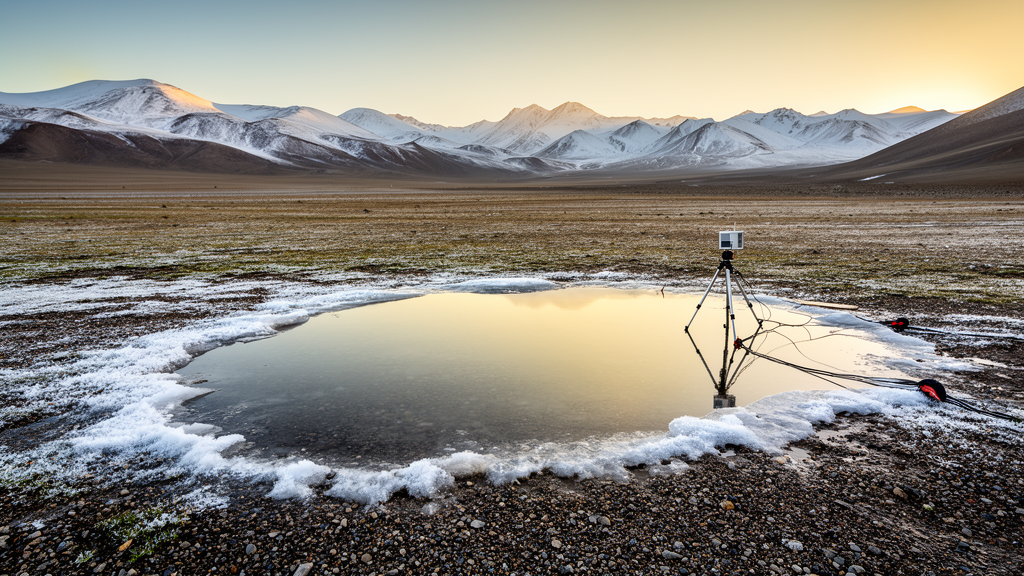
Every spring, across the high plateaus of Asia, an invisible transformation takes place beneath the feet of herders and above the aquifers that sustain rivers, lakes, and wetlands. Soil that spent the winter locked in ice begins to thaw, and with that thaw the entire plumbing system of the landscape changes. A new study of the Qinghai Lake Basin, published in Hydrology and Earth System Sciences, has now quantified exactly how this annual freeze–thaw cycle dictates where shallow groundwater comes from and which routes it takes underground. The findings come at a critical moment, because the permafrost that underpins much of the Qinghai–Tibet Plateau — often called the Asian Water Tower — is warming and degrading, and the water security of hundreds of millions of people downstream depends on how these frozen systems respond.
The research team, led by Wenhao Zhang and Xiaoyan Li of Beijing Normal University, chose the Qinghai Lake Basin as their natural laboratory for good reason. Covering nearly 30,000 square kilometers in the northeastern part of the plateau, the basin is split almost evenly between two very different frozen-ground regimes. Permafrost dominates the upstream, high-altitude areas, accounting for about 41.5 percent of the basin, while seasonally frozen soil covers the remaining 58.5 percent in the midstream, downstream, and lakeside plains. This natural gradient allowed the researchers to compare, within a single watershed, how permanently frozen ground and ground that freezes and thaws each year shape groundwater recharge in distinct ways.
To untangle these processes, the team built a comprehensive ecohydrological monitoring network across the basin. Between May and October 2025, they collected 481 samples in total: 90 of groundwater drawn from wells used by local herders, 306 of soil from three depth intervals — 0–30, 30–60, and 60–90 centimeters — and 85 of precipitation, including both rainfall and snow. Every sample was analyzed for its hydrogen and oxygen stable isotope composition using isotope ratio infrared spectrometry, with analytical precisions of ±0.5 per mil for deuterium and ±0.1 per mil for oxygen-18. Because every source of water — rain, snowmelt, soil moisture at different depths — carries a slightly different isotopic fingerprint, these measurements act like natural tracers, allowing the researchers to work out after the fact which waters ended up in the aquifer and how they got there.
The team divided the study window into three freeze–thaw periods based on sustained air and soil temperature thresholds: a thawing period in May and June, when soils transition from frozen to unfrozen; a thawed period from July to September, when the ground stays entirely unfrozen; and a freezing period in October, when temperatures drop back below zero. They then fed the isotope data into MixSIAR, a Bayesian mixing model that estimates the relative contribution of each potential water source to the groundwater while explicitly accounting for uncertainty. The results were striking. Across the entire freeze–thaw cycle, soil water was the dominant source of shallow groundwater recharge, contributing between 57.0 and 76.3 percent. Rainfall contributed 13.8 to 26.1 percent, and snowmelt — despite its dramatic visual presence on the landscape — contributed only 7.9 to 22.0 percent.
That snowmelt plays such a modest direct role may come as a surprise, and the authors offer two explanations. First, during the thawing period, air temperatures remain low, so snow melts slowly rather than releasing a sudden pulse of water. Second, under the basin’s intense solar radiation and strong winds, a significant share of snow water is lost to runoff or sublimation before it can infiltrate. Snow, in other words, functions largely as temporary storage on the surface rather than as an immediate source of groundwater. Instead, it is the water already held in the soil — moisture that fell as rain or snow in previous seasons and was released as the ground thawed — that does most of the work of refilling the shallow aquifer.
The study also revealed how the physical state of the soil controls the pathways water takes downward. During the thawing period, the active layer thaws only from the top, leaving a near-impermeable frozen layer beneath that blocks vertical infiltration. Meltwater and rain therefore pool in a transient saturated zone near the surface and migrate laterally as interflow, delaying groundwater recharge and often reaching the aquifer only indirectly, through riparian seepage and soil-layer redistribution. Once the thawed period arrives and this barrier disappears, the vertical connectivity of the soil profile increases dramatically, allowing water from the 60–90 centimeter layer and surface-derived water to percolate downward more freely. During the freezing period, bidirectional freezing — from the surface downward and from the base of the active layer upward — traps water above the advancing freezing front, yet some shallow water still finds its way to groundwater through preferential channels before the profile seals completely.
Isotopic evidence pointed to a subtle but important shift in recharge mechanics over the season. The researchers used a metric called line-conditioned excess, or lc-excess, which measures how far a water sample deviates from the local meteoric water line — the reference relationship between hydrogen and oxygen isotopes in precipitation. Water that has undergone evaporation, typical of slow, matrix-driven piston flow through soil pores, carries low lc-excess values, whereas water reaching the aquifer via fast preferential pathways retains an isotopic signature close to that of precipitation. Over the course of the freeze–thaw cycle, groundwater lc-excess values shifted from resembling soil water toward resembling precipitation, indicating that piston flow gradually weakened while preferential flow intensified, producing a recharge regime in which the two mechanisms coexist.
Space mattered as much as time. In the middle and upper reaches of the basin, where permafrost prevails, groundwater is recharged primarily by water from the 0–60 centimeter soil layer traveling along longer, more circuitous hydrological pathways. In the downstream regions dominated by seasonal frozen ground, by contrast, gentle topography and shallow water tables favor rapid infiltration, and groundwater is recharged mainly by water from the 30–90 centimeter layer moving quickly through macropores and fissures. Soil moisture measurements reinforced this picture: water content in the upper reaches remained consistently higher than downstream, and the seasonal patterns of wetting and drying differed markedly between the two zones, reflecting the different thermal regimes of permafrost and seasonally frozen ground.
The authors are candid about the limitations of their approach. Snowmelt samples were collected from the snowpack, so sublimation before melt and evaporation afterward may have altered the isotopic signature used to trace snow contributions. Freezing itself causes isotopic fractionation, as lighter isotopes preferentially remain in unfrozen liquid water while heavier isotopes enrich the ice phase, complicating pathway identification. And because piston flow and preferential flow operate simultaneously, water mixing between soil layers can blur the source signatures that the mixing model relies upon. Future work, they suggest, should combine high-frequency in situ monitoring with multiple tracers, including dye tracing, to pin down recharge pathways with greater precision.
Even with those caveats, the implications are far-reaching. As climate warming deepens the active layer and degrades permafrost across the plateau, the balance between recharge sources is likely to narrow while the differences between recharge pathways widen, reorganizing how water moves through these landscapes. The study demonstrates that assessments focused solely on rainfall risk underestimating the contributions of snowmelt and, above all, soil water to alpine aquifers. For water managers charged with sustaining baseflow in plateau rivers and the communities and ecosystems that depend on them, the message is clear: in frozen ground, the seasons do not merely change the weather — they rewrite the hidden architecture of the water cycle itself.
Subject of Research: Influence of freeze–thaw processes on shallow groundwater recharge sources and pathways in the Qinghai Lake Basin, traced with stable water isotopes
Article Title: Freeze–thaw processes influence shallow groundwater recharge sources and pathways in the Qinghai Lake Basin: insights from water isotopes
Article References: Zhang, W., Li, X., Deng, Y., Hu, G., & Shi, F. (2026). Freeze–thaw processes influence shallow groundwater recharge sources and pathways in the Qinghai Lake Basin: insights from water isotopes. Hydrology and Earth System Sciences, 30(18), 6039-6055. https://doi.org/10.5194/hess-30-6039-2026
Image Credits: AI Generated
DOI: 10.5194/hess-30-6039-2026
Keywords: groundwater recharge, freeze–thaw cycle, permafrost, Qinghai Lake Basin, stable water isotopes, Qinghai–Tibet Plateau, soil water, snowmelt, piston flow, preferential flow, active layer, alpine hydrology
Cite Scienmag News
Violet Maxwell. (October 9, 2026). Frozen Ground Rewrites the Rules of Groundwater Recharge on the Qinghai–Tibet Plateau. Scienmag. https://scienmag.com/frozen-ground-rewrites-the-rules-of-groundwater-recharge-on-the-qinghai-tibet-plateau/
Violet Maxwell. "Frozen Ground Rewrites the Rules of Groundwater Recharge on the Qinghai–Tibet Plateau." Scienmag, 9 October 2026, https://scienmag.com/frozen-ground-rewrites-the-rules-of-groundwater-recharge-on-the-qinghai-tibet-plateau/. Accessed 9 October 2026.
Violet Maxwell. "Frozen Ground Rewrites the Rules of Groundwater Recharge on the Qinghai–Tibet Plateau." Scienmag. October 9, 2026. https://scienmag.com/frozen-ground-rewrites-the-rules-of-groundwater-recharge-on-the-qinghai-tibet-plateau/


