


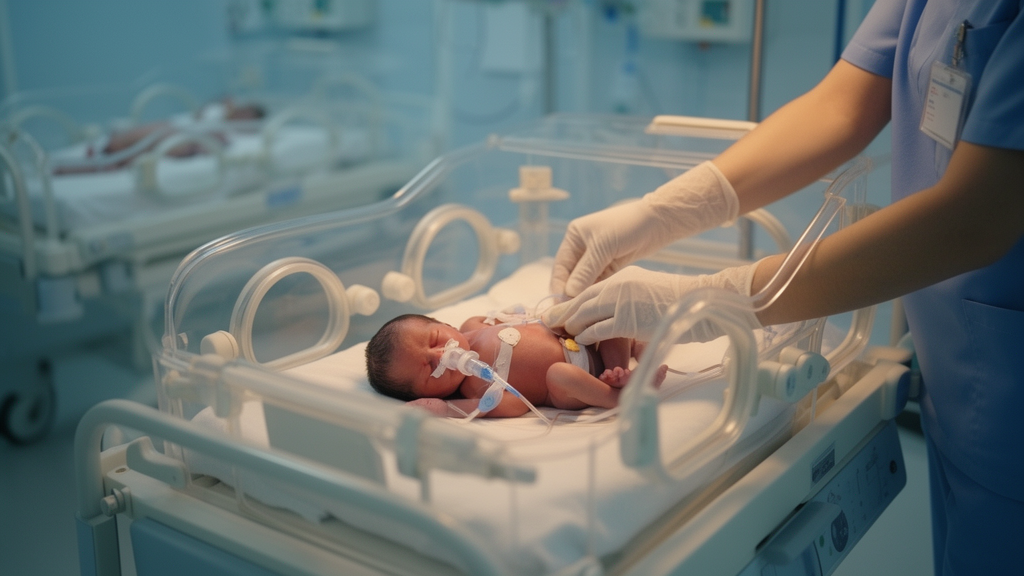
For infants born before 28 weeks of gestation, the first hours of life are a race against physiology. Their skin is gelatinous, their blood vessels are thinner than a human hair, and their survival depends on the rapid delivery of fluids, medications, blood products, and parenteral nutrition through devices inserted into veins no wider than a pin. Now, the largest international survey ever conducted on neonatal vascular access has revealed just how differently the world’s intensive care units approach this delicate, high-stakes task — and the findings suggest that a baby’s odds of avoiding a catheter-related complication may depend heavily on the geography of their birth.
The survey, published in the Journal of Perinatology, gathered responses from 848 tertiary neonatal units across 100 countries, spanning all six World Health Organization regions. Each unit was represented by a single clinician — 60 percent medical staff and 40 percent nursing staff — identified as most familiar with their unit’s vascular access practices. The 18-item questionnaire, distributed between February 2019 and August 2021, probed four domains: guideline availability, insertion practices, monitoring routines, and device removal policies. The results, reported in accordance with STROBE and CROSS reporting standards, paint a picture of remarkable heterogeneity in a field where consistency could mean the difference between health and harm.
The starkest variation emerged in guideline availability. While 85 to 98 percent of units reported having local protocols for umbilical venous catheters — the flexible tubes threaded through the umbilical stump into the large central veins of newborns — coverage for peripheral intravenous catheters ranged from a low of 29 percent in African units to a high of 97 percent in South America. That means in some regions, the most commonly used device in neonatal medicine is being inserted and managed with little formal guidance, leaving practice to individual habit and institutional folklore rather than evidence.
Device preference also followed a clear hierarchy. For the most fragile infants, the umbilical venous catheter reigned supreme: 70 percent of units caring for babies born at 23 weeks and 63 percent of those caring for 24-week infants chose it as the initial vascular access device. The preference makes technical sense. Umbilical catheters exploit a natural anatomical window — the vessels of the umbilical cord remain patent for days after birth — whereas threading a peripherally inserted central catheter through the minuscule veins of a 500-gram infant demands exceptional dexterity. Yet the choice carries risk: reported rates of umbilical catheter malposition, thrombosis, and infection range from 8 to 36 percent, and bloodstream infection has been documented in up to 12 percent of cases.
Securement techniques, the methods used to keep these devices from migrating once placed, have barely evolved in half a century. Sixty percent of units still anchor umbilical catheters with a stitch through Wharton’s jelly, the gelatinous connective tissue within the cord, tied with a suture, while 43 percent use a goal-post dressing. Only 7 percent employ a commercial securement device. The authors note that these approaches have remained largely unchanged for five decades, a stagnation they attribute partly to market forces: with relatively low usage volumes, manufacturers have little financial incentive to develop neonatal-specific securement technology. Securement failure is not a trivial matter — a migrating catheter can cause bloodstream infection, thrombosis, or even hepatic injury.
Monitoring practices showed equally troubling gaps. Only 56 percent of units assessed peripherally inserted central catheter sites at intervals shorter than eight hours, and a striking 58 percent reported using no formal tool at all to detect extravasation — the leakage of infused fluids into surrounding tissue. This is particularly concerning because extremely preterm infants are the highest-risk pediatric population for extravasation-related tissue injury; their fragile skin can be damaged by even small volumes of infiltrated fluid, sometimes leaving permanent scarring. Where formal scales were used, uptake varied from 45 percent of North American units to just 21 percent in Africa, suggesting that even where awareness exists, structured assessment has not become routine.
Insertion practices revealed a spectrum of rigor. Hand hygiene during peripheral catheter insertion was nearly universal at 90 percent, but glove choice split the world: 57 percent of units used sterile gloves while 43 percent settled for clean gloves, with South America and Oceania favoring sterility and North America leaning toward clean gloves. Tourniquets were routine in more than 70 percent of Oceanian and North American units but used in only 36 percent of African units. Vein-finding technology — infrared devices that illuminate subcutaneous vessels — was used routinely by 46 percent of Oceanian units but a mere 7 percent in South America, despite growing evidence supporting ultrasound-guided and technology-assisted vascular access in neonates.
Perhaps the most intriguing finding concerned gestational age thresholds. Units that offered active care to infants born at 22 to 23 weeks — the very edge of viability — were roughly twice as likely to have comprehensive vascular guidelines as units whose threshold began at 24 to 25 weeks. These same units practiced more frequent hand hygiene, used more insertion aids and transparent dressings, and performed more intensive catheter site surveillance. The authors suggest this heightened vigilance may be associated with lower rates of systemic infection, an observation that hints at a paradox: the units caring for the smallest, most vulnerable babies may have developed the most disciplined vascular cultures precisely because their patients leave no margin for error.
The survey period overlapped with the onset of the COVID-19 pandemic, which the authors acknowledge may have affected staffing, resources, and procedural practices, and self-reported data carry inherent recall bias. Still, with item completion rates above 90 percent and representation from every inhabited continent, the study offers an unprecedented baseline. The authors call for international consensus, targeted research, and investment in neonatal-specific technology — including tissue adhesives, ultrasound guidance, and standardized extravasation scoring — to bring vascular access care into the same evidence-based era that resuscitation and respiratory management already enjoy.
For the roughly 13 million preterm infants born worldwide each year, and especially the fraction born at the threshold of viability, the message is clear: the tubes that carry their lifeline are inserted, secured, and watched over in wildly different ways depending on where they happen to be born. Standardizing those practices, the authors argue, is not a bureaucratic nicety but a matter of safety, equity, and survival for the world’s smallest patients.
Subject of Research: International variation in vascular access device practices for extremely preterm infants
Article Title: Vascular device practices in extremely preterm infants: an international cross-sectional survey
Article References: Mishra, U., de Souza, S., Buchmayer, J., Maheshwari, R., D’Çruz, D., Walker, K., Gözen, D., Lowe, K., Wright, A., Marceau, J., Culcer, M., Priyadarshi, A., Moore, J., Shah, V., Vaidya, U., Khashana, A., Godambe, S., Cheah, F., Zhou, W., … Jani, P. (2026). Vascular device practices in extremely preterm infants: an international cross-sectional survey. Journal of Perinatology. https://doi.org/10.1038/s41372-026-02892-7
Image Credits: AI Generated
DOI: 10.1038/s41372-026-02892-7
Keywords: extremely preterm infants, vascular access, umbilical venous catheter, peripheral intravenous catheter, peripherally inserted central catheter, neonatal intensive care, extravasation, guideline variation, catheter securement, infection prevention, global health, Journal of Perinatology
Cite Scienmag News
Harold Sullivan. (October 9, 2026). Global Survey Reveals Stark Inconsistencies in Lifeline Care for the Tiniest Newborns. Scienmag. https://scienmag.com/global-survey-reveals-stark-inconsistencies-in-lifeline-care-for-the-tiniest-newborns/
Harold Sullivan. "Global Survey Reveals Stark Inconsistencies in Lifeline Care for the Tiniest Newborns." Scienmag, 9 October 2026, https://scienmag.com/global-survey-reveals-stark-inconsistencies-in-lifeline-care-for-the-tiniest-newborns/. Accessed 9 October 2026.
Harold Sullivan. "Global Survey Reveals Stark Inconsistencies in Lifeline Care for the Tiniest Newborns." Scienmag. October 9, 2026. https://scienmag.com/global-survey-reveals-stark-inconsistencies-in-lifeline-care-for-the-tiniest-newborns/


