


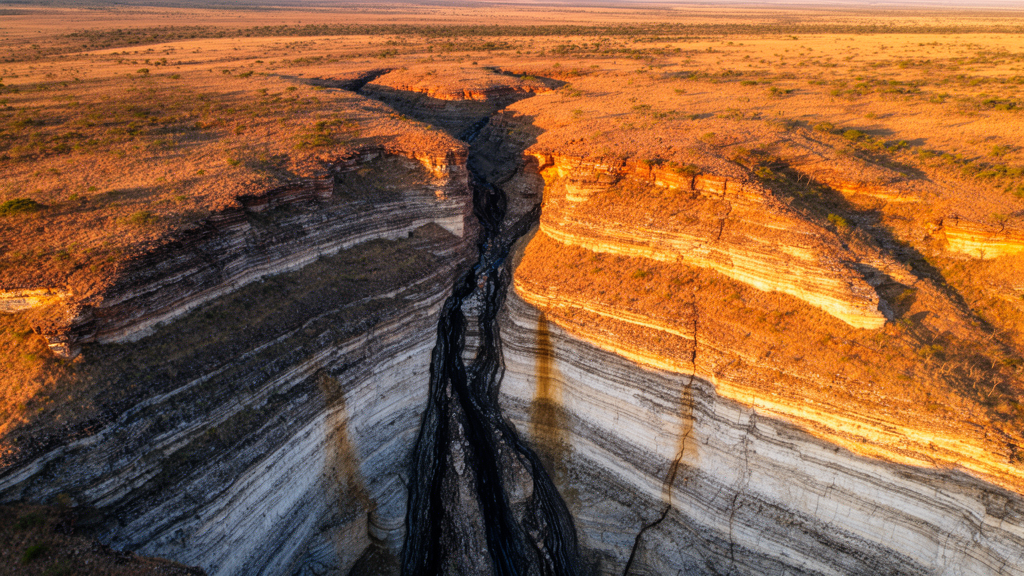
Deep beneath South Africa’s Bushveld Complex, an international scientific drilling campaign has uncovered compelling evidence that hot, saline, gas-rich fluids are still moving through one of the world’s most famous bodies of igneous rock. In a study published in Scientific Drilling, researchers led by Rolene Lubbe of the University of the Free State report that water sampled from a deep exploration well shows a dramatic chemical shift at 450 metres below ground level, exactly where the drill bit passed through a severely fractured anorthosite layer. The finding suggests that structural features, rather than the rock itself, control how fluids travel through crystalline formations that are otherwise nearly impermeable, and it challenges long-standing assumptions about how deep groundwater can move in such settings.
The Bushveld Complex is a roughly two-billion-year-old layered igneous intrusion that spans hundreds of kilometres and reaches thicknesses of seven to nine kilometres. It hosts the world’s largest reserves of platinum-group elements, along with vast deposits of chromium and vanadium. Scientists have long debated how repeated pulses of magma built the Rustenburg Layered Suite, the remarkable stack of mafic and ultramafic rocks that gives the complex its economic value. Yet while the magmatic story has been studied intensively, the role of hydrothermal fluids that circulated after the magma crystallised has remained surprisingly underexplored, particularly in the deeper parts of the sequence where direct observations are scarce.
The new evidence comes from the Bushveld Complex Drilling Project, an initiative funded by the International Continental Scientific Drilling Program. The near-vertical exploration well on the eastern limb of the complex was collared in the Upper Critical zone, between the UG1 and MG4 chromitite layers, and hydrogeological data were collected to a depth of 950 metres, with drilling continuing toward roughly 2000 metres. The team worked in phases, flushing the borehole with water for around nine hours to displace residual drilling fluids, then running geophysical surveys and hydrogeological logging to identify permeable intervals before collecting depth-specific groundwater samples with a controlled-depth sampler. Between phases, the well was cased and cemented to preserve its integrity.
The lithological log reads like a journey through the heart of the intrusion. The upper 500 metres intersected norites, gabbronorites, anorthosites, pyroxenites and chromitites of the Upper Critical zone, with the MG4 chromitite appearing at about 255 metres. Below 500 metres, the Lower Critical zone is dominated by ultramafic rocks including harzburgite and dunite, and the LG1 chromitite, the lowest chromitite horizon of the suite, was crossed at roughly 810 metres. Because these crystalline igneous rocks have negligible primary porosity, any groundwater movement must exploit secondary porosity created by fractures, faults and intrusive contacts. Open fractures were identified at depths of up to 322 metres, and their abundance was high enough to cause total water loss during drilling until the upper section could be sealed.
The pivotal discovery lies between 450 and 455 metres, where a severely fractured anorthosite layer hosting disseminated chromitite was encountered. The fractures are filled with calcite, chlorite and quartz, a mineral assemblage that points to past circulation of hydrothermal fluids. Downhole logging of electrical conductivity, converted to total dissolved solids, revealed a striking spike at this depth, with concentrations exceeding 6000 milligrams per litre. The groundwater sample from this interval is chemically distinct, classified as a calcium chloride type, whereas shallower samples show a mixed magnesium-calcium-chloride-bicarbonate signature and deeper samples trend toward sodium chloride. This positions the fractured anorthosite as a transition zone where old, evolved fluids are being channelled through a structurally weakened horizon.
The chemical fingerprint of the 450-metre water is rich in clues. Sodium, chloride, sulfate, calcium, potassium, zinc, fluoride and boron all peak sharply there, and redox-sensitive metals such as iron and manganese are elevated, indicating increasingly reducing conditions with depth. Boron and fluoride enrichment is particularly significant because both elements are commonly associated with hydrothermal systems worldwide. Stable isotope analysis reinforces the picture: samples deeper than 450 metres show markedly more positive values of both oxygen-18 and deuterium relative to the global and local meteoric water lines, a pattern consistent with prolonged water-rock interaction and the formation of saline formation waters rather than recent rainwater recharge. Analogous patterns have been documented in the crystalline rocks of the Canadian Shield, where deep brines show similar chemical and isotopic evolution.
Structural evidence gathered downhole paints a consistent picture of fluid pathways. Acoustic Televiewer imaging revealed hydraulically significant fractures at multiple depths, including around 360, 450, 606, 885 and 932 metres, the last near a dolerite dyke. Caliper logs, which measure borehole diameter, flagged zones of mechanical weakness and open fracturing that correspond with the hydrological responses, while low Rock Quality Designation values in the core mirror the same disrupted intervals. Perhaps most strikingly, a high-density fractured zone was intersected at about 800 metres and extends deeper, demonstrating that unweathered igneous rock at such depths can retain substantial permeability, contrary to the traditional model in which fracture frequency and groundwater flow simply diminish with depth.
The deepest chapter of the story emerged during Phase 3 drilling below 950 metres. Between roughly 1150 and 1270 metres, the team encountered anomalous groundwater influx so persistent that cement could not be cured despite four attempts; a re-drilled cement core visibly shows where flowing water prevented the cement from setting. At about 1267 metres the well intersected a lamprophyre dyke exhibiting significant fracturing and weathering. Lamprophyres are alkaline intrusions derived from mantle melts, and they are known to transport high-temperature, volatile-rich fluids from depth. Previous work in the western limb of the Bushveld Complex documented methane emissions associated with a lamprophyre dyke, and methane has also been reported at the mine near the current study area, supporting the interpretation that these dykes act as conduits connecting deep hydrothermal sources to the upper crust.
The implications reach well beyond academic curiosity. Hydrothermal fluids are central to ore-forming processes in the Bushveld, and studies of fluid inclusions in quartz from the complex’s metal-bearing reefs have already revealed saline, volatile-rich fluids enriched in sodium, potassium, calcium, chloride, iron, manganese and sulfate, associated with thermally altered zones containing water, carbon dioxide and methane. If such fluids are still migrating along fractures and dykes, they could mobilise volatiles that pose operational and safety risks during mining and drilling, which is why the authors recommend integrating real-time gas monitoring into future campaigns, using portable mass spectrometers to analyse gases carried in the circulating drilling fluid.
The team also proposes off-site isotopic analysis of carbon-13 and helium-3 to helium-4 ratios in collected fluids, tools that can distinguish biogenic from abiogenic gas sources and trace the origin and migration pathways of deep volatiles. Continued hydrogeochemical sampling during the remaining phases of drilling will allow direct comparison with the signatures documented at 450 metres. Taken together, the study delivers an updated hydrogeological conceptual model for the Bushveld Complex, one in which weathered shallow aquifers give way to deep fractured aquifers, a dense fracture zone near 800 metres, and volatile-rich anomalies linked to a lamprophyre conduit at depth. It reframes the complex not merely as a frozen magma chamber but as a living hydrological system where the ghost of hydrothermal activity still shapes groundwater, mineralisation and the risks and rewards of exploration in fractured crystalline rock.
Subject of Research: Hydrothermal fluid migration through fractures and dykes in the Bushveld Complex layered igneous intrusion
Article Title: Geochemical and structural indicators for hydrothermal fluid migration: a case study in the Bushveld Complex
Article References: Lubbe, R., Allwright, A. J., de Lange, S. S., & Roelofse, F. (2026). Geochemical and structural indicators for hydrothermal fluid migration: a case study in the Bushveld Complex. Scientific Drilling, 35(1), 39-53. https://doi.org/10.5194/sd-35-39-2026
Image Credits: AI Generated
Keywords: Bushveld Complex, hydrothermal fluids, groundwater, scientific drilling, lamprophyre dyke, fractured aquifers, hydrogeochemistry, stable isotopes, ICDP, platinum-group elements, methane, crystalline rocks
Cite Scienmag News
Violet Maxwell. (October 9, 2026). Deep Fractures and a Hidden Dyke Reveal Hydrothermal Fluid Highways in the Bushveld Complex. Scienmag. https://scienmag.com/deep-fractures-and-a-hidden-dyke-reveal-hydrothermal-fluid-highways-in-the-bushveld-complex/
Violet Maxwell. "Deep Fractures and a Hidden Dyke Reveal Hydrothermal Fluid Highways in the Bushveld Complex." Scienmag, 9 October 2026, https://scienmag.com/deep-fractures-and-a-hidden-dyke-reveal-hydrothermal-fluid-highways-in-the-bushveld-complex/. Accessed 9 October 2026.
Violet Maxwell. "Deep Fractures and a Hidden Dyke Reveal Hydrothermal Fluid Highways in the Bushveld Complex." Scienmag. October 9, 2026. https://scienmag.com/deep-fractures-and-a-hidden-dyke-reveal-hydrothermal-fluid-highways-in-the-bushveld-complex/


