


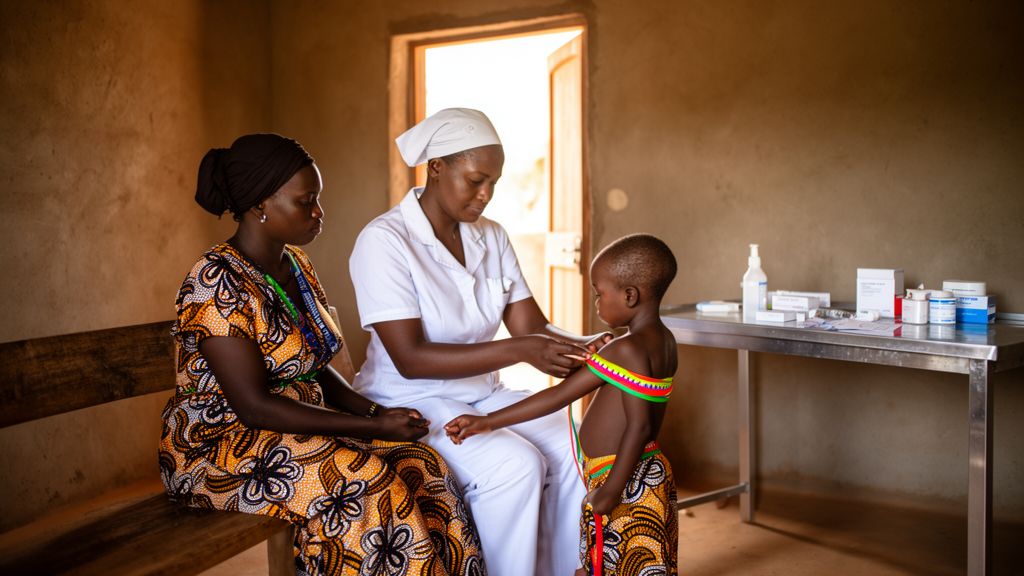
A simple colored tape wrapped around a child’s upper arm has become one of the most powerful tools in global health. Mid-upper arm circumference, or MUAC, is measured by community health workers across much of sub-Saharan Africa to identify children at risk of severe acute malnutrition, a condition that contributes substantially to illness and death among children under five. When the tape reads below 11.5 centimeters, the child is flagged for referral to a nutritional treatment program. Yet a fundamental question has lingered beneath this widespread practice: does crossing that threshold, and being marked eligible for referral, actually change what happens to a child afterward?
A new study from Nouna District in rural Burkina Faso set out to answer that question with unusual methodological rigor. Published in PLOS One, the research was led by Huiyu Hu of the University of California, San Francisco, together with colleagues including Catherine E. Oldenburg and investigators from the Centre de Recherche en Santé de Nouna in Burkina Faso. Rather than simply comparing children who were referred with those who were not, the team used a prospective regression discontinuity design, an approach borrowed from economics and epidemiology that exploits the arbitrary nature of a treatment cutoff to estimate causal effects near the threshold itself.
The logic of a regression discontinuity design is elegant. Children whose MUAC falls just below 11.5 centimeters are recommended for referral, while children measuring just above it are not. Because arm circumference varies continuously, children at 11.4 and 11.6 centimeters are, on average, nearly identical in every other respect. Any sharp difference in their later outcomes can therefore be attributed to the eligibility rule itself rather than to underlying differences in health status. This makes the design far less vulnerable to the confounding that plagues ordinary observational comparisons, in which sicker children are naturally more likely to be referred.
The analysis was nested within the Community Health with Azithromycin Treatment trial, a cluster-randomized controlled trial registered as NCT03676764. As part of that trial, children aged 6 to 59 months in Nouna District were screened during twice-yearly censuses, with MUAC measured at each encounter. A reading below 11.5 centimeters triggered a recommendation that the child be referred to a nutritional program. Crucially, the researchers could not measure whether referred children actually enrolled in treatment, so the study estimated the effect of referral eligibility rather than of treatment receipt itself. This distinction, known as an intention-to-treat framing, reflects the reality of many health systems, where a referral slip is only the first step in a long chain of care.
The scale of the screening effort was enormous. Among 65,554 children measured across the study, only 226, or roughly one in three hundred, met the referral threshold at least once. That low prevalence underscores both the rarity of severe acute malnutrition in this population at the time of screening and the logistical challenge of studying it: even a census covering tens of thousands of children yields only a few hundred children near the cutoff. The researchers therefore concentrated their analysis on observations close to the 11.5-centimeter boundary, using outcome-specific bandwidth selection following the Imbens-Kalyanaraman approach to decide how wide a window around the cutoff to include.
For the anthropometric outcome, the selected bandwidth contained 2,901 observations, of which 158 fell below the cutoff and 2,743 above it. For mortality, the window included 2,628 observations, with 148 below and 2,480 above the threshold. The team fitted mixed-effects models with a random intercept for each child, accounting for the fact that the same children contributed repeated measurements across census rounds. The primary outcomes were MUAC at the next census and death from any cause before that census, providing a standardized follow-up window anchored to the routine measurement schedule.
The results were strikingly null. At the cutoff, children eligible for referral had a mean MUAC at the next census just 0.21 centimeters greater than children just above the threshold, with a 95 percent confidence interval stretching from minus 0.22 to 0.65 centimeters, a range that comfortably includes no effect. For mortality, the estimated odds ratio was 0.95, with a confidence interval from 0.03 to 31.37. That interval is so extraordinarily wide that it technically spans everything from a nearly complete protective effect to a more than thirtyfold increase in risk, a consequence of the small number of deaths near the cutoff. The authors were careful to emphasize this imprecision rather than overstate the reassurance that a point estimate near one might suggest.
Most sensitivity analyses produced similar findings, lending some stability to the central conclusion. The exception was instructive: when the researchers imposed the widest fixed bandwidth, the estimates became discordant and unstable, a reminder that regression discontinuity results depend on how far from the cutoff one is willing to extrapolate. Far from the threshold, children differ in ways that the design can no longer balance, and the local causal interpretation dissolves. The narrow, honest answer this study provides applies to children hovering near 11.5 centimeters, not to all children with malnutrition.
What, then, explains the absence of an effect? The authors point to a gap that the study was never designed to close but that its framing illuminates. Referral eligibility is not treatment. A recommendation to seek care must survive the journey to a health facility, the availability of ready-to-use therapeutic foods, stock-outs, costs, and caregiver decisions before it becomes actual treatment. If few children near the cutoff ultimately completed referral and received therapy, an intention-to-treat estimate near zero is exactly what one would expect, even if the treatment itself works well. The study, by its own account, does not evaluate whether SAM treatment is effective, only whether the screening-and-referral machinery as it operated in Nouna moved the needle on child outcomes.
The implications reach well beyond Burkina Faso. MUAC-based screening is a cornerstone of community case finding for severe acute malnutrition across the Sahel and beyond, and the 11.5-centimeter cutoff is an international standard. This study does not challenge the cutoff’s ability to identify high-risk children, but it does raise a pointed question about what happens after identification. If crossing the threshold does not reliably translate into improved nutritional status or survival, the bottleneck may lie downstream, in the strength of the referral chain and the capacity of treatment programs. As the authors conclude, stronger mechanisms may be needed to complete referrals and link children to care. For a global health community investing heavily in community screening, the message is sobering and constructive at once: finding the children is only half the task, and the half that follows may determine whether the tape measure saves lives.
Subject of Research: Effect of referral eligibility based on mid-upper arm circumference screening for severe acute malnutrition on child nutritional status and mortality in Burkina Faso
Article Title: Effect of eligibility for referral following mass screening for severe acute malnutrition using mid-upper arm circumference: A prospective regression discontinuity design
Article References: Hu, H., Ouattara, M., Bountogo, M., Boudo, V., Ouedraogo, T., Dah, C., Lebas, E., Bärnighausen, T., Arnold, B. F., O’Brien, K. S., Lietman, T. M., Sié, A., & Oldenburg, C. E. (2026). Effect of eligibility for referral following mass screening for severe acute malnutrition using mid-upper arm circumference: A prospective regression discontinuity design. PLOS One, 21(10), e0359729. https://doi.org/10.1371/journal.pone.0359729
Image Credits: AI Generated
DOI: 10.1371/journal.pone.0359729
Keywords: severe acute malnutrition, mid-upper arm circumference, MUAC, regression discontinuity, Burkina Faso, child mortality, referral eligibility, community screening, nutritional programs, global health, PLOS One, intention-to-treat
Cite Scienmag News
Daisy Hatcher. (October 9, 2026). Screening Cutoff for Severe Malnutrition in Burkina Faso Shows Little Effect on Child Outcomes. Scienmag. https://scienmag.com/screening-cutoff-for-severe-malnutrition-in-burkina-faso-shows-little-effect-on-child-outcomes/
Daisy Hatcher. "Screening Cutoff for Severe Malnutrition in Burkina Faso Shows Little Effect on Child Outcomes." Scienmag, 9 October 2026, https://scienmag.com/screening-cutoff-for-severe-malnutrition-in-burkina-faso-shows-little-effect-on-child-outcomes/. Accessed 9 October 2026.
Daisy Hatcher. "Screening Cutoff for Severe Malnutrition in Burkina Faso Shows Little Effect on Child Outcomes." Scienmag. October 9, 2026. https://scienmag.com/screening-cutoff-for-severe-malnutrition-in-burkina-faso-shows-little-effect-on-child-outcomes/


