


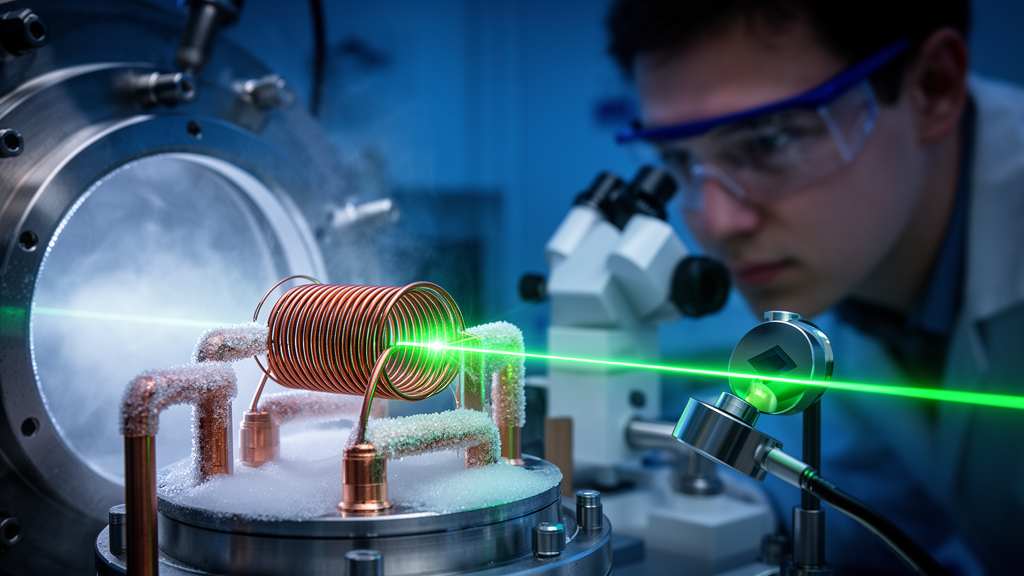
Superconductors can carry electricity with zero resistance, but they are not infinitely strong. Push too much current through one and superconductivity collapses. For decades, physicists have known that the current limits measured in laboratories are not the true limits of the material itself. In type-II superconductors, the workhorses of modern magnet technology, conventional measurements fall short because of two culprits: magnetic vortices that wiggle loose and slide through the material, and the self-heating that follows. Now a team of researchers has sidestepped both problems with a beautifully simple trick: move faster than the vortices can. Using electrical pulses lasting just a few picoseconds, they have driven superconductors to their intrinsic depairing limit and, in doing so, revealed a fundamental difference between two major classes of superconducting materials.
The distinction between what is measured and what is real comes down to the physics of vortices. Type-II superconductors are characterized by a magnetic penetration depth that exceeds the superconducting coherence length, which means magnetic fields penetrate the material as quantized whirlpools of current called vortices. Below a lower critical field, no vortices enter; above an upper critical field, they crowd the sample and superconductivity dies entirely. When a current flows, each vortex feels a Lorentz force. If that force exceeds the pinning that defects in the material provide, the vortices begin to move, dissipating energy and heating the sample until it flips into its normal, resistive state. The critical current density measured this way, denoted Jc, therefore reflects the defect landscape of a particular sample rather than any intrinsic property of the superconducting condensate.
Physicists have long defined a more fundamental quantity: the thermodynamic depairing current density, Jc*. This is the current at which the energy shift imparted to quasiparticles by the supercurrent equals the superconducting energy gap itself. Beyond this point, it is no longer energetically favorable for electrons to remain bound in Cooper pairs, and the condensate dissociates into normal charge carriers. Unlike Jc, Jc* depends only on microscopic parameters such as the superfluid density and the coherence length, making it a genuine material property and the theoretical ceiling for supercurrents. Yet despite decades of theoretical predictions and indirect hints, directly measuring Jc* has remained out of reach, because any direct current strong enough to approach it sets vortices in motion within nanoseconds, destroying the superconducting state before depairing can be observed.
The new study, published in Nature Physics by E. Wang of the Max Planck Institute for the Structure and Dynamics of Matter in Hamburg and colleagues, exploits a window in time where vortex physics simply cannot keep up. Vortices move at speeds limited to a few tens of kilometres per second, which means that within a two-picosecond pulse they can travel only a few tens of nanometres, nowhere near enough to cross a sample tens of micrometres wide. On these timescales, vortex motion is inertially frozen near the sample edges, dissipation is negligible, and the bulk of the superconductor experiences a pure, dissipationless supercurrent pushed all the way to its intrinsic limit. The experiment effectively outruns the very mechanism that has always masked the depairing threshold.
The experimental platform is an elegant piece of ultrafast engineering. The team fabricated thin films of two archetypal superconductors: niobium nitride (NbN), a disordered s-wave superconductor with a critical temperature of 15 kelvin, and yttrium barium copper oxide (YBCO), a d-wave cuprate superconducting at 85 kelvin. Each film was integrated into a coplanar waveguide with three pairs of photoconductive switches. Femtosecond laser pulses at 515 nanometres strike the middle pair of voltage-biased switches, launching current pulses with a full width at half maximum of roughly two picoseconds. Unbiased switches on either side sample the incoming, reflected and transmitted pulses at controlled time delays, allowing the researchers to reconstruct exactly how much current the superconductor carried and how the electromagnetic field responded.
The baseline measurements confirmed the familiar picture. Conventional direct-current tests yielded critical current densities of approximately 100 gigaamperes per square metre for NbN at 7 kelvin and slightly below 50 gigaamperes per square metre for YBCO at 50 kelvin. Below the critical temperature, the picosecond response was unmistakably superconducting: the reflected pulse showed a small inductive feature proportional to the kinetic inductance of the condensate, and about 90 percent of the incoming pulse transmitted through the sample. Above the critical temperature, the response became resistive, with the pulse partially reflected and partially transmitted, exactly as expected for a normal metal.
Then came the dramatic part. When the researchers drove NbN at 7 kelvin with pulses reaching about 6.5 times the conventional critical current density, the sample’s response suddenly resembled its own normal-state behaviour at 20 kelvin, indicating that superconductivity had been transiently suppressed. Tracking the transmitted peak electric field as a function of the peak current density revealed a sharp, well-defined drop at roughly 2.2 times Jc, corresponding to about 220 gigaamperes per square metre. Below that threshold, the transmitted current was carried by Cooper pairs; above it, the current was carried by normal carriers, and the slope of the response matched the normal state. Between the two regimes, the transmitted current actually decreased with increasing drive, a hallmark of rapid Cooper pair breakup. The local maximum in transmitted current marks the depairing current density Jc*, observed directly for the first time in this setting.
YBCO told a strikingly different story. Instead of a sharp threshold, the d-wave cuprate showed a gradual, continuous suppression of superconductivity beginning well before the conventional critical current was reached, with no local maximum in the transmitted current at all. The difference traces back to the symmetry of the superconducting gap. In an s-wave superconductor like NbN, the gap is isotropic, so every Cooper pair breaks at the same critical current, producing a clean threshold. In a d-wave superconductor like YBCO, the gap varies from zero along the nodal directions to its maximum along the antinodal directions. Pairs in different parts of the Fermi surface depair at different currents, so partial depairing begins immediately and accumulates continuously, and a well-defined Jc* simply does not exist. The picosecond technique thus doubles as a probe of gap symmetry in materials that cannot easily be accessed by conventional spectroscopy.
The researchers took care to rule out alternative explanations. All measurements were performed under zero-field cooling with ambient magnetic fields shielded below one microtesla, ensuring no pre-existing vortices in the sample. Even in the most pessimistic scenario, a vortex could move no more than a few tens of nanometres during a pulse, making full penetration implausible. And the stark contrast between the s-wave and d-wave responses points to a mechanism rooted in the microscopic gap structure rather than in vortex dynamics. On the theory side, simulations based on Bardeen-Cooper-Schrieffer theory in the dirty limit, using the Usadel equation with parameters taken directly from experimental characterization, reproduced the sharp transmission drop in NbN, attributing it to the strong nonlinearity of the superfluid density. Time-dependent Ginzburg-Landau theory, valid only near the critical temperature, could not capture this nonlinearity. The calculated temperature dependence of Jc* also agreed closely with the measurements, with experimental values slightly below theory, plausibly because thermal fluctuations initiate depairing marginally early. At 0.8 times the critical temperature, the conventional critical current was nearly an order of magnitude smaller than the intrinsic depairing current.
The implications extend in two directions. Fundamentally, the technique opens a route to probing superconducting properties, including gap symmetry and condensate stiffness, in regimes that conventional transport cannot touch, and it may eventually help interrogate cuprate superconductors for which no complete microscopic theory exists even in equilibrium. Practically, the results show that the maximum supercurrent a type-II superconductor can sustain is accessible on picosecond timescales, suggesting a platform for generating ultrashort, intense magnetic field pulses and for superconducting electronics that operate closer to their intrinsic current limits. For a field in which the gap between what materials can do and what engineers can measure has persisted for more than half a century, outrunning the vortices may prove to be one of the most consequential ideas in modern superconducting research.
Subject of Research: Picosecond measurement of the intrinsic depairing current density in type-II superconductors
Article Title: Probing picosecond depairing currents in type-II superconductors
Article References: Wang, E., Chavez-Cervantes, M., Satapathy, J., Matsuyama, T., Meier, G., Zhang, X., You, L., Marijanovic, F., Curtis, J. B., Demler, E., & Cavalleri, A. (2026). Probing picosecond depairing currents in type-II superconductors. Nature Physics. https://doi.org/10.1038/s41567-026-03469-z
Image Credits: AI Generated
DOI: 10.1038/s41567-026-03469-z
Keywords: superconductivity, depairing current, type-II superconductors, picosecond pulses, Cooper pairs, vortices, NbN, YBCO, s-wave gap, d-wave gap, ultrafast transport, BCS theory
Cite Scienmag News
Denise Maddox. (October 9, 2026). Picosecond Pulses Push Superconductors to Their True Current Limit. Scienmag. https://scienmag.com/picosecond-pulses-push-superconductors-to-their-true-current-limit/
Denise Maddox. "Picosecond Pulses Push Superconductors to Their True Current Limit." Scienmag, 9 October 2026, https://scienmag.com/picosecond-pulses-push-superconductors-to-their-true-current-limit/. Accessed 9 October 2026.
Denise Maddox. "Picosecond Pulses Push Superconductors to Their True Current Limit." Scienmag. October 9, 2026. https://scienmag.com/picosecond-pulses-push-superconductors-to-their-true-current-limit/


