


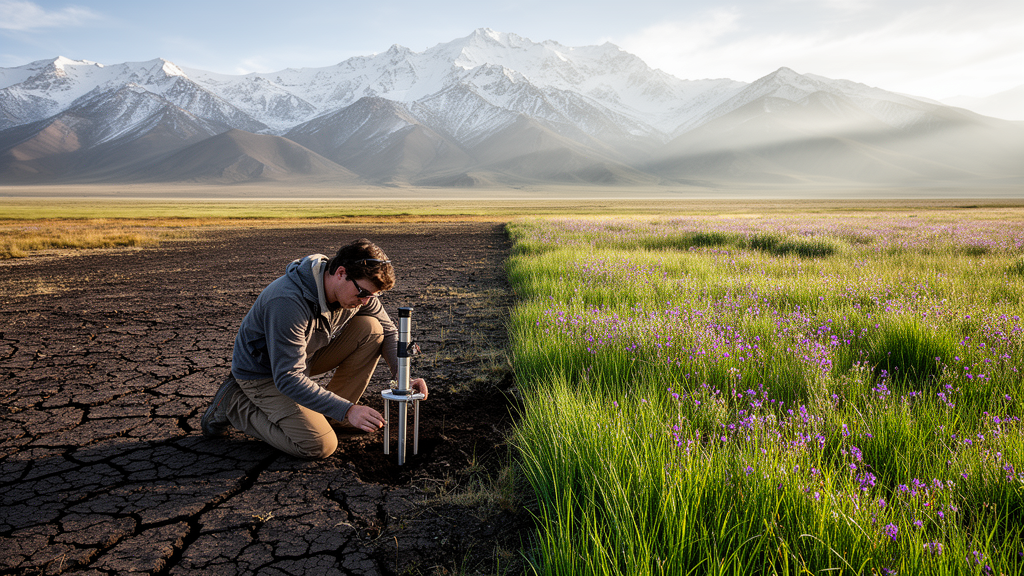
High on the Qinghai–Tibet Plateau, where the world’s largest store of alpine soil carbon sits locked beneath a thin carpet of grasses, scientists have been racing to understand what happens when degraded rangeland is actively replanted. A new study published in Plant and Soil offers one of the most detailed molecular portraits yet of that recovery process, tracking not just how much carbon returns to the soil, but which forms it takes and which microbial genes are switched on to build it. The findings suggest that even six years of restoration can meaningfully rebuild soil organic carbon, but that the carbon being accumulated is not yet the stable, long-lived kind that makes grasslands such powerful climate allies.
The research team, led by Yanlong Wang and colleagues at Qinghai University’s Academy of Animal and Veterinary Science, compared three grassland states in the Three-River Headwaters region: intact natural grassland, degraded grassland scarred by the notorious local phenomenon known as black soil hill, and artificial grassland that had been actively restored six years earlier. Soil from each site was analyzed for its physical and chemical properties, its microbial communities, the activity of extracellular enzymes, and, crucially, the full suite of carbohydrate-active enzyme genes, or CAZymes, encoded in the soil metagenome. These genes encode the molecular machinery microbes use to dismantle complex plant and microbial carbohydrates, making them a direct readout of how organic matter is being processed underground.
The headline result is encouraging for restoration practitioners. Artificial restoration significantly increased total soil organic carbon, along with both of its major fractions: particulate organic carbon, or POC, which consists of partially decomposed plant fragments that are relatively light and fast-cycling, and mineral-associated organic carbon, or MAOC, which is chemically bound to clay and mineral surfaces and far more resistant to decomposition. Across all three treatments, POC averaged 63.9 percent of the carbon measured, indicating that particulate material dominates the carbon pool in these alpine soils regardless of their condition. That dominance matters, because POC is generally more vulnerable to disturbance and warming than its mineral-bound counterpart.
Why does the balance between these two fractions matter so much? Soil scientists increasingly view POC and MAOC as fundamentally different currencies in the carbon economy. Particulate carbon is the raw fuel of the soil food web, turning over in years to decades and releasing carbon dioxide as microbes consume it. Mineral-associated carbon, by contrast, can persist for centuries, protected from enzymatic attack by its association with reactive mineral surfaces. A grassland whose carbon stock is mostly POC is therefore sitting on a more volatile asset than one whose carbon has been converted into mineral-stabilized forms. The new study’s finding that short-term restoration primarily drives POC accumulation suggests that the restored sites are in an early, dynamic phase of carbon rebuilding, one where gains are real but not yet fully secured.
The metagenomic analysis revealed a striking asymmetry in the genetic potential of the soil microbial community. Across all treatments, CAZyme genes responsible for decomposing plant-derived components accounted for 66 to 67 percent of the carbon-degradation repertoire, while genes targeting microbially derived components made up only 33 to 34 percent. In other words, the microbial communities in these alpine grasslands are overwhelmingly equipped to break down fresh plant litter rather than recycled microbial biomass. This plant-litter dominance shapes which carbon fractions accumulate: abundant plant-degrading capacity fuels the particulate pool, while the slower microbial necromass pathway that feeds mineral-associated carbon plays a comparatively smaller role.
The three grassland states each told a distinct genetic story. Natural grassland soils carried a significantly higher abundance of carbon-degradation genes targeting hemicellulose, a major structural component of plant cell walls, reflecting the richer supply of plant residues that intact vegetation delivers to the soil. Artificial grassland soils, by contrast, showed the lowest abundance of CAZyme genes associated with degrading both plant- and microbially derived carbon. At first glance, reduced degradation capacity might seem like bad news, but in the context of carbon sequestration it can be read differently: fewer degradation genes may mean slower breakdown of the organic matter that is accumulating, allowing carbon to build up faster than microbes can respire it away. The restored soils are, in effect, accumulating carbon while their decomposer machinery remains comparatively throttled.
Microbial community composition shifted alongside these genetic patterns. The abundance of Pseudomonadota, a bacterial phylum that includes many fast-growing, metabolically versatile organisms, was highest in the artificial grassland soils. Such a shift is consistent with the ecological upheaval that active restoration imposes: tilling, reseeding with forage grasses such as Elymus species, and altered nutrient inputs create a disturbance-filtered community favoring opportunistic bacteria. The study also found that the number of CAZyme genes was strongly correlated with extracellular enzyme activity and with microbial community abundance, reinforcing the idea that gene copy numbers translate into real enzymatic work in the soil. This gene-to-enzyme-to-process linkage is exactly what carbon cycle modelers need if genomic data are ever to improve predictions of how soils will respond to land management.
Beneath the microbial story lies a simpler chemical one. Random forest modeling and correlation analyses revealed that soil organic carbon, POC, and MAOC were all positively associated with available nitrogen. Nitrogen availability, the authors conclude, is a key regulator of carbon accumulation during restoration, likely because building new plant biomass and microbial biomass requires nitrogen in roughly fixed proportions to carbon. For managers of restored grasslands, this points to a practical lever: ensuring adequate nitrogen supply, whether through leguminous species, careful fertilization, or grazing management that conserves nutrient cycling, could accelerate the pace at which degraded alpine soils recapture carbon.
The stakes of this work extend well beyond the plateau. Grasslands and shrublands worldwide hold enormous carbon stocks, and the Qinghai–Tibet Plateau alone stores a substantial share of the global soil carbon inventory in its cold, slow-decomposing soils. Degradation of these grasslands, driven by overgrazing, climate change, and erosion, converts living carbon sinks into sources, while restoration programs across China have mobilized vast resources to reverse the damage. Whether those investments pay off in climate terms depends on questions this study begins to answer: how fast carbon returns, in which pools it accumulates, and how stable those pools are against future warming and disturbance.
The authors caution that six years is a short span in the life of a soil. Their results capture a snapshot of an early successional moment, when particulate carbon is surging and the microbial community is still reorganizing. Longer-term monitoring will be needed to determine whether the accumulating POC is gradually processed into mineral-associated forms, as some conceptual models of soil carbon formation predict, or whether it remains vulnerable to loss. Previous work on long-term restored Tibetan grasslands has suggested that extended restoration can accelerate carbon turnover while increasing stability, hinting that the trajectory from the restored sites in this study may indeed trend toward more durable storage. For now, the study provides restoration ecologists with a molecular yardstick: by tracking CAZyme gene profiles alongside carbon fractions, managers can gauge not just how much carbon a recovering grassland holds, but how its underground workforce is handling it, and what that means for the climate decades from now.
Subject of Research: Effects of short-term active grassland restoration on soil organic carbon fractions and microbial CAZyme genes on the Qinghai–Tibet Plateau
Article Title: Effects of short-term active restoration on soil organic carbon fractions and CAZyme family genes: a comparison between degraded and restored alpine grasslands
Article References: Wang, Y., Dong, R., Xie, L., Ma, Y., Li, S., Shi, J., Liu, Y., Wang, X., & Ma, Y. (2026). Effects of short-term active restoration on soil organic carbon fractions and CAZyme family genes: a comparison between degraded and restored alpine grasslands. Plant and Soil. https://doi.org/10.1007/s11104-026-08995-6
Image Credits: AI Generated
DOI: 10.1007/s11104-026-08995-6
Keywords: soil organic carbon, particulate organic carbon, mineral-associated organic carbon, CAZyme genes, alpine grassland restoration, Qinghai–Tibet Plateau, soil metagenomics, microbial communities, extracellular enzyme activity, nitrogen availability, carbon sequestration, degraded grassland
Cite Scienmag News
Juliet Wilcox. (October 9, 2026). Restoring Tibet’s Degraded Grasslands Rewrites the Genetic Recipe for Soil Carbon. Scienmag. https://scienmag.com/restoring-tibets-degraded-grasslands-rewrites-the-genetic-recipe-for-soil-carbon/
Juliet Wilcox. "Restoring Tibet’s Degraded Grasslands Rewrites the Genetic Recipe for Soil Carbon." Scienmag, 9 October 2026, https://scienmag.com/restoring-tibets-degraded-grasslands-rewrites-the-genetic-recipe-for-soil-carbon/. Accessed 9 October 2026.
Juliet Wilcox. "Restoring Tibet’s Degraded Grasslands Rewrites the Genetic Recipe for Soil Carbon." Scienmag. October 9, 2026. https://scienmag.com/restoring-tibets-degraded-grasslands-rewrites-the-genetic-recipe-for-soil-carbon/


