


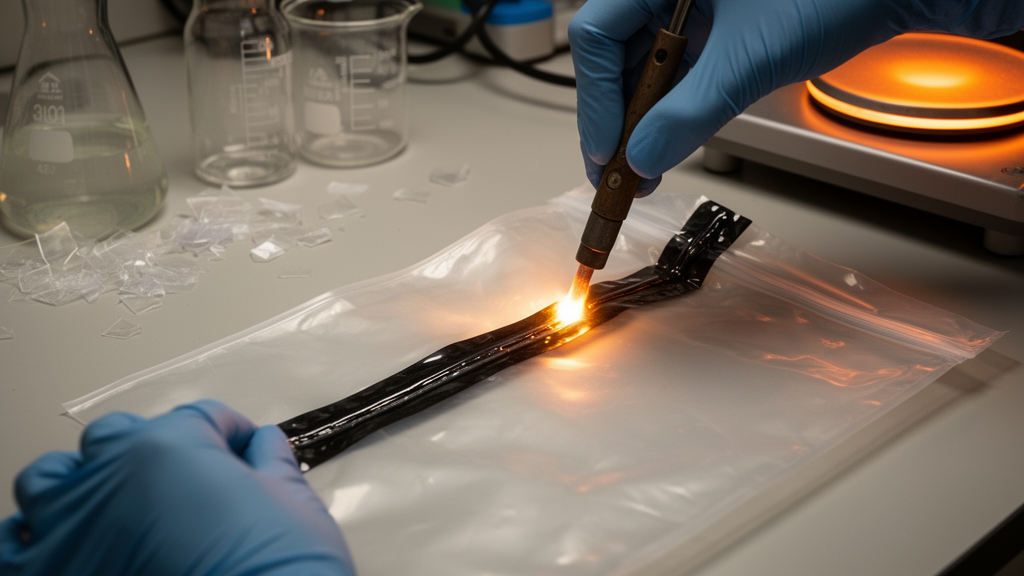
Phase-change materials have long promised a way to bottle heat: absorb it when the sun shines or when industrial waste streams run hot, and release it slowly when temperatures drop. The problem has always been containment. Most high-performing phase-change materials melt into a liquid at exactly the moment they are doing their job, so without a rigid, leak-proof scaffold they ooze, seep and eventually fail. A study published in the Journal of Materials Science by Yunbin Zhang, Dajun Luo, Xueliang Zhang and Yong Deng, researchers at Guizhou University and the Guizhou Institute of Technology, now reports a remarkably simple answer built from two unlikely partners: a fully biodegradable plastic and graphene oxide, welded together by nothing more exotic than heat.
The biodegradable polymer at the heart of the work is poly(butylene adipate-co-terephthalate), or PBAT, a flexible compostable plastic familiar from shopping bags and food packaging films. PBAT is cheap, tough and breaks down in the environment, which makes it an attractive candidate for a carrier scaffold that encapsulates a phase-change material. Yet, as the authors note, PBAT has been substantially underexplored in this role, largely because making it porous is surprisingly difficult. The two standard routes each carry a serious flaw. Phase inversion, in which a polymer solution is cast and the solvent is exchanged away, relies on toxic organic solvents that sit awkwardly with any claim to sustainability. Carbon dioxide foaming, meanwhile, tends to produce predominantly closed-cell pores, tiny sealed bubbles that a molten phase-change material cannot easily enter or be retained within.
The Chinese team’s solution borrows its logic from one of the oldest techniques in materials processing: hot-pressing. Instead of dissolving PBAT or blowing it into foam, they used a graphene oxide aerogel as both a dispersion medium and a carrier for PBAT powder particles. Graphene oxide, the oxidized flake form of graphene, naturally assembles into lightweight three-dimensional networks when dispersed in water and frozen or gelated. Into this porous carbon scaffold the researchers introduced PBAT powder, allowing the particles to distribute uniformly and aggregate throughout the aerogel interior to form a macroscopically stable PBAT/GO composite aerogel. The key trick came next: isothermal heating. Held at a temperature that softened but did not destroy the polymer, adjacent PBAT particles began to melt at their contact points and fuse together, a process the authors describe as melt-bridging, effectively welding the powder into a continuous porous skeleton in situ.
What makes the resulting pore architecture clever is that it is formed by two cooperating mechanisms. The three-dimensional graphene oxide network provides the macroscopic template, while the physical space occupied by ice crystals during the freezing step carves out additional channels. When the ice sublimes or melts away, it leaves behind an interconnected, open-pore structure, precisely the kind of plumbing that a liquid phase-change material needs. The graphene oxide is simultaneously reduced to reduced graphene oxide during the thermal treatment, yielding the final PBAT/rGO porous composites, labeled PG-x, where x denotes the compositional series. No toxic solvent is involved at any stage, and the process avoids the closed-cell trap that has limited foamed PBAT carriers.
With the scaffold in hand, the researchers loaded it with polyethylene glycol, or PEG, a workhorse organic phase-change material that stores and releases large amounts of latent heat near room temperature. Loading was accomplished by vacuum impregnation, in which the porous composite is evacuated and then flooded with molten PEG so that capillary forces draw the liquid deep into every interconnected channel. The resulting shape-stable composites, designated PGP-x, held an average actual PEG loading ratio that peaked at 70.04 weight percent, an impressively high fraction for a polymer-based support. At that loading the composite delivered a phase-change enthalpy of 110.37 joules per gram, meaning that each gram of material absorbs or releases more than a hundred joules of heat as PEG melts and solidifies.
Shape stability, the property that gives these composites their name, is where the numbers become genuinely striking. The researchers subjected the PGP-x samples to 100 consecutive thermal cycles of melting and freezing, a torture test that would quickly expose any weak scaffold. After 100 cycles, the leakage rate remained below 2 weight percent, indicating that the welded PBAT/rGO network, together with capillary confinement and possible interfacial interactions between PEG and the reduced graphene oxide walls, keeps the molten wax-like PEG locked in place. For applications such as building envelopes, solar thermal collectors, battery thermal management and waste-heat recovery, where a leaking composite would stain, corrode or short-circuit surrounding components, that kind of cycling durability is the difference between a laboratory curiosity and a deployable technology.
The graphene component contributes more than mechanical containment. Graphene oxide and its reduced form are strong broadband absorbers of solar radiation, converting absorbed photons into heat with high efficiency. Because the reduced graphene oxide sheets line the pore walls throughout the composite, sunlight penetrating the material is captured close to where the PEG is stored, so the photothermal conversion performance of the PGP-x composites was significantly enhanced relative to the neat phase-change material. In practical terms, this means the composites can be charged directly by sunlight: place them in the sun and the graphene framework heats up, melts the PEG, and the latent heat is banked for later release. This light-driven charging pathway opens the door to passive solar energy storage in walls, windows, textiles and off-grid devices without any pumps, heat exchangers or electrical input.
The choice of a biodegradable carrier deserves emphasis in an era when the materials community is scrutinizing the end-of-life footprint of every new composite. Most shape-stable phase-change composites reported to date rely on non-degradable supports such as expanded graphite, metal foams, polyurethane foams or MXene-polymer hybrids. A PBAT-based scaffold, by contrast, can in principle compost along with the polymer matrix once the storage material is recovered, aligning the composite with circular-economy principles. The authors argue that their solvent-free, hot-pressing-inspired preparation method offers novel insights for latent heat energy storage research precisely because it sidesteps the environmental liabilities of phase inversion while solving the pore-connectivity problem of CO2 foaming. The approach is also conceptually portable: any thermoplastic powder that melt-bridges under isothermal heating could, in principle, be welded inside a graphene oxide or other aerogel template by the same route.
There are, of course, questions that follow any such laboratory demonstration. The reported enthalpy of 110.37 joules per gram, while respectable, is below that of pure PEG, since the non-melting scaffold dilutes the active material, and further engineering would be needed to push energy density toward the levels demanded by grid-scale storage. Long-term behavior beyond 100 cycles, mechanical robustness under compression, and the cost of graphene oxide at scale all remain open engineering challenges. The work was supported by the National Natural Science Foundation of China and startup funding from the Guizhou Institute of Technology, and the authors report no conflicts of interest. Still, the demonstration that a humble compostable plastic can be thermally welded into a high-performance, sunlight-charging heat reservoir, using water, ice and heat as the only processing agents, is the kind of elegant simplification that tends to reshape a field.
If the broader promise holds, the implications extend well beyond thermal storage. The same in situ thermal welding strategy could produce open-porous PBAT structures for filtration membranes, oil-spill remediation monoliths, tissue engineering scaffolds and electromagnetic shielding foams, all areas where PBAT composites are already being explored but where solvent-free, interconnected porosity has been hard to achieve. For the energy transition, meanwhile, the study adds a compelling entry to the growing catalog of carbon-based porous supports for form-stable phase-change materials, one distinguished by its biodegradability and by the sheer simplicity of its fabrication. A plastic bag polymer, a graphene oxide aerogel and a hot plate may sound like an unlikely recipe for the future of heat storage, but the numbers, 70 percent loading, 110 joules per gram, and less than 2 percent leakage over a hundred melt-freeze cycles, make a persuasive case that sometimes the greenest route is also the simplest one.
Subject of Research: Biodegradable PBAT/reduced graphene oxide porous scaffolds for shape-stable composite phase-change thermal energy storage materials
Article Title: In situ thermal welding for constructing PBAT/rGO porous structures for shape-stable composite phase-change materials
Article References: Zhang, Y., Luo, D., Zhang, X., & Deng, Y. (2026). In situ thermal welding for constructing PBAT/rGO porous structures for shape-stable composite phase-change materials. Journal of Materials Science. https://doi.org/10.1007/s10853-026-13861-y
Image Credits: AI Generated
DOI: 10.1007/s10853-026-13861-y
Keywords: phase-change materials, PBAT, graphene oxide, thermal energy storage, polyethylene glycol, biodegradable polymers, aerogel, porous materials, photothermal conversion, shape-stable composites, thermal welding, latent heat
Cite Scienmag News
Neil Sanderson. (October 9, 2026). Thermal Welding of Biodegradable Polymer and Graphene Oxide Yields Leak-Proof Heat Storage Materials. Scienmag. https://scienmag.com/thermal-welding-of-biodegradable-polymer-and-graphene-oxide-yields-leak-proof-heat-storage-materials/
Neil Sanderson. "Thermal Welding of Biodegradable Polymer and Graphene Oxide Yields Leak-Proof Heat Storage Materials." Scienmag, 9 October 2026, https://scienmag.com/thermal-welding-of-biodegradable-polymer-and-graphene-oxide-yields-leak-proof-heat-storage-materials/. Accessed 9 October 2026.
Neil Sanderson. "Thermal Welding of Biodegradable Polymer and Graphene Oxide Yields Leak-Proof Heat Storage Materials." Scienmag. October 9, 2026. https://scienmag.com/thermal-welding-of-biodegradable-polymer-and-graphene-oxide-yields-leak-proof-heat-storage-materials/


