


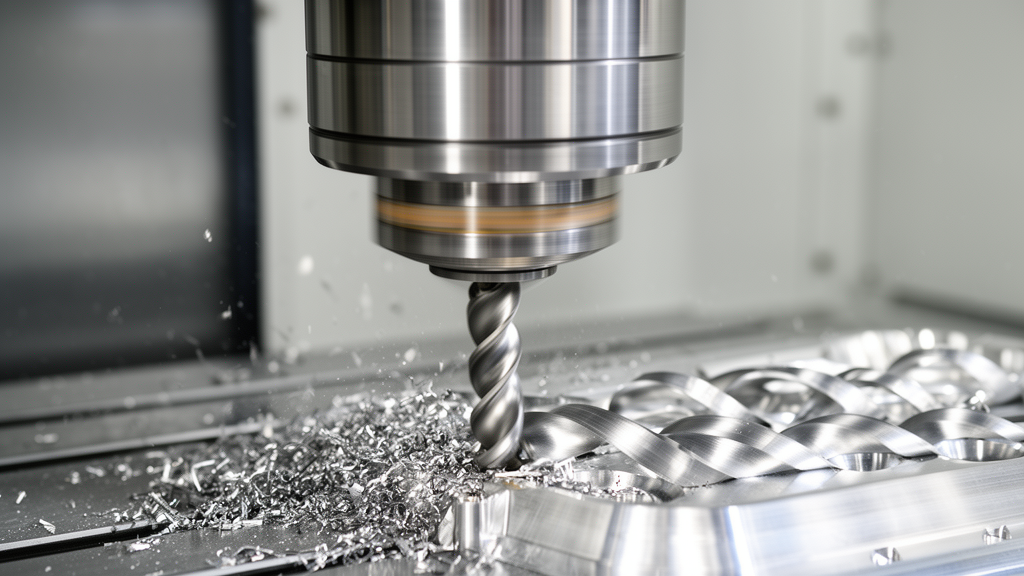
High-speed motorized spindles are the beating heart of precision manufacturing, spinning at tens of thousands of revolutions per minute inside CNC machine tools that carve out aircraft components, medical implants, and intricate molds. At those speeds, even microscopic vibrations at the tool tip can ruin a surface finish, shorten tool life, or damage the bearings themselves. A new study published in Mechanical Sciences by Huimin Wu and Jianwei Ma of Dalian University of Technology presents a data-driven framework that tackles this problem head-on, combining one thousand experimental identification runs with a reliability-based robust optimization scheme. The result is a spindle design that cuts peak vibration by nearly 17 percent, reduces response variability by almost 30 percent, and slashes the probability of catastrophic vibration overload from a startling 55.44 percent to just 0.35 percent.
The core challenge the researchers set out to solve is uncertainty. In an idealized computer model, bearing stiffness and damping are tidy numbers pulled from a manufacturer’s catalog. In the real world, they are anything but. Manufacturing tolerances, assembly errors, thermal expansion mismatches between the steel shaft and its housing, and speed-dependent centrifugal forces all conspire to shift these parameters by roughly 5 to 12 percent from their nominal values. Traditional deterministic designs may look excellent on paper but can fluctuate wildly or fail outright when reality deviates from the assumed values. Worse, most prior studies have relied on theoretical catalog data rather than measurements, ignoring what engineers call epistemic uncertainty, the gap between the model and the physical machine.
Wu and Ma’s first move was to measure rather than assume. They built a high-speed motorized spindle test rig spanning an operational range from 1,000 to 24,000 rpm, discretized into 50 speed points. At each point, the spindle ran under steady-state thermal conditions while high-precision eddy current sensors sampled vibration at 10 kilohertz. Repeating the identification procedure 20 times per speed produced a dataset of 1,000 identified parameter vectors. To extract bearing stiffness and damping coefficients from these measured frequency responses, the team employed the Multi-Innovation Stochastic Gradient, or MISG, algorithm, a recursive estimation technique that accelerates convergence by stacking innovation information from several consecutive time steps rather than using a single sample at a time.
The numerical verification of this algorithm is striking in its own right. In synthetic tests where the true parameter values were known, MISG reduced the number of convergence iterations from 606 to just 75, an 8.1-fold speedup and an 87.6 percent reduction compared with the standard stochastic gradient method, while also lowering the final normalized root-mean-square error by 15 percent. Although each iteration costs about 18 percent more computation, the faster convergence cuts total computation time by 28 percent. A sensitivity study further confirmed that algorithmic identification error contributes less than 3 percent of the total output variance, meaning the scatter in the identified parameters reflects genuine physical variability, not artifacts of the estimation procedure.
With the empirical distributions in hand, the team validated them statistically before feeding them into the optimizer. The identified stiffness parameters showed coefficients of variation between roughly 6.0 and 6.4 percent, and Shapiro-Wilk tests confirmed that a multivariate normal distribution was a physically permissible model, with quantile-quantile plots yielding coefficients of determination above 0.99. Bearing damping was not treated as an independent random variable; instead, it was coupled proportionally to the identified stiffness through a constant calibrated by modal hammer testing, keeping the probabilistic model lean while preserving fidelity. The identified stiffness values deviated only about 1.5 to 3.0 percent from the numerical baseline, with the small residual attributed to installation-specific effects such as thermal expansion mismatch and bearing-seat tolerances, exactly the factors catalog values ignore.
The optimization phase then framed spindle design as a bi-objective problem: minimize both the mean peak vibration amplitude at the tool tip and its standard deviation, subject to a probabilistic constraint that the probability of vibration exceeding a critical threshold of 195 micrometers stays below a target level. That threshold was calibrated from surface roughness requirements in precision milling, where larger displacements degrade finish beyond aerospace-grade limits. Rather than relying on first-order or second-order reliability methods, which linearize the problem and can incur errors of 20 to 30 percent in nonlinear bearing-rotor dynamics, the researchers propagated uncertainty through direct Monte Carlo simulation with 1,000 samples per candidate design. The Non-dominated Sorting Genetic Algorithm II then evolved populations of designs, with each run producing a Pareto front of optimal trade-offs.
Crucially, the team ran the optimization three times, for target failure probabilities of 1, 5, and 10 percent, generating a family of Pareto fronts that reveals the marginal cost of safety. The results expose sharp diminishing returns. Tightening the constraint from 10 to 5 percent delivered a high marginal benefit ratio of 0.55 micrometers of variance reduction per percentage point of reliability, but squeezing from 5 to 1 percent dropped that ratio to 0.39 and demanded a 7.0 percent increase in bearing preload, pushing it to its physical limit of 3,000 newtons, for only a marginal robustness gain. Such aggressive preload accelerates rolling-element wear and risks friction-induced thermal problems. Weighing these trade-offs against ISO 20816-3 vibration standards, the researchers identified the 5 percent configuration as the optimal engineering equilibrium.
The optimized design itself is physically revealing. The framework selected a front-bearing preload of about 2,804 newtons and shortened the bearing support span from roughly 750 to 537 millimeters, a geometric change that raises the first natural frequency and pushes the third critical speed from about 22,000 rpm to 25,800 rpm, safely beyond the 24,000 rpm maximum operating speed. Benchmarking against conventional approaches underscored the value of the joint formulation: a pure robust design optimization achieved low variability but left the failure probability at an unacceptable 21.07 percent, while a pure reliability-based design hit a low failure probability but suffered an inflated response standard deviation of 11.80 micrometers. The integrated framework achieved failure probability of 0.35 percent while keeping variability at 9.69 micrometers and mean amplitude at 16.44 micrometers.
Physical validation sealed the case. Twenty independent replication runs at the rated speed of 24,000 rpm showed the optimized spindle reducing mean peak vibration by 16.84 percent, from 19.77 to 16.44 micrometers, and the response standard deviation by 29.78 percent, from 13.80 to 9.69 micrometers, with all improvements statistically significant in paired-sample t-tests. Across the full 1,000 to 24,000 rpm spectrum, the optimized spindle maintained stable, constrained responses, eliminating the severe resonant amplification that plagued the baseline design near its third critical speed. The variance reduction of 50.70 percent in experimental terms also surpasses the roughly 22 percent typically reported in simulation-based robust optimization studies.
Beyond the immediate numbers, the study signals a broader shift in how rotating machinery can be engineered. By grounding probabilistic models in measured reality rather than catalog assumptions, and by mapping the full trade-off surface between performance, robustness, and reliability instead of fixing a single safety target, the framework gives engineers a quantitative language for deciding how much safety margin a given application truly needs. The authors note that the approach currently assumes linear bearing behavior within the Hertzian elastic regime and depends on sufficient experimental data, pointing toward amplitude-dependent identification schemes and non-probabilistic interval methods as future extensions for heavily loaded or multi-shaft systems. For now, the message is clear: the path to quieter, more dependable high-speed spindles runs directly through the test rig, with every ounce of uncertainty measured, quantified, and designed against.
Subject of Research: Reliability-based robust optimization of high-speed motorized spindle-bearing systems using experimentally identified bearing parameter uncertainties
Article Title: Experimental identification and robust optimization of spindle–bearing systems with reliability constraints
Article References: Wu, H., & Ma, J. (2026). Experimental identification and robust optimization of spindle–bearing systems with reliability constraints. Mechanical Sciences, 17(2), 839-855. https://doi.org/10.5194/ms-17-839-2026
Image Credits: AI Generated
Keywords: motorized spindle, bearing stiffness, vibration control, robust optimization, reliability-based design, uncertainty quantification, Monte Carlo simulation, NSGA-II, multi-innovation stochastic gradient, CNC machining, Pareto optimization, rotor dynamics
Cite Scienmag News
Denise Maddox. (October 9, 2026). Smarter Spindle Design Slashes Vibration and Failure Risk in High-Speed Machining. Scienmag. https://scienmag.com/smarter-spindle-design-slashes-vibration-and-failure-risk-in-high-speed-machining/
Denise Maddox. "Smarter Spindle Design Slashes Vibration and Failure Risk in High-Speed Machining." Scienmag, 9 October 2026, https://scienmag.com/smarter-spindle-design-slashes-vibration-and-failure-risk-in-high-speed-machining/. Accessed 9 October 2026.
Denise Maddox. "Smarter Spindle Design Slashes Vibration and Failure Risk in High-Speed Machining." Scienmag. October 9, 2026. https://scienmag.com/smarter-spindle-design-slashes-vibration-and-failure-risk-in-high-speed-machining/


