


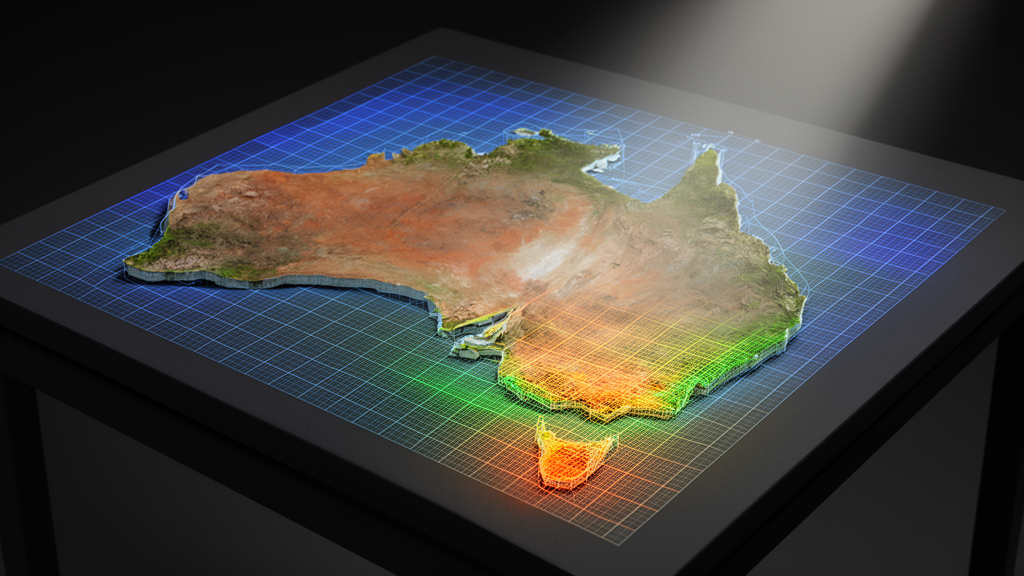
Australasia is one of the most climate-exposed regions on Earth, a vast territory spanning the arid interior of Australia, the temperate southeast, the tropical north, and the scattered island nations of the Pacific. Understanding how greenhouse warming will unfold across such a mosaic of landscapes has always been a formidable scientific challenge, because the global climate models that simulate the entire planet simply cannot resolve the local details that matter most to people. Over the past fifteen years, an international effort known as CORDEX-Australasia has quietly transformed the region’s ability to see its own climate future, coordinating regional climate downscaling under the Coordinated Regional Climate Downscaling Experiment and producing the largest high-resolution projection datasets ever assembled for the area.
The core idea behind downscaling is deceptively simple. Global climate models divide the planet into grid cells that are typically one hundred kilometres or more across, a resolution at which coastlines, mountain ranges, and individual thunderstorms are essentially invisible. Regional climate models take the large-scale output from these global models and re-simulate it over a smaller domain at much finer resolution, adding back the topographic and coastal complexity that shapes local weather. In Australasia, where the Great Dividing Range, the complex coastline of Bass Strait, and the steep rainfall gradients of the tropical north all exert powerful influences on climate, this added detail is not a luxury but a necessity for credible projections.
The CORDEX-Australasia programme has now completed successive ensembles based on the fifth and sixth phases of the Coupled Model Intercomparison Project, known respectively as CORDEX-CMIP5 and CORDEX-CMIP6. These coordinated collections of regional simulations, produced by modelling groups across Australia and beyond, allow scientists to separate the robust signals of climate change from the noise of model-to-model differences. The synthesis of this fifteen-year effort, published in PLOS Climate by Jason Evans of the University of New South Wales and a large team of collaborators from institutions across the region, documents both the scientific achievements and the formidable challenges that remain.
One of the clearest findings to emerge from the programme is that regional models demonstrate genuine added value over the global models that drive them. This is not merely a matter of sharper pictures. The high-resolution simulations represent temperature extremes, heavy precipitation events, coastal processes, and complex terrain with substantially greater fidelity, which matters because these are precisely the phenomena that cause the most damage to communities and infrastructure. When a regional model can resolve the sea breeze that moderates a coastal heatwave, or the orographic uplift that triggers a flash flood on a mountain slope, its projections of future extremes become far more useful to planners and emergency managers.
The CMIP6-based projections now available for Australasia show robust agreement on one central fact: substantial warming through the twenty-first century is essentially locked in across the region. The magnitude of that warming, however, depends overwhelmingly on which emissions pathway the world follows, making human choices the dominant source of uncertainty in temperature projections. Precipitation is a different story altogether. Rainfall responses vary considerably from one subregion to another, with some areas projected to become drier and others facing changes that are harder to pin down, reflecting the intricate interplay of atmospheric circulation, ocean temperatures, and local geography that governs water availability across the continent and its island neighbours.
Beyond the headline projections, the past decade and a half has seen significant methodological advances that have quietly revolutionised the field. Convection-permitting modelling, which runs regional models at kilometre-scale resolutions fine enough to simulate thunderstorms directly rather than approximating them with statistical formulas, has moved from research curiosity to operational tool. Benchmarking frameworks now allow systematic evaluation of model performance against observations, while improved bias-correction methods help translate raw model output into information that hydrologists, engineers, and farmers can actually use. Together these advances have sharpened both the physical realism of the simulations and the credibility of their evaluation.
The practical payoff of this scientific investment is now visible across nearly every sector of Australian and Pacific society. Regional climate projections underpin decision-making in water resource management, where reservoir operators need to know how inflows will shift in the decades ahead. Agricultural planners use the projections to assess how growing seasons and crop water requirements will change. Disaster risk reduction agencies, energy system planners, public health authorities, and national climate services all draw on the same coordinated datasets, meaning that a single scientific infrastructure quietly supports adaptation decisions worth billions of dollars across the region.
None of this would have been possible without sustained investment in shared computing infrastructure. The National Computational Infrastructure in Australia has provided the enormous processing power and data storage that regional climate modelling demands, and coordination has been strengthened further through the National Partnership for Climate Projections, which links state and federal programmes into a coherent whole. This model of collaboration, in which different levels of government and multiple research institutions contribute to a common international framework, has become a quiet success story in how complex scientific infrastructure can be built and maintained over decades.
Significant challenges nonetheless remain on the horizon. Regional climate modelling is computationally voracious, and the demand for ever-finer resolution continually pushes against available supercomputing capacity. Persistent model biases, particularly in simulating precipitation, continue to limit confidence in some projections. Designing ensembles that efficiently sample the range of possible futures without duplicating effort is an ongoing scientific puzzle, and perhaps the most difficult challenge of all is communicative rather than computational: translating sprawling multi-model datasets into decision-ready guidance that a council engineer or a hospital administrator can act upon without needing a doctorate in climate science.
The strategic priorities identified for the coming years point toward an ambitious future. Kilometre-scale convection-permitting modelling is expected to become the new standard, capturing storm-scale processes that current models still approximate. Enhanced coupling between regional models and Earth system components such as oceans, vegetation, and carbon cycles promises more complete simulations. Coordinated super-ensembles combining many models and scenarios, the responsible integration of artificial intelligence techniques to accelerate both simulation and analysis, stronger observational constraints to narrow uncertainty, and expanded support for vulnerable remote Australian islands and Pacific Island nations all feature prominently in the roadmap. For the low-lying atoll nations of the Pacific, whose very existence is threatened by rising seas and intensifying storms, the stakes of this work could hardly be higher.
The fifteen-year story of CORDEX-Australasia is ultimately a story about turning planetary-scale physics into locally meaningful knowledge. As the synthesis makes clear, delivering robust, high-resolution climate information for adaptation and resilience across Australasia will require sustained investment, continued collaboration, and relentless innovation. But the foundation has been laid, the datasets exist, the methods have matured, and the region now possesses a scientific capability that its founders could scarcely have imagined when the first coordinated downscaling experiments began. The task ahead is to ensure that this capability keeps pace with a changing climate and the growing urgency of the decisions it must inform.
Subject of Research: Regional climate downscaling and high-resolution climate projections for Australasia under the CORDEX programme
Article Title: Fifteen years of regional climate downscaling in CORDEX-Australasia
Article References: Fifteen years of regional climate downscaling in CORDEX-Australasia. (n.d.). https://doi.org/10.1371/journal.pclm.0001066
Image Credits: AI Generated
DOI: 10.1371/journal.pclm.0001066
Keywords: CORDEX-Australasia, regional climate modelling, climate downscaling, CMIP6, convection-permitting models, climate extremes, precipitation projections, Australasia, Pacific Islands, climate adaptation, bias correction, climate services
Cite Scienmag News
Sloane Callahan. (October 9, 2026). Fifteen Years of Downscaling Reveal Australasia’s Climate Future in Fine Detail. Scienmag. https://scienmag.com/fifteen-years-of-downscaling-reveal-australasias-climate-future-in-fine-detail/
Sloane Callahan. "Fifteen Years of Downscaling Reveal Australasia’s Climate Future in Fine Detail." Scienmag, 9 October 2026, https://scienmag.com/fifteen-years-of-downscaling-reveal-australasias-climate-future-in-fine-detail/. Accessed 9 October 2026.
Sloane Callahan. "Fifteen Years of Downscaling Reveal Australasia’s Climate Future in Fine Detail." Scienmag. October 9, 2026. https://scienmag.com/fifteen-years-of-downscaling-reveal-australasias-climate-future-in-fine-detail/


