


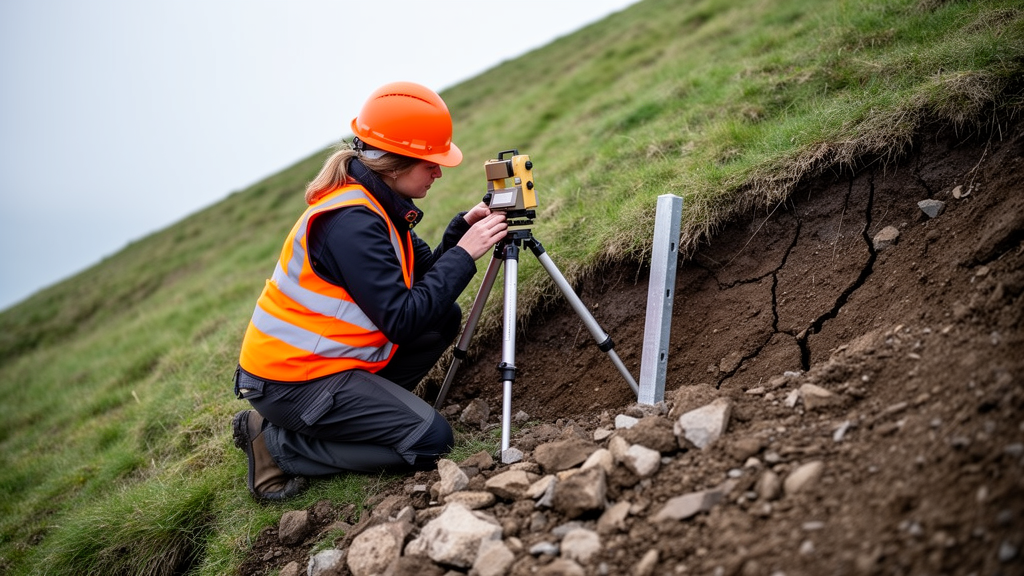
Every landslide early-warning system, every slope stability certificate, and every geotechnical design decision ultimately rests on a chain of numbers that begins with a physical measurement in the field. Displacement sensors, Global Navigation Satellite System receivers, and borehole inclinometers record how a slope is moving, and engineers then feed those observations into numerical models to infer the hidden mechanical properties of the rock and soil mass. This process, known as displacement back-analysis, has become a cornerstone of modern geotechnical practice. Yet the measurements themselves are never perfect. Instruments have finite precision, temperature swings and humidity shift readings, and the very act of installing a sensor can perturb the quantity it is meant to observe. A new study published in the journal Natural Hazards has now quantified, with unusual rigor, just how much these seemingly small random errors can ripple through a back-analysis and ultimately change a landslide safety verdict.
The research, conducted by Wujiao Dai and Jiaxun Li of Central South University in Changsha and Yue Dai of Central South University of Forestry and Technology, develops a systematic framework built on Monte Carlo simulation to trace how random displacement measurement errors propagate into geotechnical parameter estimates and, from there, into slope stability assessments. Monte Carlo methods, first formalized by Nicholas Metropolis and Stanislaw Ulam in 1949, work by repeatedly sampling random values from specified probability distributions and observing how those values flow through a computational model. Instead of asking what happens with one noisy dataset, the technique asks what happens across thousands or millions of plausible noisy datasets, producing a full statistical picture of the uncertainty rather than a single misleading point estimate.
The team anchored their numerical experiments in a real rock slope model, which gave the study a concreteness that purely synthetic benchmarks often lack. They considered two families of measurement errors separately: errors contaminating surface displacement observations, typically gathered by GNSS stations or total stations on the slope face, and errors affecting subsurface displacement measurements, usually obtained from inclinometers installed inside boreholes. For each error type and magnitude, they ran repeated back-analyses in which synthetic random noise was superimposed on the simulated displacement field, and they then examined how the recovered parameter estimates deviated from their true values. Two key geotechnical quantities took center stage: the elastic modulus, which describes how stiff the rock mass is, and cohesion, one of the two shear strength parameters that govern whether a slope holds together or fails.
The results carry a message that should unsettle anyone who assumes millimeter-level noise is harmless. The influence of measurement errors turned out to depend on both the magnitude of the error and the location of the monitoring point, meaning that where an instrument is placed matters nearly as much as how precise it is. At the common error levels of 1 and 2 millimeters, subsurface displacement errors produced larger maximum relative errors in the recovered parameters than surface displacement errors did. This finding is practically significant because subsurface instruments are often treated as the gold standard of deformation monitoring, precisely because they capture internal deformation that surface observations can miss. The new results suggest that this trust must be tempered by an awareness of how sensitive the inverse problem is to noise in those internal measurements.
When the researchers pushed the error levels across the practical range encountered in real monitoring campaigns, the largest deviations appeared under a 10 millimeter random error in surface displacement measurements. Under that scenario, the estimated cohesion deviated by as much as 12.1 percent from its true value, while the elastic modulus deviated by up to 5.5 percent. A twelve percent error in cohesion is not a rounding nuisance. Cohesion, together with the internal friction angle, determines the shear strength available along a potential sliding surface, and the factor of safety of a slope is computed directly from those strength parameters. An engineer who overestimates cohesion because of noisy displacement data may conclude that a marginally stable slope is safe, when in fact the margin is thinner than the model suggests. Conversely, an underestimated cohesion could trigger unnecessary and expensive stabilization works.
Perhaps the most consequential comparison in the study concerns the choice of back-analysis methodology itself. The authors implemented both a deterministic back-analysis, which seeks a single best-fitting parameter set, and a Bayesian back-analysis, which treats parameters as random variables and updates prior knowledge with the observed data to yield full probability distributions. Under the tested random measurement-error scenarios, the Bayesian approach proved consistently more robust than its deterministic counterpart. This outcome aligns with Bayesian theory: because the Bayesian framework explicitly models observation noise in its likelihood function, it can distinguish, at least partially, between genuine structural signal and random measurement scatter. A deterministic inversion, by contrast, will happily chase the noise, fitting spurious wiggles in the data and thereby absorbing measurement error into the parameter estimates themselves.
The Bayesian machinery used in the study builds on a rich literature of geotechnical model updating, including the influential Bayesian calibration framework for computer models introduced by Kennedy and O’Hagan in 2001 and numerous applications to braced excavations, high rock slopes, and tunneling. In a Bayesian back-analysis, prior distributions encode what is known about parameters before any monitoring data arrive, and the likelihood function describes how probable the observed displacements are given any candidate parameter values. When measurement errors are properly characterized, the posterior distribution of the parameters naturally widens to reflect the added uncertainty, rather than collapsing onto a falsely precise point. The new study demonstrates empirically that this built-in honesty about noise translates into parameter estimates that degrade more gracefully as the instruments get noisier.
Beyond the methodological comparison, the study delivers a concrete, actionable guideline for practitioners. For the specific rock slope they analyzed, the authors suggest keeping the standard deviation of random surface displacement measurement errors within approximately 3 millimeters in order to limit their influence on the slope stability assessment. This number transforms an abstract error-propagation analysis into a specification that monitoring engineers can act upon: it tells them what instrument accuracy, data-processing quality, and environmental correction procedures they need to achieve before their displacement data can be trusted as input to a stability back-analysis. Given that modern GNSS-based landslide monitoring can achieve millimeter to sub-millimeter precision under favorable conditions, the 3 millimeter threshold is demanding but attainable, particularly with careful antenna calibration, multipath mitigation, and dual-base-station configurations that recent research in deformation monitoring has advanced.
The broader significance of the work lies in closing a loop that is often left open in landslide hazard assessment. A large body of research has addressed the forward problem of predicting slope deformation and the inverse problem of inferring parameters from observations, and a parallel literature has examined slope reliability under spatially variable soil and rock properties. But the specific question of how measurement noise, as opposed to natural material variability or model bias, corrupts the back-analysis pipeline has received comparatively less systematic attention. By isolating random measurement error and quantifying its propagation through both parameter estimation and stability evaluation, the study fills a genuine gap. The findings also connect to a wider metrological tradition: the Joint Committee for Guides in Metrology has promoted Monte Carlo methods as a reference technique for evaluating measurement uncertainty, and this study extends that tradition deep into geotechnical territory.
For landslide-prone regions around the world, where climate change and infrastructure expansion are placing ever more slopes under scrutiny, the practical implications are hard to overstate. Monitoring networks are expensive, and decisions about sensor density, placement, and precision involve real trade-offs. The new framework offers a rational basis for those decisions, allowing engineers to simulate in advance how a proposed monitoring layout would perform under realistic noise conditions before committing resources in the field. It also provides a quality-control lens for existing networks: if the estimated parameters from a back-analysis begin to drift, the study’s sensitivity results can help determine whether the drift reflects genuine slope evolution or merely the accumulation of measurement error. As the authors note, their findings provide a scientific basis and practical guidance for deformation monitoring and landslide stability assessment, and in a field where lives and infrastructure hang on the difference between a stable slope and a failing one, knowing exactly how much to trust a millimeter of data is knowledge worth having.
Subject of Research: Quantifying the propagation of random displacement measurement errors through geotechnical displacement back-analysis and slope stability assessment using Monte Carlo simulation.
Article Title: Error evaluation for geotechnical displacement back-analysis via Monte Carlo simulation
Article References: Dai, W., Li, J., & Dai, Y. (2026). Error evaluation for geotechnical displacement back-analysis via Monte Carlo simulation. Natural Hazards, 122(21), Article 666. https://doi.org/10.1007/s11069-026-08443-9
Image Credits: AI Generated
DOI: 10.1007/s11069-026-08443-9
Keywords: displacement back-analysis, Monte Carlo simulation, measurement error, error propagation, slope stability, landslide monitoring, Bayesian inference, geotechnical engineering, deformation monitoring, cohesion, elastic modulus, rock slope
Cite Scienmag News
Courtney Benton. (October 9, 2026). How Tiny Measurement Errors Can Distort Landslide Safety Predictions. Scienmag. https://scienmag.com/how-tiny-measurement-errors-can-distort-landslide-safety-predictions/
Courtney Benton. "How Tiny Measurement Errors Can Distort Landslide Safety Predictions." Scienmag, 9 October 2026, https://scienmag.com/how-tiny-measurement-errors-can-distort-landslide-safety-predictions/. Accessed 9 October 2026.
Courtney Benton. "How Tiny Measurement Errors Can Distort Landslide Safety Predictions." Scienmag. October 9, 2026. https://scienmag.com/how-tiny-measurement-errors-can-distort-landslide-safety-predictions/


