


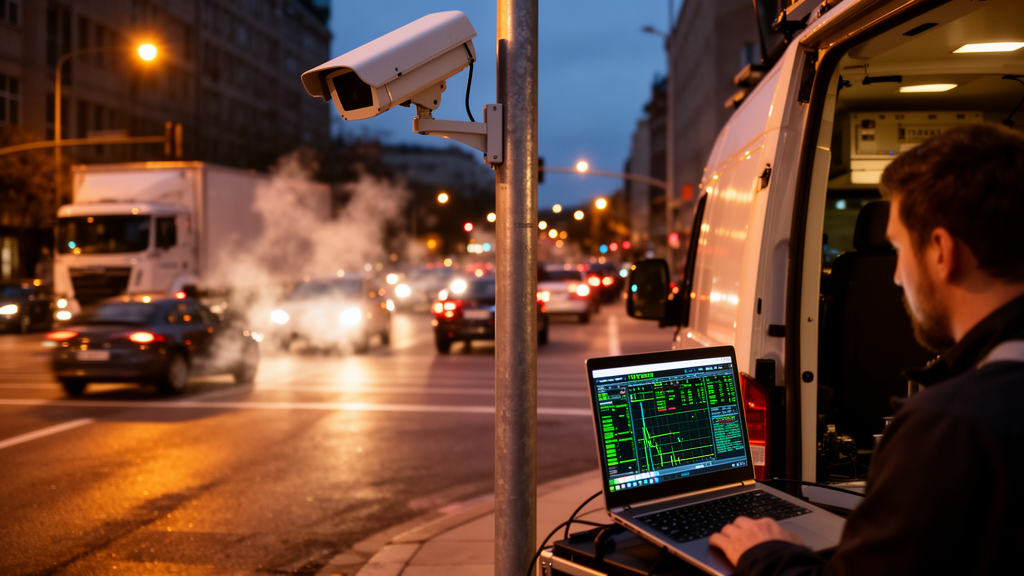
Urban traffic remains one of the most stubborn sources of air pollution in cities around the world, and despite the steady march of electrification, the vehicles clogging city streets today continue to threaten public health. A team of researchers led by the Senseable City Lab at the Massachusetts Institute of Technology, working with collaborators in Japan, Hong Kong, Italy, and the Netherlands, has now unveiled a deep learning framework that turns ordinary street video footage into vehicle-resolved emission estimates. The study, published in Communications Engineering, demonstrates the approach in Amsterdam and Abu Dhabi and offers what the authors describe as a standardized, scalable method for high-resolution urban emission monitoring.
The core problem the researchers set out to solve is one of resolution. Traditional emission inventories typically rely on coarse inputs: fleet averages, fuel sales statistics, and traffic models that spread pollution estimates across entire districts or cities. Such approaches struggle with the spatial and temporal heterogeneity of real traffic, where a congested intersection at rush hour can behave very differently from a free-flowing arterial road a few hundred meters away. Addressing that heterogeneity, the authors argue, requires scalable methodologies capable of resolving emissions at the level of individual vehicles and individual moments in time.
The framework begins with computer vision. The team trained a vehicle classification model on a dataset of 2.3 million images covering 4,923 distinct car models. That granularity matters because emissions are not uniform across a fleet: a heavy older sedan with a large combustion engine emits far more per kilometer than a modern compact hybrid, and knowing which vehicles are actually passing a camera transforms the quality of any downstream estimate. By classifying traffic at the level of make and model rather than broad category, the pipeline captures much of the variation that average-based inventories average away.
Classification alone, however, says little about how a vehicle is being driven at the moment it passes a camera. The second stage of the pipeline therefore tracks each detected vehicle across consecutive video frames and extracts its speed and acceleration. These kinematic variables are critical inputs for emission modeling, because the operating mode of an engine strongly influences its pollutant output. Cold starts, hard accelerations, idling in queues, and steady cruising all produce markedly different emission profiles for the same vehicle. By measuring driving behavior directly from video, the framework captures the dynamics of real traffic rather than assuming idealized driving cycles.
The extracted vehicle classes, speeds, and accelerations are then fed into a modified version of COPERT, a widely used European emission model that computes pollutant emissions from vehicle fleets based on vehicle characteristics and operating conditions. The researchers adapted the model so it could consume the vehicle-resolved, second-by-second information derived from video rather than the aggregated fleet and activity data it conventionally relies upon. The result is an emission estimate tied to specific vehicles on specific street segments at specific times, which is precisely the kind of granularity needed to identify pollution hotspots and evaluate targeted interventions.
To demonstrate the approach, the team applied it in two very different urban environments: Amsterdam and Abu Dhabi. The two cities differ in fleet composition, climate, street geometry, and traffic culture, making them a useful test of generality. In both settings, the framework proved effective for real-time traffic flow analysis, converting live camera feeds into continuously updated emission estimates. The authors present this as evidence that the method is not confined to a single urban context but has genuine potential for scalability across cities with widely varying characteristics.
The implications for urban policy could be substantial. Cities increasingly deploy networks of traffic cameras for congestion management and security, and this research suggests that the same infrastructure can double as a distributed environmental sensing network. A city that knows, street by street and hour by hour, which vehicle types are driving its emissions can design smarter low-emission zones, time its traffic signal strategies to reduce stop-and-go driving, and prioritize corridors for electrification or public transport investment. The authors emphasize that the framework provides a standardized approach to high-resolution emission monitoring, with implications for data-driven urban policy and environmental regulation worldwide.
The technical achievement rests on a demanding computational foundation. Processing street video at scale requires robust object detection and multi-object tracking under real-world conditions: occlusion, varying illumination, weather, and dense traffic all complicate the task of keeping a consistent identity attached to each vehicle across frames. The training corpus of 2.3 million images spanning nearly five thousand car models reflects the scale of data needed to make fine-grained classification reliable in the wild. The study also benefited from high-performance computing resources, including Tesla A100 GPU cluster nodes provided by the Information Technology Center at the University of Tokyo, underscoring the computational intensity of turning raw video into structured emission data.
The work also fits into a broader movement in urban science that treats the city itself as a laboratory instrument. The Senseable City Lab and its collaborators have long explored how ubiquitous digital infrastructure, from sensors to cameras to mobile network data, can render urban processes legible in new ways. This study extends that vision into the environmental domain, proposing that the visual data cities already collect can be repurposed to answer questions about air quality and public health that conventional monitoring stations answer only coarsely. Related efforts, such as digital twins for city traffic emissions built on deep vision and real-time monitoring, suggest a growing research frontier in which emission accounting becomes continuous rather than periodic.
Challenges remain before such systems become routine municipal tools. Camera coverage is uneven across and within cities, raising questions about how estimates generalize to unobserved streets. Privacy considerations around video analytics demand careful governance, even when the analytical output is anonymous emission data. And while the framework resolves vehicle type and driving dynamics, it does not by itself capture every factor influencing real-world emissions, such as temperature, maintenance state, or fuel quality, which emission models handle through their own parameterizations. Nonetheless, the Amsterdam and Abu Dhabi demonstrations mark a concrete step toward emission monitoring that is continuous, vehicle-resolved, and deployable on infrastructure cities already own. As electrification reshapes urban fleets, tools like this one will be essential for verifying that the transition is actually delivering cleaner air, street by street.
Subject of Research: Deep learning analysis of street video footage for vehicle-resolved urban emission estimation
Article Title: Estimating vehicular emissions by applying deep learning on video camera scenes
Article References: Kumar, A., Benson, T., Wang, A., Hu, S., Sekimoto, Y., Santi, P., Duarte, F., Zhu, X., Venverloo, T., & Ratti, C. (2026). Estimating vehicular emissions by applying deep learning on video camera scenes. Communications Engineering. https://doi.org/10.1038/s44172-026-00785-3
Image Credits: AI Generated
DOI: 10.1038/s44172-026-00785-3
Keywords: deep learning, vehicular emissions, computer vision, urban air pollution, COPERT model, traffic monitoring, vehicle classification, Amsterdam, Abu Dhabi, Senseable City Lab, emission inventory, smart cities
Cite Scienmag News
Blake Davidson. (October 9, 2026). Street Cameras and Deep Learning Reveal Vehicle Emissions Block by Block. Scienmag. https://scienmag.com/street-cameras-and-deep-learning-reveal-vehicle-emissions-block-by-block/
Blake Davidson. "Street Cameras and Deep Learning Reveal Vehicle Emissions Block by Block." Scienmag, 9 October 2026, https://scienmag.com/street-cameras-and-deep-learning-reveal-vehicle-emissions-block-by-block/. Accessed 9 October 2026.
Blake Davidson. "Street Cameras and Deep Learning Reveal Vehicle Emissions Block by Block." Scienmag. October 9, 2026. https://scienmag.com/street-cameras-and-deep-learning-reveal-vehicle-emissions-block-by-block/


