


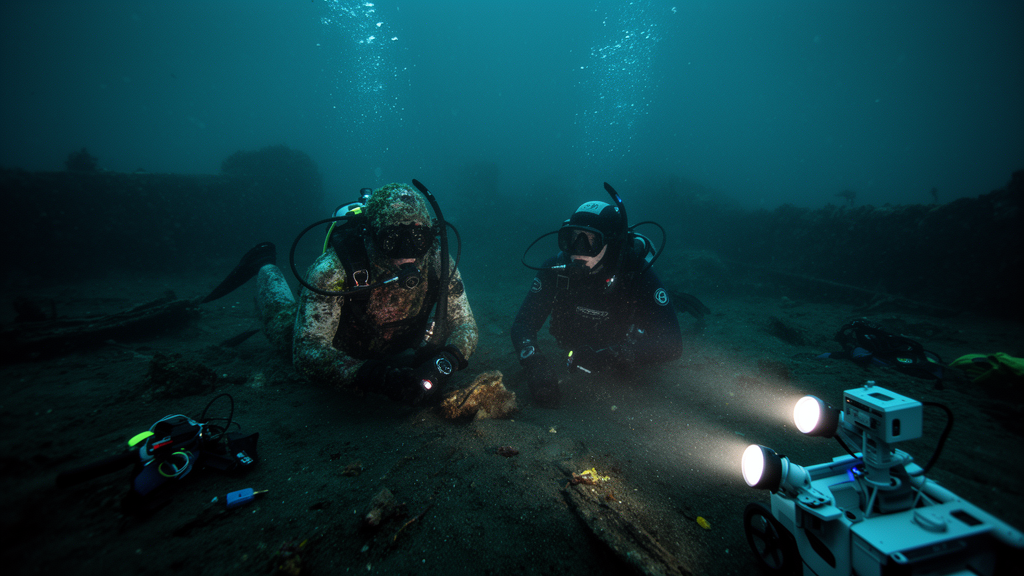
In December 1993, two divers vanished during the same accident in the Mediterranean Sea. For three decades, their families had no answers. Then, thirty years later, both bodies were recovered from the seafloor at depths of 103 and 113 meters, lying just 13 meters apart. What forensic pathologists found when the remains arrived at the medico-legal institute in Nice, France, has now been published in the International Journal of Legal Medicine, and it is already forcing specialists to rethink one of the most stubborn problems in forensic science: how to estimate how long a body has been underwater.
The case is extraordinary on its own terms, but its scientific value lies in a rare natural experiment. Because both divers disappeared together and rested at nearly the same depth on the same seabed, they shared an identical postmortem submersion interval of roughly thirty years. Yet their bodies decomposed in strikingly different ways. One set of remains was largely reduced to a disorganized skeleton, while the other retained skin, hair, and recognizable muscle masses in the lower limbs. Two bodies, one environment, one timeline, two completely different taphonomic outcomes.
Both sets of remains underwent a full forensic workup. Whole-body postmortem computed tomography provided detailed internal imaging before any incision was made, followed by external examination, autopsy, toxicological analyses, and genetic identification. The imaging revealed advanced skeletonization predominantly affecting the upper body in both individuals, a pattern consistent with the well-documented sequence of marine decomposition, in which the head, neck, and thorax, rich in orifices and exposed to scavengers and currents, break down earliest. But the pelvic regions and lower limbs told a different story, preserving tissues compatible with adipocere, the waxy, soap-like substance that forms when body fat hydrolyzes under specific conditions.
Adipocere is one of the most fascinating phenomena in forensic taphonomy. It develops when anaerobic bacteria break down adipose tissue into saturated fatty acids, chiefly palmitic and stearic acid, which can inhibit further decomposition and essentially mummify soft tissue from within. Its formation typically requires a moist, oxygen-poor, alkaline environment, conditions that certain microenvironments within a submerged body can provide even on the open seafloor. In this case, computed tomography quantified the phenomenon precisely: the pelvic tissues compatible with adipocere showed attenuation values ranging from −100 to −40 Hounsfield units, a radiological signature that helps distinguish preserved fatty material from ordinary soft tissue or bone.
The critical difference between the two divers appears to have been their diving equipment. The first individual, designated X1, wore a two-piece semi-dry wetsuit, which allows water to circulate against the skin and offers limited protection from the surrounding environment. The second, X2, wore a full dry suit, which seals the body off almost completely. After thirty years on the seabed, X1’s residual tissues were largely disorganized, consisting of yellowish-to-brown aggregates, whereas X2 showed far more extensive preservation of skin, hair, and discernible muscle masses in the lower limbs. The dry suit, the authors suggest, may have created a sequestered microenvironment around the body, slowing bacterial activity and scavenger access in the enclosed regions, a hypothesis consistent with earlier experimental work showing that body coverings significantly alter adipocere formation in aquatic settings.
This finding matters because forensic scientists routinely use decomposition scoring systems to estimate the postmortem submersion interval, or PMSI. Several such aquatic decomposition scores have been developed and validated, including applications on bodies recovered from the Northern Adriatic Sea, and they assume a broadly predictable relationship between visible decomposition stage and time underwater. A thirty-year case in which one body looks far more decomposed than another, despite identical submersion times, exposes the limits of that assumption. The macroscopic appearance of a body recovered from water, the authors conclude, cannot by itself support a reliable PMSI estimate, especially after prolonged submersion and in the presence of adipocere.
The case also demonstrates the resilience of forensic genetics over decades in the marine environment. Identification of X1 was achieved from muscle tissue, while X2 was identified from femoral bone, a reminder that even when soft tissue fails, compact bone can preserve DNA for extraordinarily long periods. Previous reports have documented successful genetic identification of submerged remains after 26 years of submersion and full STR profiles from bones immersed for decades in freshwater lakes. Toxicological analyses in both Mediterranean cases came back negative, closing the loop on the medico-legal investigation that had waited three decades for its subjects.
Depth adds another layer of complexity. At more than 100 meters, the Mediterranean seafloor is cold, dark, and oxygen-poor, conditions that dramatically slow decomposition compared with shallow, warm, sunlit waters. Research on submerged carrion in the Strait of Georgia at 170 meters has shown that faunal scavenging at such depths differs profoundly from shallow-water patterns, with different scavenger communities and slower colonization. Comparative taphonomic studies have also distinguished between sequestered environments, such as enclosed bays or vehicle interiors underwater, and non-sequestered open water, where currents and scavengers accelerate disarticulation. The two divers, lying 13 meters apart on the same slope, may have experienced subtly different currents, sediment exposure, or scavenger activity, compounding the effect of their different suits.
Historical precedents hint at how long preservation can last underwater. German forensic literature from 1991 described body changes after fifty years in water, and case reports from Poland and elsewhere document submerged remains recovered 24 years after death. But the Nice case is unusual in offering a matched pair: two individuals from the same accident, same sea, same decade-long interval, examined with modern imaging and genetics. That pairing transforms an anecdote into evidence, allowing researchers to isolate variables such as clothing and microenvironment with a clarity that no laboratory experiment with animal models can fully replicate.
For forensic practitioners, the message is sobering and practical at once. When a body is recovered from water, the visible state of preservation is a starting point, not a conclusion. Radiological findings such as Hounsfield unit ranges for adipocere, contextual information about depth, temperature, clothing, and sequestration, and genetic identification from the most resilient tissues all need to be weighed together. Thirty years after two divers disappeared into the Mediterranean, their remains have finally given their families names, and given forensic science a benchmark that will shape how the next generation of underwater deaths is interpreted.
Subject of Research: Marine forensic taphonomy and postmortem submersion interval estimation in two divers recovered after 30 years
Article Title: Two divers submerged in the Mediterranean Sea for 30 years: persistence of adipocere and implications for postmortem submersion interval estimation
Article References: Bernardi, C., Amoretti, N., Isaac, A., Nogueira, L., Temma, J., Leccia, C., & Alunni, V. (2026). Two divers submerged in the Mediterranean Sea for 30 years: persistence of adipocere and implications for postmortem submersion interval estimation. International Journal of Legal Medicine. https://doi.org/10.1007/s00414-026-04038-y
Image Credits: AI Generated
DOI: 10.1007/s00414-026-04038-y
Keywords: adipocere, postmortem submersion interval, marine taphonomy, forensic genetics, postmortem computed tomography, forensic medicine, Mediterranean Sea, decomposition, dry suit, DNA identification, Hounsfield units, scuba diving fatality
Cite Scienmag News
Ophelia Keating. (October 9, 2026). Two Divers Lost in 1993 Found After 30 Years on the Seafloor, and Their Bodies Rewrote Forensic Timelines. Scienmag. https://scienmag.com/two-divers-lost-in-1993-found-after-30-years-on-the-seafloor-and-their-bodies-rewrote-forensic-timelines/
Ophelia Keating. "Two Divers Lost in 1993 Found After 30 Years on the Seafloor, and Their Bodies Rewrote Forensic Timelines." Scienmag, 9 October 2026, https://scienmag.com/two-divers-lost-in-1993-found-after-30-years-on-the-seafloor-and-their-bodies-rewrote-forensic-timelines/. Accessed 9 October 2026.
Ophelia Keating. "Two Divers Lost in 1993 Found After 30 Years on the Seafloor, and Their Bodies Rewrote Forensic Timelines." Scienmag. October 9, 2026. https://scienmag.com/two-divers-lost-in-1993-found-after-30-years-on-the-seafloor-and-their-bodies-rewrote-forensic-timelines/


