


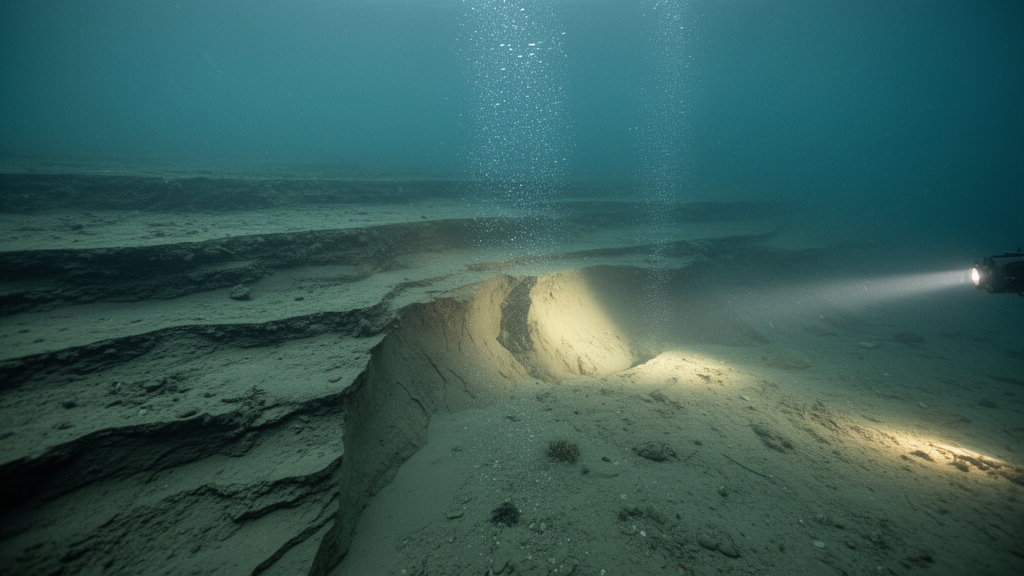
Deep beneath the waves of the northwestern Black Sea, the seafloor is quietly failing. A team of marine geophysicists led by Helene-Sophie Hilbert of GEOMAR Helmholtz Centre for Ocean Research Kiel has now pieced together, in unprecedented detail, why the slopes of the Danube Fan—a vast, fine-grained deep-sea deposit built by Europe’s second-longest river—are so prone to collapse. Their study, published in the journal Solid Earth, combines two of the most powerful tools in marine seismic exploration: high-resolution multichannel seismic (MCS) imaging and four-component ocean-bottom seismometers (OBS). The verdict is striking. The slope is not dangerous because of gas hydrates, the ice-like methane compounds often blamed for submarine landslides. It is dangerous because the sediments themselves are extraordinarily weak, waterlogged, and still refusing to compact, while free gas accumulates in hidden sandy pockets beneath them.
The Danube Fan is a relic of dramatic climate swings. During the Last Glacial Maximum, when global sea level stood roughly 100 to 150 metres lower than today, the Danube River discharged directly onto a then-exposed shelf and fed powerful turbidity currents that carved canyons and built enormous channel-levee systems on the continental slope. The fan system has grown over roughly 900,000 years through stacked channel-levee complexes interbedded with mass-transport deposits—the geological fingerprints of past submarine landslides. When postglacial sea level rose and the Black Sea reconnected with the global ocean around 7,500 years ago, this sediment supply largely ceased. What remains is a frozen record of rapid deposition, and it is precisely that rapidity which, according to the new study, set the stage for instability.
To interrogate that record, the researchers used data acquired during cruise MSM-34 of the research vessel Maria S. Merian, within the German SUGAR and MIDAS projects. Two seismic profiles, designated A and B, were shot across a horseshoe-shaped slump scar on the western flank of the S2 canyon using a 0.74-litre Generator-Injector airgun and a 144-channel streamer. Four ocean-bottom seismometers were deployed along each profile, each carrying three-component geophones and a hydrophone, sampling at 1,000 hertz. The OBS instruments recorded not only compressional P-waves but also converted shear S-waves—vibrations that only travel through the solid skeleton of the sediment. Because S-waves are exquisitely sensitive to shear strength, measuring them alongside P-waves allowed the team to compute Vp/Vs ratios, a diagnostic quantity that reveals how soft, saturated, and mechanically fragile the subsurface truly is.
The results paint a picture of sediments that have barely begun to consolidate. P-wave velocities increase only from about 1,510 metres per second at the seafloor to 1,900 metres per second at roughly 1.2 kilometres depth, while S-wave velocities climb from just 140 to about 860 metres per second over the same interval. Near the seafloor, the Vp/Vs ratio reaches an astonishing 10.6—far above the value of around 2.6 expected in fully compacted marine sediments at kilometre depth. These elevated ratios and depressed velocities, benchmarked against the classic reference curves of marine sediment acoustics, indicate under-consolidated, clay-rich levee deposits that have retained excess pore water because sedimentation outpaced dewatering. Drilling with the MeBo200 seafloor drill rig during a later cruise confirmed the seismic interpretation: boreholes recovered high-porosity, weakly consolidated hemipelagic clays and silts interbedded with sandy levee deposits, with low undrained shear strength throughout.
Both seismic profiles revealed a consistent three-unit stratigraphy. Unit 1, a 40-to-80-metre-thick drape of well-stratified, high-amplitude reflections, caps the slope. Beneath it lies Unit 2, a roughly 150-metre-thick zone of chaotic seismic facies—discontinuous, jumbled reflections that the authors interpret as material disturbed during the S2 slope failure event, possibly even its remnants. Unit 3 consists of older, stratified levee and overbank deposits extending to depths of about 1.2 kilometres. Scattered through these units are lens-shaped mass-transport deposits, small normal faults cutting the upper 100 metres, and a prominent downward-dipping reflector that appears to separate mechanically distinct sediment packages. Together, these features record a repeating cycle of failure, remobilisation, and redeposition that has shaped the slope for millennia.
But the study’s most intriguing findings concern gas. The seismic sections are riddled with fluid-related anomalies: polarity-reversed reflections, velocity pull-downs that bend deeper reflectors downward, and a vertically focused zone of disrupted reflectivity beneath one seismometer that the team interprets as a seismic chimney—a possible conduit for upward gas migration. Free gas in pore spaces dramatically slows P-waves while leaving S-waves almost untouched, and the measured velocity reductions of 80 to 190 metres per second match expectations for low gas saturations in porous sediments. Gas samples from the region are up to 99 percent methane of microbial origin, generated in place from organic-rich sediments. Active gas flares—bubbles streaming through the water column—were observed during the cruise, some only about 40 metres from a seismometer, at water depths shallower than the upper limit of the gas hydrate stability zone, which lies near 655 to 720 metres in this part of the Black Sea.
Here the story takes a surprising turn. Bottom-simulating reflectors, or BSRs—seismic horizons that mimic the seafloor and mark the base of the gas hydrate stability zone—do appear on profile B, with the reversed polarity that signals free gas trapped beneath. Yet the BSRs are discontinuous, stacked, and sit about 20 metres deeper than the thermally predicted base of today’s stability zone. That mismatch, the authors argue, means the hydrate system is in transient disequilibrium, still adjusting to post-glacial warming since the Last Glacial Maximum, when colder bottom waters allowed hydrates to form at shallower levels. Combined with electromagnetic surveys and drilling that indicate hydrate saturations near zero within most of the stability zone and below 10 percent even at the BSR, the picture is of a hydrate-poor system. Crucially, the absence of S-wave velocity anomalies shows the hydrates are not cementing sediment grains together; they occur as sparse, patchy pore-filling accumulations that barely alter the sediment’s bulk strength.
This finding inverts a common assumption. In hydrate-rich provinces such as the Krishna-Godavari Basin off India, where sand-hosted hydrates can fill more than half the pore space, or the Gulf of Mexico’s Mississippi Fan, dissociation of abundant hydrates is a recognised driver of pore-pressure build-up and slope failure. The Danube Fan, by contrast, emerges as an endmember case: a hydrate-poor but gas-active margin where instability is governed primarily by under-consolidation and localised gas overpressure rather than by hydrate dynamics. Free gas accumulates in sand-rich layers sealed by impermeable clays beneath the stability zone, and when pressure builds sufficiently, it escapes episodically through focused vents—much like the episodic seepage documented at Hydrate Ridge off Oregon and Formosa Ridge off Taiwan. The hydrates’ influence on slope stability is indirect at most, operating through dissociation-driven gas release rather than any mechanical role.
The implications reach well beyond the Black Sea. Submarine landslides can generate destructive tsunamis and rupture seafloor infrastructure, and understanding which margins are vulnerable is a global priority. The Danube Fan study shows that even on slopes dipping a mere 2.5 degrees, weak, under-consolidated muds combined with stratigraphic discontinuities, shallow faults, and gas overpressure can create a system primed for failure—where moderate triggers such as sediment loading or regional earthquakes may suffice. The gas-trapping and migration mechanisms observed here are also directly analogous to those required for secure long-term CO2 storage in marine settings, making the results relevant to carbon capture and storage site selection. As the authors conclude, the Danube Fan offers a critical analogue for other fine-grained, rapidly deposited continental margins in the early stages of hydrate system development—a reminder that the most dangerous seafloors are not always those with the most gas hydrates, but those with the weakest sediments and nowhere for the gas to go.
Subject of Research: Gas migration, gas hydrate distribution, and submarine slope instability in the Danube Fan, northwestern Black Sea
Article Title: Gas migration and slope instability in the Danube Fan: insights from integrated OBS-MCS seismic analysis
Article References: Hilbert, H.-S., Dannowski, A., Bialas, J., Gross, F., Hoffmann, J., Klaeschen, D., & Berndt, C. (2026). Gas migration and slope instability in the Danube Fan: insights from integrated OBS-MCS seismic analysis. Solid Earth, 17(8), 923-946. https://doi.org/10.5194/se-17-923-2026
Image Credits: AI Generated
Keywords: Danube Fan, Black Sea, gas hydrates, submarine landslides, slope stability, ocean-bottom seismometers, multichannel seismic, free gas, under-consolidated sediments, seismic chimneys, bottom-simulating reflector, marine geohazards
Cite Scienmag News
Violet Maxwell. (October 9, 2026). Weak Muds and Wandering Gas: Seismic Study Reveals Why the Danube Fan’s Seafloor Keeps Sliding. Scienmag. https://scienmag.com/weak-muds-and-wandering-gas-seismic-study-reveals-why-the-danube-fans-seafloor-keeps-sliding/
Violet Maxwell. "Weak Muds and Wandering Gas: Seismic Study Reveals Why the Danube Fan’s Seafloor Keeps Sliding." Scienmag, 9 October 2026, https://scienmag.com/weak-muds-and-wandering-gas-seismic-study-reveals-why-the-danube-fans-seafloor-keeps-sliding/. Accessed 9 October 2026.
Violet Maxwell. "Weak Muds and Wandering Gas: Seismic Study Reveals Why the Danube Fan’s Seafloor Keeps Sliding." Scienmag. October 9, 2026. https://scienmag.com/weak-muds-and-wandering-gas-seismic-study-reveals-why-the-danube-fans-seafloor-keeps-sliding/


