


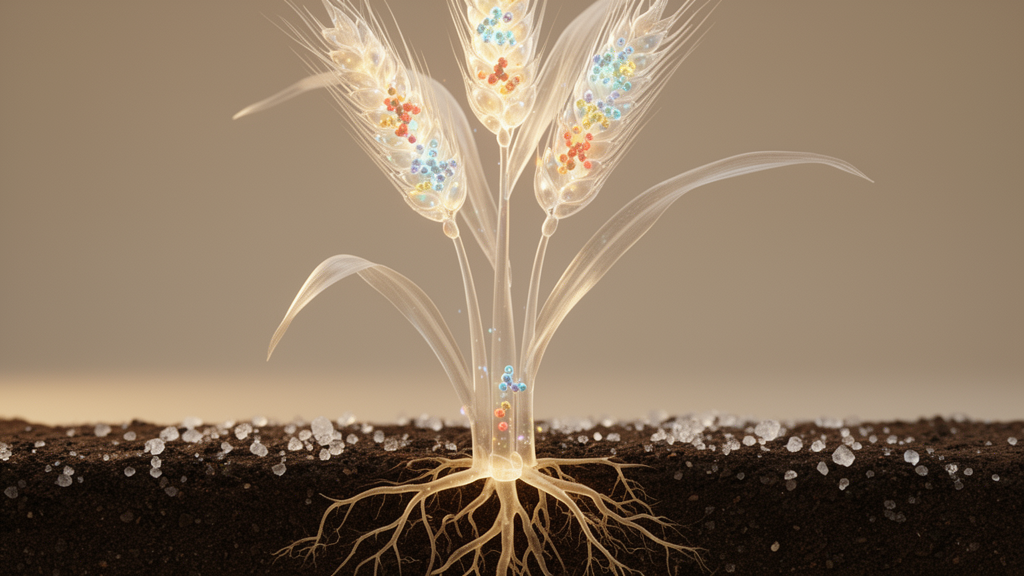
Salt is quietly strangling one of the world’s most important food crops. Wheat, which supplies roughly a fifth of the calories consumed by humanity, loses yield and grain quality whenever soils become too salty, a problem that is spreading as irrigation intensifies and climates shift. Now a team of researchers at Qingdao Agricultural University, working with a collaborator at Murdoch University in Australia, has delivered the first systematic, genome-wide portrait of a family of regulatory genes in wheat that appears to sit at the crossroads of how the plant senses and responds to environmental stress. The study, published in BMC Plant Biology, identifies twenty members of the AT-rich interaction domain, or ARID, gene family in wheat and provides the first experimental evidence that several of them respond dynamically to salt stress.
The ARID family belongs to a broader class of proteins known as transcription factors, molecular switches that bind specific DNA sequences and control whether downstream genes are switched on or off. In animals and fungi, ARID proteins have long been recognized as key players in development, chromatin remodeling, and cell-cycle control. In plants, however, the family has remained comparatively understudied, even though emerging evidence suggested that ARID genes participate in abiotic stress responses, the biological reactions to non-living stresses such as drought, cold, and salinity. What was missing was a complete inventory of the family in wheat, a crop whose genome is famously complicated: bread wheat carries three overlapping subgenomes, the legacy of hybridization events in its evolutionary history, making gene discovery and classification a genuinely demanding task.
The researchers began by scanning the wheat reference genome for proteins containing the characteristic ARID domain, a stretch of roughly one hundred amino acids that recognizes AT-rich DNA sequences. Their search yielded twenty TaARID genes, a relatively compact family compared with the sprawling transcription factor families that dominate plant stress biology. To make sense of these twenty genes, the team constructed a phylogenetic tree, a diagram of evolutionary relatedness, which sorted the family into three distinct groups. This grouping matters because genes that descend from a common ancestor tend to retain related functions, so the tree provides an immediate hypothesis about which genes might behave similarly in the living plant.
Mapping the genes onto wheat’s chromosomes revealed an uneven distribution across fourteen of the crop’s chromosomes, with no members detected on the remaining seven. The pattern of their locations told a story about how the family grew. The dominant force behind its expansion was segmental duplication, the process by which large blocks of chromosomes, carrying multiple genes at once, are copied and retained over evolutionary time. This contrasts with tandem duplication, where individual genes are duplicated side by side, which played only a minor role. Segmental duplication is a hallmark of the polyploid wheat genome, and the finding suggests that the ARID family expanded largely as a passenger of the genome’s own turbulent history rather than through repeated single-gene amplification.
To test whether the wheat genes had counterparts in other grasses, the team performed synteny analysis, comparing the positions of ARID genes across related species. They detected strong interspecific synteny between wheat and other grass species, meaning that corresponding genes occupy matching chromosomal neighborhoods across species boundaries. This conservation is more than a curiosity: it allows researchers to transfer functional knowledge from better-studied grasses such as rice or barley to wheat, and it indicates that the core regulatory roles of ARID genes were established before these species diverged, millions of years ago.
Within each phylogenetic group, the genes showed strikingly conserved structures. The team examined exon-intron architecture, the arrangement of coding regions and intervening sequences within each gene, and the composition of conserved protein motifs, short recurring amino-acid patterns that often carry out specific biochemical functions. Members of the same group shared highly similar gene structures and motif compositions, reinforcing the idea that the phylogenetic classification reflects genuine functional similarity. This kind of internal consistency is exactly what genome-wide surveys aim to find, because it means the classification can be used to predict the behavior of untested genes based on their better-characterized relatives.
The next question was when and where these genes are active. Transcription factors are controlled in large part by regulatory DNA sequences in their promoters, the regions upstream of each gene. Scanning the TaARID promoters, the researchers uncovered numerous cis-elements, short DNA motifs that serve as docking sites for other regulatory proteins, responsive to plant hormones and to stress signals. The abundance of hormone- and stress-responsive elements in these promoters suggested that the genes are wired to react to environmental and developmental cues, rather than operating as static, housekeeping regulators. It is a genomic forecast of stress responsiveness that the team then set out to verify experimentally.
Transcriptome analysis, which measures the activity levels of genes across different tissues, revealed diverse tissue-specific expression patterns among the TaARID family. Some genes were preferentially active in roots, the first line of contact with saline soil, while others showed stronger activity in aerial tissues, hinting at divided labor within the family. The researchers then turned to quantitative real-time polymerase chain reaction, or qRT-PCR, a sensitive laboratory technique that tracks the abundance of specific gene transcripts over time. Their experiments confirmed that TaARID genes display dynamic, tissue- and time-dependent responses to salt stress: expression rose and fell on distinct schedules in different parts of the plant, exactly the kind of kinetic signature expected from genes involved in orchestrating a stress response rather than merely suffering its collateral effects.
Two further lines of evidence rounded out the picture. First, the team verified that representative TaARID proteins localize to the nucleus, the cellular compartment where transcription factors must reside to contact DNA. This was confirmed experimentally rather than assumed from sequence alone, and it establishes that the proteins are positioned to act as direct regulators of gene expression. Second, protein-protein interaction analysis predicted functional associations among multiple family members, suggesting that TaARID proteins do not work in isolation but may form regulatory complexes or participate in shared signaling networks. Together, these results sketch a family whose members are evolutionarily conserved in some respects and functionally divergent in others, a combination that gives wheat both a stable regulatory backbone and the flexibility to fine-tune responses across tissues and conditions.
The practical significance of the work lies in what it enables next. Because salt stress is one of the principal abiotic constraints on wheat yield, identifying regulatory genes that respond to salinity provides candidate targets for breeding and biotechnology. A transcription factor that modulates a plant’s stress response can influence large sets of downstream genes, making it a potentially powerful lever, though also one that requires careful validation to avoid trade-offs in growth or grain quality. The authors position their catalog, phylogenetic framework, expression atlas, and experimental validation as a foundation for subsequent functional studies, in which individual TaARID genes can be knocked out, overexpressed, or edited to determine their precise contributions to salt tolerance. For a crop that must feed a growing population on increasingly stressed land, a complete map of a stress-linked regulatory family is a small but meaningful step from genome sequence toward food security.
Subject of Research: Genome-wide identification and salt-stress expression analysis of the ARID transcription factor gene family in wheat
Article Title: Genome‑wide identification and expression analysis of wheat ARID gene family with experimental validation of salt‑stress responses
Article References: Zhao, Y., Li, T., Zhang, S., Jia, C., Ren, M., Ma, W., & Dai, X. (2026). Genome‑wide identification and expression analysis of wheat ARID gene family with experimental validation of salt‑stress responses. BMC Plant Biology. https://doi.org/10.1186/s12870-026-10105-8
Image Credits: AI Generated
DOI: 10.1186/s12870-026-10105-8
Keywords: wheat, ARID gene family, transcription factors, salt stress, abiotic stress, genome-wide analysis, segmental duplication, synteny, qRT-PCR, gene expression, subcellular localization, plant genetics
Cite Scienmag News
Juliet Wilcox. (October 9, 2026). Wheat’s Hidden Salt-Stress Genes: Scientists Map the ARID Family From Root to Grain. Scienmag. https://scienmag.com/wheats-hidden-salt-stress-genes-scientists-map-the-arid-family-from-root-to-grain/
Juliet Wilcox. "Wheat’s Hidden Salt-Stress Genes: Scientists Map the ARID Family From Root to Grain." Scienmag, 9 October 2026, https://scienmag.com/wheats-hidden-salt-stress-genes-scientists-map-the-arid-family-from-root-to-grain/. Accessed 9 October 2026.
Juliet Wilcox. "Wheat’s Hidden Salt-Stress Genes: Scientists Map the ARID Family From Root to Grain." Scienmag. October 9, 2026. https://scienmag.com/wheats-hidden-salt-stress-genes-scientists-map-the-arid-family-from-root-to-grain/


