


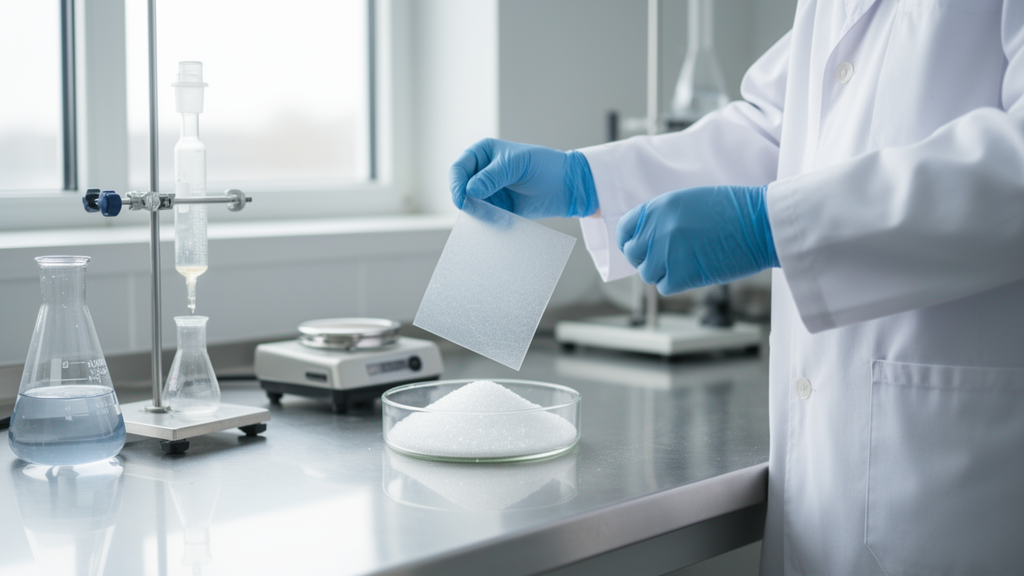
Covalent organic frameworks, or COFs, have long been celebrated as one of reticular chemistry’s most versatile achievements. By stitching organic building blocks into crystalline, porous networks through strong covalent bonds, chemists have produced thousands of these powders with tailored pore sizes, chemical functionalities, and architectures. Yet a stubborn bottleneck has kept many of these remarkable materials out of real-world use: COFs are typically made as fine powders, while many of their most promising applications, particularly molecular separations, demand continuous, defect-free membranes. Turning a flask of powder into a robust, selective film has proven so difficult that the gap between laboratory synthesis and industrial deployment has widened even as the catalogue of COF structures has exploded.
Now, a team of researchers in China reports a strategy that directly confronts this processing challenge. Writing in Nature Communications, Meidi Wang, Guan-Zheng Zhou, and colleagues describe a dual-drive transformation that converts COF powders into coherent membranes through the interplay of two forces: an internal driver based on framework reconstruction and an external driver based on acid attack. The work, carried out at China Three Gorges University with collaborators at the Harbin Institute of Technology and Huazhong University of Science and Technology, demonstrates that dynamic covalent chemistry, the same reversible bond-forming behavior that allows COFs to self-correct during synthesis, can be harnessed at the macroscopic scale to reshape an entire material.
The central insight is that COF frameworks are not as chemically inert as they might appear. Under the right conditions, the linkages that hold the network together can break and reform, allowing the structure to reorganize. The researchers exploited this plasticity deliberately. By subjecting COF powders to acid attack, they destabilized the existing bonds, while the intrinsic tendency of the framework to reconstruct drove the material to reassemble into a continuous membrane rather than remaining a collection of disconnected crystallites. The result is a transformation that operates at the macroscopic scale, converting bulk powder into a free-standing or supported film without the need for elaborate layer-by-layer assembly or high-temperature processing.
What makes the approach especially striking is its scalability. The team produced both two-dimensional and three-dimensional COF membranes, with the largest reaching an area of 225 square centimeters. For a field where many reported membranes measure only a few square centimeters, that figure represents a meaningful leap toward practical dimensions. The dual-drive strategy also achieved high conversion ratios and fabrication efficiency, outperforming conventional membrane-making methods on several fronts. Because the transformation relies on chemical driving forces rather than energy-intensive deposition techniques, the authors describe it as a green and versatile route to COF membranes, one that could in principle accommodate the wide structural diversity that reticular chemistry already provides.
The performance of the resulting membranes is where the work becomes truly compelling. The team’s optimum membrane, built from the TpPa framework, a combination of a triphenylene-based aldehyde and a phenylenediamine linker that forms imine-linked 2D layers, delivered impressive molecular sieving results. In filtration tests, the membrane rejected 99 percent of dye molecules and 98 percent of pharmaceutical molecules, while maintaining a pure water permeance of 179.0 liters per square meter per hour per bar. That combination of high selectivity and high flux is the holy grail of membrane science, since the two properties usually trade off against each other: membranes that filter more precisely tend to let water through more slowly, and vice versa.
The implications for water treatment are considerable. Dyes from textile manufacturing and active pharmaceutical compounds from municipal and industrial wastewater are among the most troublesome classes of aquatic pollutants, being small enough to slip through many conventional membranes yet harmful at low concentrations. A membrane that can reject these molecules at the 98 to 99 percent level while sustaining fast water transport could reduce the energy and cost of advanced treatment processes. The authors position the technology within chemical engineering separations broadly, suggesting applications that extend beyond pollution remediation to areas such as solvent purification and resource recovery.
To appreciate why the powder-to-membrane problem has been so persistent, it helps to consider the alternatives. Researchers have tried to grow COF membranes directly on supports through interfacial polymerization, to exfoliate 2D COFs into nanosheets and restack them into laminates, and to blend COF particles into polymer matrices as mixed-matrix films. Each route has drawbacks. Direct growth can be slow and difficult to control over large areas, often leaving pinholes that destroy selectivity. Exfoliation and restacking depend on delicate assembly steps that are hard to scale. Mixed-matrix membranes suffer from poor interface compatibility between the inorganic-like framework and the polymer. The dual-drive transformation sidesteps many of these issues by starting from the fully formed, crystalline powder and letting dynamic covalent chemistry do the assembly work.
The strategy also speaks to a broader trend in materials chemistry: the recognition that synthesis and processing should not be treated as separate stages. Reticular chemistry has excelled at designing structures atom by atom, but the history of materials science shows that a material only matters industrially when it can be shaped into the form a device requires. Graphene, metal-organic frameworks, and zeolites have all faced similar processing bottlenecks, and breakthroughs in shaping them, such as scalable graphene films or zeolite membranes, unlocked entire application domains. The COF community has been waiting for its own processing breakthrough, and a powder-to-membrane transformation that is green, efficient, and general enough to span 2D and 3D frameworks may prove to be exactly that.
There are, of course, questions that will shape the road ahead. The reported work is at an early stage, and the authors note that the published version is subject to further editorial refinement. Long-term stability under continuous operation, mechanical robustness, performance in complex real-world feed streams, and the economics of scale-up all remain to be demonstrated beyond the laboratory. The acid attack step, while central to the transformation, will need careful engineering in industrial settings. Still, the fundamentals are encouraging: the membranes are defect-free, the areas achieved are the largest reported for this class of material by a wide margin, and the underlying chemistry is inherently modular, meaning new COF chemistries could be plugged into the same transformation pipeline as they are invented.
The study, published open access on 30 September 2026 with support from the National Natural Science Foundation of China and the Hubei Three Gorges Laboratory, arrives at a moment when demand for advanced separation technology is rising across water purification, chemical manufacturing, and energy storage. If the dual-drive transformation proves as general and scalable as the authors suggest, the vast library of COF powders accumulated over the past two decades could suddenly become a library of usable membranes. That would be a quiet revolution in separation science, achieved not by inventing a new material, but by finding the chemistry that lets an existing one take the shape the world needs.
Subject of Research: Transformation of covalent organic framework powders into 2D/3D membranes for molecular separation
Article Title: Powder-to-membrane transformation affording 2D/3D COF membranes for molecular separations
Article References: Wang, M., Zhou, G.-Z., Zhou, Z., Shao, L., Shu, C., Ma, T.-Y., Wu, X.-Q., & Li, D.-S. (2026). Powder-to-membrane transformation affording 2D/3D COF membranes for molecular separations. Nature Communications. https://doi.org/10.1038/s41467-026-78068-w
Image Credits: AI Generated
DOI: 10.1038/s41467-026-78068-w
Keywords: covalent organic frameworks, COF membranes, molecular separations, dynamic covalent chemistry, water purification, membrane technology, reticular chemistry, dye rejection, pharmaceutical pollutants, framework reconstruction, porous materials, chemical engineering
Cite Scienmag News
Violet Maxwell. (October 9, 2026). Scientists Turn COF Powders Into Defect-Free Membranes With a Dual-Drive Strategy. Scienmag. https://scienmag.com/scientists-turn-cof-powders-into-defect-free-membranes-with-a-dual-drive-strategy/
Violet Maxwell. "Scientists Turn COF Powders Into Defect-Free Membranes With a Dual-Drive Strategy." Scienmag, 9 October 2026, https://scienmag.com/scientists-turn-cof-powders-into-defect-free-membranes-with-a-dual-drive-strategy/. Accessed 9 October 2026.
Violet Maxwell. "Scientists Turn COF Powders Into Defect-Free Membranes With a Dual-Drive Strategy." Scienmag. October 9, 2026. https://scienmag.com/scientists-turn-cof-powders-into-defect-free-membranes-with-a-dual-drive-strategy/


