


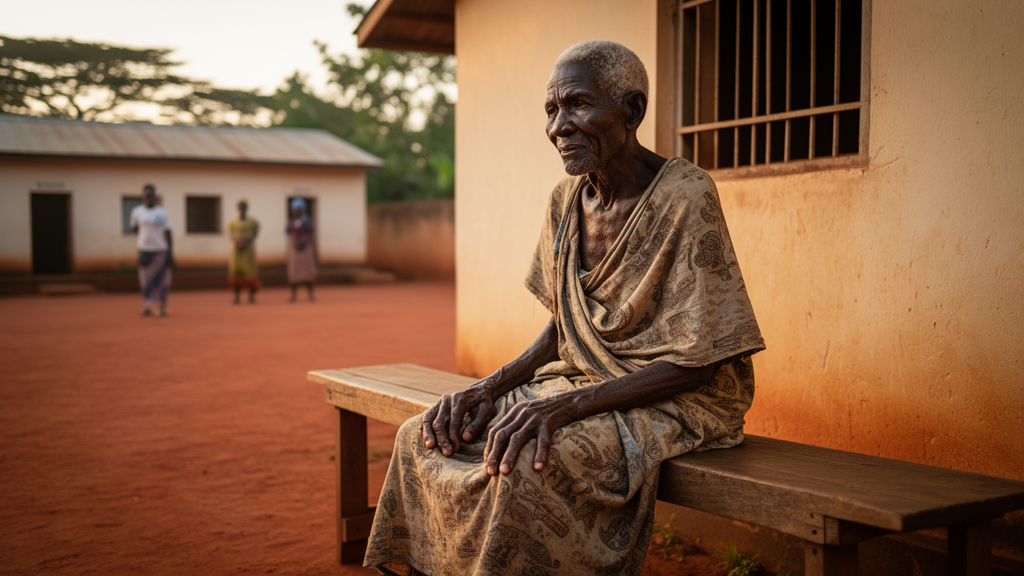
In a small community in Ghana’s Volta Region, people who have been medically cured of leprosy continue to live with a disease of a different kind: the lingering belief that their illness was sent by witches, ancestors, or contaminated food. A new qualitative study from the Godokpe community in the Ho Municipality documents in striking detail how these beliefs, together with poverty, disability, and informal charges for nominally free treatment, continue to shape the healthcare decisions of persons cured of leprosy long after the bacteria that cause the disease have been cleared from their bodies. The research, published in PLOS Neglected Tropical Diseases, offers one of the most granular portraits to date of how a curable neglected tropical disease keeps its grip on a community through culture, economics, and the quiet mechanics of stigma.
Leprosy, caused by the bacterium Mycobacterium leprae, is one of humanity’s oldest recorded diseases and one of its most misunderstood. It primarily affects the skin, peripheral nerves, the upper respiratory tract, and the eyes, producing the characteristic skin lesions, nodules, and loss of sensation that, if untreated, can progress to limb deformities and disabling ulcers. Crucially, the disease is curable with multidrug therapy, and transmission is far less efficient than folklore suggests, requiring prolonged close contact rather than casual touch. Ghana officially reached the World Health Organization’s threshold for elimination of leprosy as a public health problem decades ago, yet new cases continue to be detected each year, and the people who were treated continue to carry the social and physical scars of the disease. It is this post-cure landscape, where the pathogen is gone but its consequences remain, that the Godokpe study set out to map.
The research team, led by Redeemer Joy Duboh, Dickson Kweku Delali, and Emmanuel Manu, conducted a qualitative descriptive study designed to capture the lived experience of persons cured of leprosy in their own words. Using purposive sampling, the researchers recruited twenty participants, continuing interviews until they reached thematic saturation, the point at which new conversations stopped yielding new insights. Each participant took part in a semi-structured, face-to-face, in-depth interview lasting between twenty and thirty minutes, conducted in the community itself, audio-recorded, and transcribed verbatim. The team then applied reflexive thematic analysis using Atlas.ti version 7.5.0, a qualitative data analysis platform that allows researchers to code interview text and trace patterns across it, and reported their methods in line with the COREQ guidelines, the international standard for transparency in qualitative research. The result is a study that trades statistical breadth for depth, but depth is precisely what the question demands.
The analysis surfaced four central themes, and the first, knowledge of leprosy, is the most sobering. Among the participants, supernatural explanations dominated: bewitchment, ancestral curses, and contaminated food were cited as causes of the disease, while recognition of a bacterial origin appeared only rarely. Participants did, however, describe the clinical signs of leprosy with precision, listing skin lesions, ulcers, nodules, limb deformities, loss of sensation, and body pain. The gap between accurate symptom recognition and inaccurate causal attribution is not a trivial detail. In communities where illness is understood as the work of witches or offended ancestors, the logical first response is not a clinic but a spiritual intervention, and the person who falls ill may be blamed for the illness itself. Public health messaging that teaches symptoms without addressing beliefs about causation, the study suggests, is working against the grain of local explanatory models.
The second theme, social treatment and stigma, revealed a more nuanced and in some ways more hopeful picture than the popular image of total ostracism. Participants described two distinct patterns running in parallel. Within families and the wider community, interpersonal avoidance persisted, and its resolution was uneven: some relationships had healed over the years, while others had not, leaving cured individuals navigating a patchwork of acceptance and rejection. At health facilities, by contrast, participants documented a clear shift over time toward equal treatment. Nurses and doctors who once may have kept their distance now treated persons cured of leprosy like any other patient. This divergence is analytically important. It suggests that formal health institutions can change faster than informal social networks, and that facility-based care can serve as a space of dignity even when the walk home remains a gauntlet of suspicion. It also suggests that stigma reduction is not a single switch but a slow, uneven trajectory that differs by setting.
When it came to health-seeking behaviour itself, the study found a pluralistic pattern that defies any simple division between traditional and modern medicine. Participants drew on biomedical facilities, including the Ho Polyclinic and the Ho Teaching Hospital, but also on herbal remedies, self-medication, and spiritual or church-based healing, choosing among these options according to their perception of the severity of the problem. A minor ailment might be treated at home with herbs; a worsening wound might prompt a clinic visit; a symptom that resisted both might be reframed as spiritual and taken to a church. This layered, pragmatic approach is common across much of sub-Saharan Africa and is best understood not as ignorance of biomedicine but as rational triage under constraint. People weigh cost, distance, trust, and expected outcomes, and they move between systems as circumstances change. Any intervention that assumes a single pathway to care will miss most of the actual pathways people use.
The fourth theme catalogued the barriers stacked against those pathways, and here the study’s most consequential finding emerges: a documented gap between free-care entitlements and practice. Leprosy care in Ghana is nominally free, yet participants reported that medication was sometimes unavailable at facilities, and that informal charges were levied for treatment that should have cost nothing. Layered on top of this were logistical barriers, including long distances to facilities and the cost of transport; physical limitations, including mobility impairment, painful or wounded legs, and visual loss, all common residua of untreated nerve damage; and socioeconomic constraints, including unemployment, financial hardship, low allowances, and dependence on donors. Perhaps most strikingly, participants described prioritising food over healthcare, a stark illustration of what happens when a household’s budget cannot cover both. For a person with wounded legs, a transport fare to the hospital competes directly with the day’s meals, and the meals usually win.
The authors frame these findings against the Sustainable Development Goals, and the framing is more than rhetorical. The barriers documented in Godokpe map directly onto SDG 1 on poverty reduction, SDG 3 on good health and well-being, and SDG 10 on reduced inequalities. A fee-exemption policy that fails at the point of service is an inequality in itself, converting a guaranteed entitlement into a lottery that the poorest are least able to win. The study’s central recommendation follows directly from its evidence: verification of fee-exemption entitlements at the facility level, so that the promise of free care is honoured in the consultation room and the dispensary, alongside sustained engagement with families and communities to address the supernatural attributions and interpersonal avoidance that facilities alone cannot reach.
What makes the Godokpe study resonate beyond its small sample is the clarity with which it shows that curing a disease and ending its burden are two different projects. The multidrug therapy regimens that defeated Mycobacterium leprae in these twenty participants did nothing to defeat the witchcraft narrative, the family member who still keeps his distance, or the informal fee collected at the clinic door. Elimination targets count new cases, but they do not count the cured woman who chooses food over a follow-up appointment, or the cured man whose neighbours still believe his old lesions were a curse. Those are the numbers that qualitative research can see, and they are the numbers that will determine whether the final chapter of the leprosy story is written in clinics or in communities.
For global health, the lesson is that the endgame of a neglected tropical disease is social as much as biomedical. Ghana’s elimination milestone was a genuine achievement, but Godokpe shows what persists after the milestone passes: beliefs that predate germ theory, stigma that dissolves unevenly, and a health system whose formal generosity is undercut by informal practice. The study’s participants, by speaking plainly about bewitchment and hidden charges, have given researchers and policymakers something a case register never can, a map of the terrain where the next phase of leprosy control must actually be fought. Whether that map is acted upon, in Godokpe and in the many segregated communities like it, will test how seriously the global health community takes its own promises about equity, poverty, and the right to care after the cure.
Subject of Research: Health-seeking behaviours among persons cured of leprosy in the Godokpe community, Volta Region, Ghana
Article Title: Understanding influences on health-seeking behaviours among persons cured of leprosy in the Godokpe community, Volta Region of Ghana: A qualitative descriptive study
Article References: Duboh, R. J., Delali, D. K., & Manu, E. (2026). Understanding influences on health-seeking behaviours among persons cured of leprosy in the Godokpe community, Volta Region of Ghana: A qualitative descriptive study. PLOS Neglected Tropical Diseases, 20(9), e0014753. https://doi.org/10.1371/journal.pntd.0014753
Image Credits: AI Generated
DOI: 10.1371/journal.pntd.0014753
Keywords: leprosy, Ghana, neglected tropical diseases, health-seeking behaviour, stigma, qualitative research, supernatural beliefs, fee exemption, Volta Region, public health, Sustainable Development Goals, Mycobacterium leprae
Cite Scienmag News
Ophelia Keating. (October 9, 2026). Cured but Not Free: Leprosy Survivors in Ghana Still Face Supernatural Fear and Hidden Fees. Scienmag. https://scienmag.com/cured-but-not-free-leprosy-survivors-in-ghana-still-face-supernatural-fear-and-hidden-fees/
Ophelia Keating. "Cured but Not Free: Leprosy Survivors in Ghana Still Face Supernatural Fear and Hidden Fees." Scienmag, 9 October 2026, https://scienmag.com/cured-but-not-free-leprosy-survivors-in-ghana-still-face-supernatural-fear-and-hidden-fees/. Accessed 9 October 2026.
Ophelia Keating. "Cured but Not Free: Leprosy Survivors in Ghana Still Face Supernatural Fear and Hidden Fees." Scienmag. October 9, 2026. https://scienmag.com/cured-but-not-free-leprosy-survivors-in-ghana-still-face-supernatural-fear-and-hidden-fees/


