


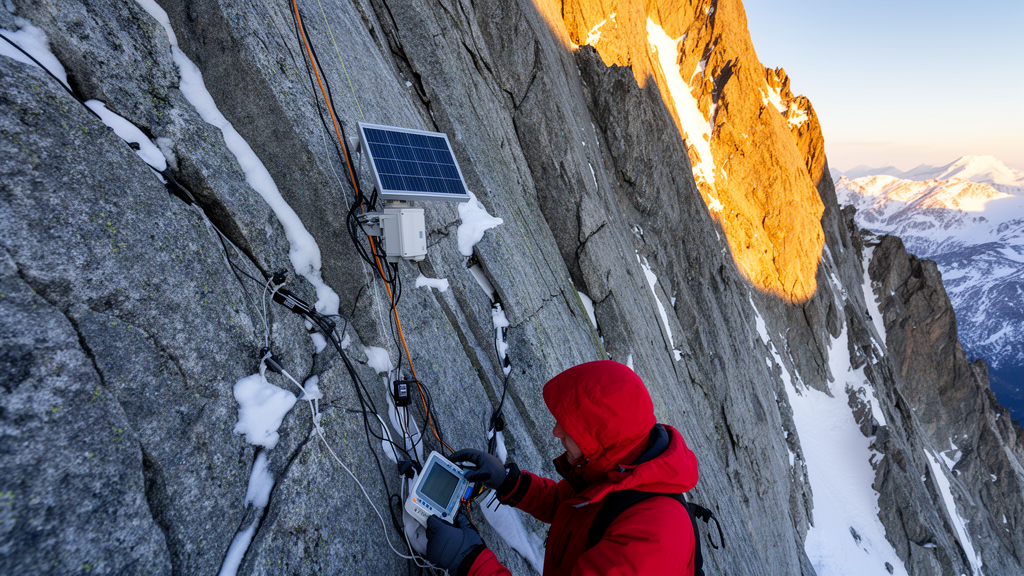
High in the Austrian Alps, on the north face of the Kitzsteinhorn at more than 3,000 meters above sea level, a team of researchers has spent a full year listening to a steep permafrost rockwall in a way no one has done before. By running an automated electrical resistivity tomography system every single day from April 2024 to April 2025, and pairing those measurements with borehole temperatures, rock anchor load cells and a deep piezometer, they have produced the most detailed picture yet of how water and ice seasonally stress fractured bedrock. The study, published in Earth Surface Dynamics, identifies five distinct seasonal phases and pinpoints two of them, spring snowmelt and midwinter deep freezing, as periods when the rockwall experiences mechanical forcing strong enough to help precondition rock slope failures.
The scientific stakes are considerable. Rockfall and rock slope failures in periglacial environments are projected to increase as climate warms, threatening mountaineers, high-alpine infrastructure such as cable cars and huts, and even downstream valleys through large cascading events with long run-out distances. While the role of permafrost thaw in weakening rock has been studied intensively, the mechanical role of water and ice within fractures has often been neglected, even though hydrostatic and cryostatic pressures are increasingly recognised as key drivers in the conditioning and initiation of instabilities. Field evidence for these pressures has been scarce, largely because observing hydrological and cryogenic processes in steep, frozen rock is inherently difficult.
The Kitzsteinhorn site offered an ideal natural laboratory. The rockwall consists of fractured calcareous mica schist with well-developed schistosity dipping parallel to the slope, creating open pathways for water flow. Optical borehole scans revealed open fractures with apertures of up to 71 millimetres in the upper metres of the rock mass. The site is accessible year-round by cable car and hosts a dense array of complementary instruments, including a 30-metre-deep borehole recording rock temperature since 2015, fifteen nearly horizontal 25-metre-long rock anchors instrumented with hydraulic load cells, and a vertical borehole with a piezometer installed at 16.85 metres depth, exactly at the boundary between the mica schist and an underlying serpentinite band.
The electrical resistivity tomography setup itself is an engineering achievement. Thirty stainless-steel expansion anchors bolted into the rock at 2-metre intervals served as electrodes along a 58-metre profile beginning near the cable car station at 3,016 metres. A terrameter housed inside the summit station collected up to 135 data points per day using the Wenner configuration, chosen to maximise signal strength in the high-resistance conditions typical of frozen bedrock. Reciprocal measurements allowed the team to quantify errors precisely, and only about half a percent of data points exceeded even the strictest outlier thresholds, confirming the exceptional quality of the dataset, which totalled more than 20,000 measurements over the year.
Converting resistivity into meaningful physical information required careful calibration. The researchers used a resistivity-temperature relation calibrated with in situ borehole temperatures and laboratory experiments on saturated core samples from the site, whose pore water conductivity closely matched local snowmelt water. Inversions were performed with a time-lapse difference algorithm that suppressed systematic errors while preserving the rapid spatial resistivity changes caused by water infiltration along fractures, which conventional filtering approaches would have smoothed away. The result was a daily-resolution, quantitatively interpretable image of the subsurface through an entire seasonal cycle, something previous monthly surveys could only hint at.
The analysis revealed five characteristic phases of seasonal forcing. Phase I, stable freezing from April to May, kept rock temperatures below minus 0.5 degrees Celsius with fractures predominantly ice-filled and hydraulic heads gradually rising from 0.78 to 0.88 bar. Phase II, snowmelt and subsurface warming from May to July, proved dramatic: resistivity plummeted from around 140 to as low as 9 kilo-ohm metres as meltwater flooded the fracture network, while piezometric levels reached pressures equivalent to water columns of up to 12 metres, or about 1.2 bar. Simultaneously, anchor loads declined from 576 to 519 kilonewtons, signalling stress redistribution within the jointed rock mass as the active layer developed and ice in deep fractures began to melt.
Phase III, from July to September, saw the active layer reach its maximum thickness of 4.5 metres, with resistivity and anchor loads falling to their seasonal minima of 2.5 kilo-ohm metres and 493 kilonewtons respectively. Phase IV, superficial cooling from September to November, brought subzero temperatures through the entire rock mass by mid-October, yet resistivity and anchor loads at depth remained stable, indicating that the transition from water-filled to ice-filled discontinuities had not yet begun, likely due to freezing-point depression from rock properties, salinity or pore pressure. Phase V, deep freezing from November to April, then delivered the second critical window: resistivity in deeper layers rose and anchor loads climbed to a seasonal peak of 574 kilonewtons as the freezing front propagated downward, suggesting the onset of ice formation and rising cryostatic pressures within the fractures.
The mechanical interpretation of these two critical phases draws on well-established physics. During snowmelt, water perches above ice-sealed fissures, which are far less permeable than unfrozen ones, building hydrostatic pressure that can mechanically widen fractures; because flow through a planar fracture scales with the cube of its aperture, such widening feeds back into even greater water flux. Pressurised water also transports heat into the rock far more efficiently than conduction alone, potentially carving thaw corridors that accelerate permafrost degradation. In winter, the roughly 9 percent volumetric expansion as water freezes can theoretically generate pressures up to 207 megapascals, though fully confined, water-saturated freezing is unlikely on an open rockwall face. More plausible is ice segregation, in which slow freezing rates and sustained subzero temperatures draw water toward the freezing front, growing ice lenses whose crystallisation pressures are captured by the rising anchor loads. The team notes that cryostatic shear forces may rise faster than the cooling-strengthened shear resistance of the rock, preparing the ground for instability.
The broader implications reach well beyond one mountainside. Recent collapses at the Matterhorn, Bliggspitze, Piz Scerscen and Fluchthorn underscore how permafrost rock slopes are failing across the Alps, and the seasonal windows of high hydrostatic and cryostatic pressure identified here offer a framework for understanding when such failures are most likely to be preconditioned. The study also demonstrates that automated, temperature-calibrated resistivity monitoring can work reliably in one of the harshest monitoring environments on Earth, provided cables are protected from rockfall and avalanches and equipment is disconnected during lightning storms. As permafrost continues to warm, continuous daily imaging of the water, ice and stress hidden inside fractured rockwalls may become an essential early-warning tool for the infrastructure and communities that cling to high-alpine terrain.
Subject of Research: Seasonal hydrostatic and cryostatic forcing of permafrost rockwalls monitored with automated electrical resistivity tomography
Article Title: Seasonal thermo-hydro-mechanical dynamics of permafrost rockwalls revealed by automated electrical resistivity monitoring
Article References: Offer, M., Hartmeyer, I., Weber, S., Keuschnig, M., & Krautblatter, M. (2026). Seasonal thermo-hydro-mechanical dynamics of permafrost rockwalls revealed by automated electrical resistivity monitoring. Earth Surface Dynamics, 14(5), 661-683. https://doi.org/10.5194/esurf-14-661-2026
Image Credits: AI Generated
DOI: 10.5194/esurf-14-661-2026
Keywords: permafrost, rockwalls, electrical resistivity tomography, cryostatic pressure, hydrostatic pressure, rockfall, Kitzsteinhorn, snowmelt, ice segregation, alpine hazards, active layer, frost weathering
Cite Scienmag News
Violet Maxwell. (October 9, 2026). Hidden Water and Ice Pressures That Weaken Alpine Rockwalls Captured Year-Round by Electrical Monitoring. Scienmag. https://scienmag.com/hidden-water-and-ice-pressures-that-weaken-alpine-rockwalls-captured-year-round-by-electrical-monitoring/
Violet Maxwell. "Hidden Water and Ice Pressures That Weaken Alpine Rockwalls Captured Year-Round by Electrical Monitoring." Scienmag, 9 October 2026, https://scienmag.com/hidden-water-and-ice-pressures-that-weaken-alpine-rockwalls-captured-year-round-by-electrical-monitoring/. Accessed 9 October 2026.
Violet Maxwell. "Hidden Water and Ice Pressures That Weaken Alpine Rockwalls Captured Year-Round by Electrical Monitoring." Scienmag. October 9, 2026. https://scienmag.com/hidden-water-and-ice-pressures-that-weaken-alpine-rockwalls-captured-year-round-by-electrical-monitoring/


