


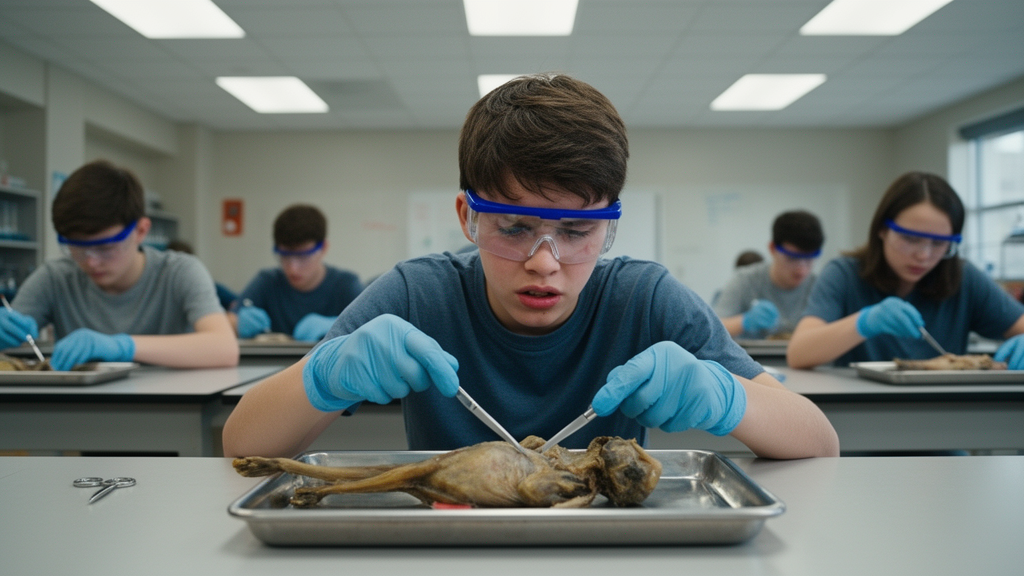
For decades, the dissection of animal organs has been a rite of passage in science classrooms, a hands-on ritual intended to teach anatomy and the methods of scientific inquiry. Yet it has also been a source of quiet dread for many students. A new experimental study published in Discover Psychology now offers the most detailed picture yet of what actually happens to schoolchildren’s bodies and minds when a pig’s heart lands on their lab bench, and the answer is surprising: the scalpel itself is not the problem. Disgust is.
The research team, led by Karsten Damerau of the Europa-Universität Flensburg in Germany, recruited 141 students from sixth and seventh grades across eleven classes at five lower secondary schools. The children were randomly assigned at the class level to one of two treatments. In the dissection group, 100 students worked in pairs to cut open animal hearts, mostly pig hearts but occasionally chicken hearts for religious or cultural reasons, using scalpels to identify chambers, valves, and blood vessels. In the comparison group, 41 students assembled and labeled a paper heart model, also working in pairs and also using scalpels. Both lessons lasted roughly 45 minutes and were taught by trained members of the research team.
What set this study apart was its dual measurement strategy. Physiological stress was captured continuously through chest-strap heart rate variability sensors, which recorded three established indices: the Baevsky Stress Index, reflecting sympathetic nervous system activation; the ratio of low-frequency to high-frequency heart rate variability, indicating the balance between sympathetic and parasympathetic control; and RMSSD, a marker of parasympathetic activity that typically falls under stress. Because physical movement can distort these readings, the system’s nine-axis motion sensors logged movement intensity every second, allowing the researchers to statistically account for the fact that dissection students moved around more than their modeling counterparts.
Emotional stress, by contrast, was measured with a visual analogue scale administered after the lesson, asking students to rate how stressed they felt during and after the activity on a scale from zero to one hundred percent. The team also assessed disgust, perceived competence, and social support using adapted Likert-scale questionnaires, framing these within the transactional model of stress developed by Lazarus and Folkman. In that framework, stress arises when a person appraises a situation as threatening and then judges their internal and external resources, such as competence and social support, to be insufficient for coping with it.
The physiological results were strikingly unremarkable. Heart rate variability did shift from the resting baseline to the lesson in both groups, with RMSSD falling and the LF/HF ratio rising, but these changes occurred equally in the modeling condition, suggesting they reflected the general arousal of any structured classroom activity rather than something specific to cutting into real tissue. The Baevsky Stress Index showed a moderate treatment effect, but the within-group increases were not significant, and the three indices did not point consistently in one direction. The authors suggest a fascinating explanation: physically induced disgust from a bloody organ and morally induced disgust from ethical concerns about dissecting a dead animal may exert opposite effects on the autonomic nervous system, effectively canceling each other out in the aggregate data.
The emotional story was entirely different. Students in the dissection group reported significantly higher emotional stress during class than those in the modeling group, with a highly significant treatment effect. They also reported significantly more disgust. And when the researchers ran a formal mediation analysis, the result was dramatic: disgust carried 91.84 percent of the total effect of dissection on emotional stress. Once disgust was included in the model, the direct effect of the treatment on emotional stress all but vanished. In other words, it was not the act of dissection per se that stressed students out, but the revulsion it provoked.
To probe individual differences, the team performed a hierarchical cluster analysis based on the students’ appraisals of the situation and their resources. Five distinct profiles emerged. Two clusters, accounting for 47.3 percent of the dissecting students, perceived the situation as highly disgusting, one with low resources and one with high resources. The remaining clusters found the situation relatively non-threatening, varying in their levels of perceived competence and social support. Crucially, only the high-disgust clusters showed significantly elevated emotional stress during class, and this stress dropped sharply once the lesson ended. Differences in resources, by contrast, made little difference to emotional stress, suggesting that the primary appraisal of the situation, as expressed through disgust, matters far more than how competent or supported students feel.
The authors are careful about the limits of their findings. Treatment was assigned at the class level rather than the individual level, and the nested structure of the data was not modeled statistically, which constrains how confidently between-group differences can be attributed to the treatment alone. Both disgust and emotional stress were assessed retrospectively after the lesson, so the temporal ordering assumed in the mediation analysis was theoretical rather than directly observed. The cluster analysis was exploratory and some clusters were small. Coping strategies, such as looking away or joking with friends, were not measured, even though children are known to avoid disgusting stimuli visually and physically.
Still, the practical implications are clear and potentially transformative for biology teaching. If disgust is the engine of emotional stress during dissection, then reducing disgust should reduce stress. The authors point to measures such as washing blood off organs before distributing them, and preparing students thoroughly for what they will encounter, which can also boost perceived competence, itself a significant negative predictor of emotional stress in the study. Importantly, the findings suggest that classroom dissections are unlikely to cause lasting harm: emotional stress and disgust fell significantly immediately after the lessons, and there was no evidence of pronounced physiological stress during the activities themselves.
Perhaps the most consequential recommendation concerns choice. Given that nearly half the dissecting students found the experience threatening, and that some students are known to prefer alternatives, the authors argue that options such as anatomical models, virtual laboratories, or teacher demonstrations should be offered not merely on ethical grounds but as a matter of student well-being. Alternatives may lower disgust and emotional stress while giving students a sense of control over their learning, a factor that research suggests can buffer against stress. The pig’s heart, it turns out, may belong on the bench, but only for those who choose to pick up the scalpel.
Subject of Research: Stress responses of lower secondary school students during classroom animal organ dissection and the mediating role of disgust
Article Title: Students’ stress responses to classroom dissection and the mediating role of disgust
Article References: Damerau, K., Börtitz, C., Hansen, K. M., Gravenhorst, W., Ahrendt, T., Schümann, S. S., & Clausen, S. (2026). Students’ stress responses to classroom dissection and the mediating role of disgust. Discover Psychology, 6(1), Article 281. https://doi.org/10.1007/s44202-026-00925-y
Image Credits: AI Generated
DOI: 10.1007/s44202-026-00925-y
Keywords: dissection, disgust, stress, heart rate variability, science education, emotional stress, physiological stress, transactional model of stress, perceived competence, social support, biology classroom, school students
Cite Scienmag News
Glenn Wilkins. (October 9, 2026). Disgust, Not the Scalpel, Drives Student Stress in Classroom Dissections. Scienmag. https://scienmag.com/disgust-not-the-scalpel-drives-student-stress-in-classroom-dissections/
Glenn Wilkins. "Disgust, Not the Scalpel, Drives Student Stress in Classroom Dissections." Scienmag, 9 October 2026, https://scienmag.com/disgust-not-the-scalpel-drives-student-stress-in-classroom-dissections/. Accessed 9 October 2026.
Glenn Wilkins. "Disgust, Not the Scalpel, Drives Student Stress in Classroom Dissections." Scienmag. October 9, 2026. https://scienmag.com/disgust-not-the-scalpel-drives-student-stress-in-classroom-dissections/


